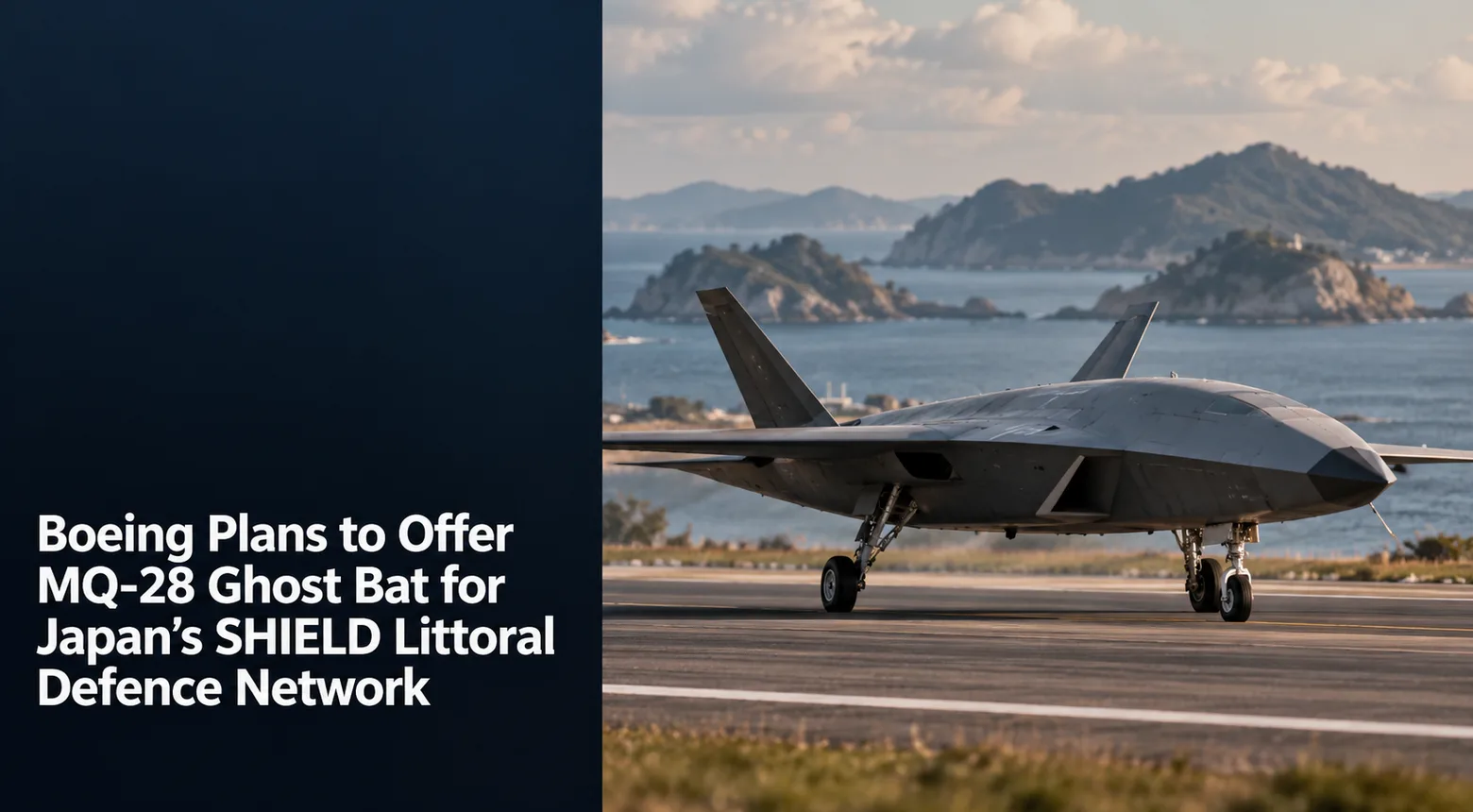
Boeing plans to offer the MQ-28 Ghost Bat uncrewed combat aircraft to Japan as Tokyo develops its SHIELD littoral-defence concept and expands work on crewed-uncrewed teaming. The move is best understood as an industrial and programme-positioning step: available reporting does not indicate that Japan’s Ministry of Defense has selected MQ-28 or awarded Boeing a procurement contract for SHIELD.
The proposal nevertheless builds on an existing relationship. Japan has already funded Boeing research connected with simulated manned-unmanned teaming for its future fighter effort, while the Australian-developed MQ-28 has progressed through flight testing and cooperative mission demonstrations. Boeing also deployed the aircraft into the multinational Valiant Shield 2026 exercise, giving the programme a more operationally relevant data point than a laboratory-only autonomy demonstration.
Key Facts
- Boeing says it plans to offer MQ-28 Ghost Bat to Japan; no Japanese selection has been announced.
- Japan is developing the SHIELD concept as part of a wider littoral and stand-off defence architecture.
- MQ-28 has a manufacturer-stated range above 2,000 nautical miles and a maximum speed up to Mach 0.9.
- The aircraft uses an open architecture and a modular missionised nose.
- MQ-28 participated in the multinational Valiant Shield exercise in June 2026.
- Japan previously awarded Boeing a small research contract for simulated manned-unmanned teaming linked to its next-generation fighter work.
Boeing positions Ghost Bat for Japan, but no selection has been made
The development is best assessed as a programme milestone rather than a complete operational endpoint. The verified evidence establishes the event described above, while subsequent procurement, integration, readiness or fielding claims require their own confirmation as the programme advances. That distinction is important for comparing announcements across defence programmes, where testing, production, delivery and operational acceptance are separate maturity stages with different evidentiary thresholds.
Range, modularity and teaming fit the SHIELD problem set
Boeing describes MQ-28 as a runway-based collaborative aircraft with a range greater than 2,000 nautical miles, speeds up to Mach 0.9 and an open systems architecture. A modular missionised nose allows different sensor or payload configurations without redesigning the entire air vehicle. Those characteristics are relevant to Japan because a distributed island-defence architecture requires persistence, sensor reach and the ability to operate across large maritime spaces while complicating an adversary’s targeting problem.
SHIELD is also broader than any single aircraft. Japan is pursuing layered stand-off weapons, sensors, command networks and distributed basing to strengthen defence of its south-western islands and surrounding waters. MQ-28 could therefore be one node within a larger kill web—extending sensing, communications or strike-support functions for crewed aircraft—rather than a stand-alone replacement for fighters or maritime patrol platforms.
Competition and programme risk remain significant
Japan retains multiple options for collaborative combat aircraft, including domestic development, partnerships tied to its next-generation fighter programme and alternative foreign systems. Airbus and other manufacturers are also tracking the Japanese uncrewed-aircraft market, while Tokyo’s industrial policy places substantial weight on sovereign technology access and domestic participation. Any future choice will therefore be shaped by data rights, mission-system integration, production workshare and compatibility with Japanese weapons and networks as much as by the airframe’s headline performance.
The next meaningful milestone would be a formal Japanese requirement, request for proposals, demonstration agreement or funded acquisition decision. Until then, Boeing’s plan should be described as a prospective offer rather than a SHIELD procurement outcome. If Japan advances MQ-28 into competitive evaluation, the key questions will be how much autonomy can be certified for operational use, how the aircraft integrates with Japanese and allied command networks, and whether local industry receives a meaningful role in sustainment or production.
Implications / Next
The next publication-grade milestone will be the first independently verifiable step that moves the programme beyond the status described here—such as a follow-on test, formal contract action, delivery, operational deployment or completed transaction, depending on the story. Defence Agenda will treat each maturity stage separately and will not infer production, operational capability or procurement completion from an earlier demonstration or announcement. The most useful follow-up evidence will therefore be dated official documentation, customer acceptance, serial-production data or operational activity that can be cross-checked against the current record.