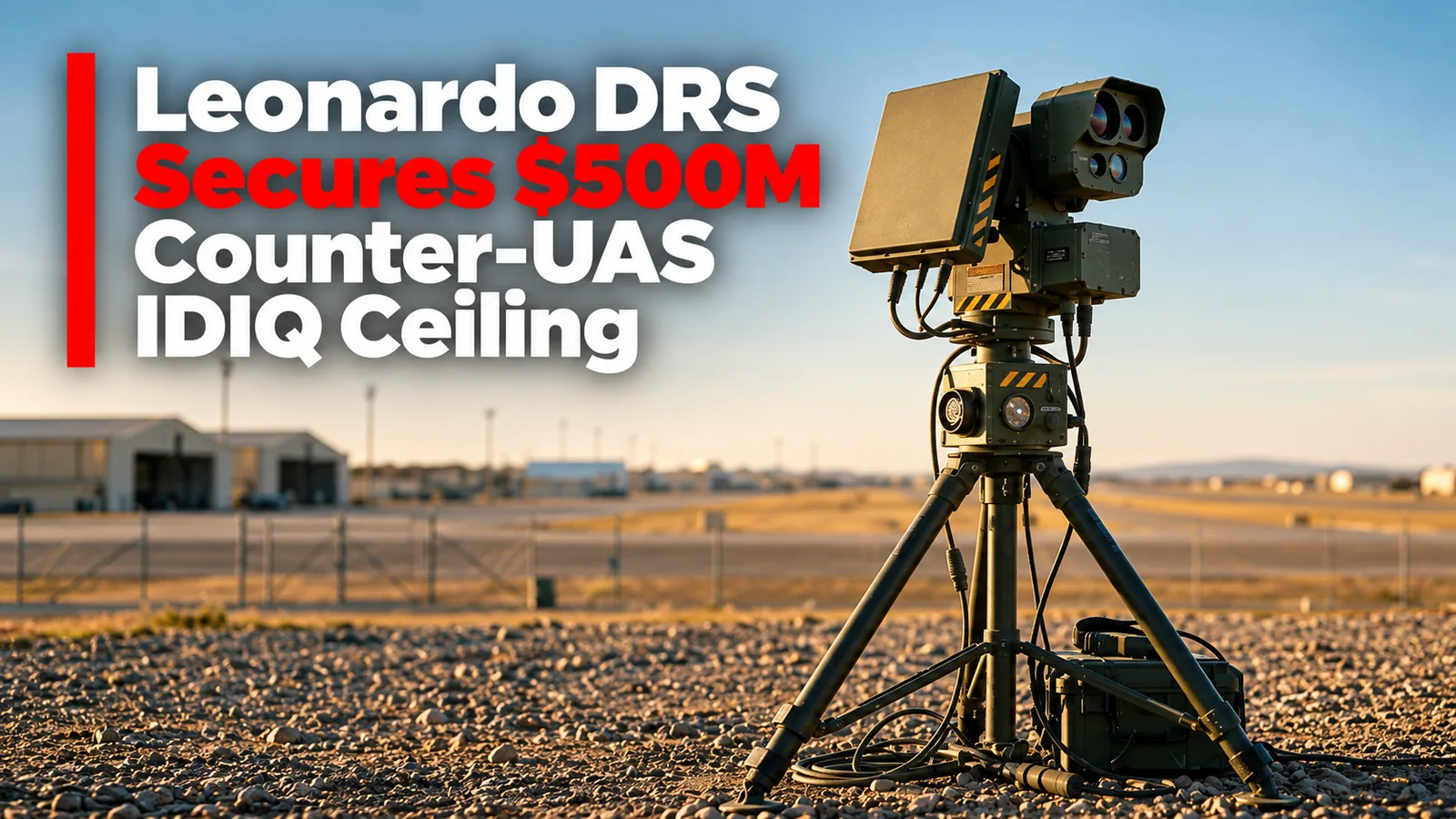
Leonardo DRS received a three-year indefinite-delivery/indefinite-quantity contract from the Pentagon's Joint Interagency Task Force 401 on 14 October 2026, with a stated ceiling of $500 million. The award makes the company eligible to compete for orders for counter-uncrewed-aircraft sensing systems, but the ceiling is not the amount already obligated or an announcement that $500 million worth of equipment has been delivered.
The Contract Creates an Ordering Route, Not an Automatic Purchase
Leonardo DRS says JIATF-401 intends to use the contract to accelerate delivery of vetted tactical counter-UAS sensing technology. The firm can pursue task orders supporting force protection and low-altitude air defence during the agreement's three-year performance period. The announcement does not name a first task order, unit quantities or the amount of funding obligated at award.
An IDIQ vehicle is designed to let the government place future orders under an established contracting framework. Its ceiling constrains the maximum cumulative value available under the specified vehicle; it is not itself evidence that every dollar will be spent. The headline dollar figure is therefore best reported as a ceiling, with future task orders identified and assessed separately when made public.
Sensing Is One Part of the Counter-Drone Engagement Chain
The company's portfolio includes tactical RADA radar systems that can provide detection and tracking inputs for counter-UAS missions. A radar helps operators establish that a threat exists, estimate its movement and generate tracks for classification or engagement. Defeating an aircraft requires additional systems and decisions: identification, command-and-control, rules of engagement, electronic effects or kinetic interceptors.
That division of labour explains the contracting focus on expeditionary sensing rather than a single complete missile-based defence system. Mobile formations and small bases need surveillance that can move with them, integrate into existing networks and avoid overwhelming operators with false alarms. The DRS announcement does not disclose a specific radar model or quantities selected under a task order, so the featured radar imagery is illustrative of the product portfolio rather than a confirmed order configuration.
Why JIATF-401 Is Prioritising Acquisition Speed
Small unmanned aircraft are evolving quickly, including changes in navigation, electronic resilience, size and attack tactics. Traditional acquisition and test timelines can be slower than adversaries' field modifications. An ordering mechanism that supports rapid selection of evaluated sensors could allow defence users to adjust equipment more readily as threats change, provided testing, cyber approval and logistics are not bypassed.
The contract also reflects the move from standalone counter-drone products towards integrated defence architectures. A sensor that cannot exchange data with command posts and effectors may be less useful than one with proven interfaces, even if its individual detection performance is strong. The relevant future question is whether task orders identify interoperable systems and measurable mission capability, not simply whether more firms gain access to a high-value contract vehicle.
What Is Still Unknown About Orders and Performance
The public release does not quantify how many radars may be purchased, the geographic scope of potential deployments, acceptance milestones or production lead times. It does not allocate any share of the $500 million ceiling to a named customer or contract year. There is also no independently released test dataset showing detection distances, false-alarm rates or performance against a defined set of drone types for equipment funded under this contract.
Those unknowns matter for both procurement and industrial analysis. A manufacturer can be eligible for task orders without receiving the entire ceiling, and equipment can pass preliminary evaluation without being deployed in operational units. Reporting should preserve the distinction between contract eligibility, an actual order, completed production and fielded operational capability.
Implications / Next
Watch for the first task-order announcements, their obligated values, selected radar configurations and delivery or acceptance milestones. Each order can then be compared with the three-year ceiling and JIATF-401's broader counter-UAS architecture. The October award is an important procurement-access milestone for Leonardo DRS, but it does not support claims that $500 million in sales or radar deliveries are already secured.