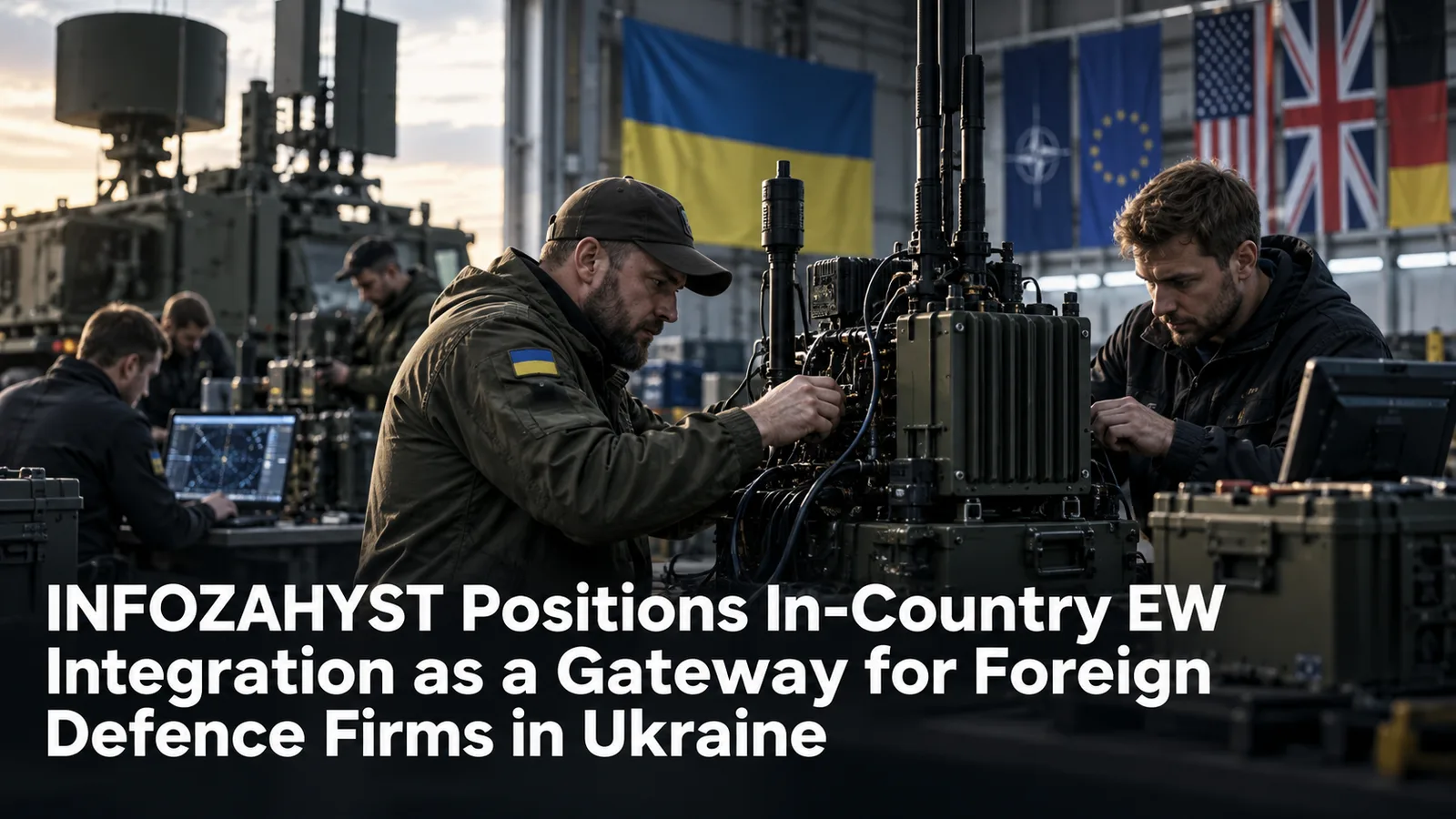
Ukraine’s INFOZAHYST is promoting a partnership model in which foreign defence companies do more than deliver equipment: they maintain, adapt, integrate and jointly develop systems inside Ukraine.
The Sept. 7 Armada International article is sponsored content, so its claims require attribution. The underlying model is nevertheless supported by INFOZAHYST’s existing electronic-warfare portfolio and a May 2026 partnership with Rohde & Schwarz.
Partnership Model and Source Framing
INFOZAHYST is promoting a model in which foreign defence companies do more than deliver equipment to Ukraine: they maintain, adapt, integrate and jointly develop systems inside the country. The 7 September Armada International article describing that approach is sponsored content, so claims portraying INFOZAHYST as a leading supplier or saying its systems have proven effectiveness should be treated as company positioning rather than independent editorial assessment. The broader cooperation model is nevertheless supported by the company’s established electronic-warfare portfolio and by publicly announced partnerships with foreign suppliers.
INFOZAHYST identifies local maintenance, diagnostics, repair, operator training, localisation and integration into command-and-control workflows as priority services for international systems entering Ukraine. It also promotes joint R&D in which foreign firms contribute mature technologies while Ukrainian engineers and operators feed combat lessons back into design. That structure attempts to turn Ukraine from an end-user market into an in-country adaptation and engineering environment.
EW Technical Base and International Integration
Electronic warfare is the company’s core technical foundation, with INFOZAHYST listing COMINT, direction finding, ELINT, ESM, counter-UAS and analytical software across its portfolio. Its KHORTYTSIA-M mobile COMINT complex is described by the company as having been delivered under Ukraine’s state defence order since 2018, giving it a domestic baseline for integration and support. That experience matters because foreign EW or counter-UAS systems often require local frequency plans, interfaces, operator workflows and rapid software or hardware updates rather than simple off-the-shelf delivery.
The May 2026 Memorandum of Partnership with Rohde & Schwarz provides a concrete example of the model. The agreement covers joint promotion, adaptation and marketing of high-power jamming, counter-UAS and a multifunctional mobile EW platform, showing that INFOZAHYST is already positioning itself as a bridge between Western technology and Ukrainian operational requirements. The memorandum does not by itself establish procurement quantities or specific deployed configurations, but it moves the partnership concept beyond marketing language.
Battlefield Feedback and Industrial Policy
Ukraine’s defence ecosystem compresses the cycle between operator feedback, repair, modification and retesting, which can make in-country engineering an industrial asset in its own right. Systems that can be diagnosed and adapted locally may return to service faster than equipment sent back to foreign factories, while suppliers gain exposure to rapidly changing requirements that are difficult to reproduce on peacetime ranges. That same environment also creates risk because partners must manage security, intellectual property, supply-chain disruption and export-control requirements while working close to an active conflict.
The sponsored article also points to Build with Ukraine as a policy framework for deeper international cooperation. The programme label does not determine the commercial structure of every project, so intellectual-property rights, localisation, financing and government support will need to be assessed case by case. Its relevance is that Ukraine is actively encouraging foreign firms to move from transactional exports toward local production, integration and joint development where security and business conditions allow.
Limitations and Counterpoint
Local access to battlefield feedback can accelerate adaptation, but it does not guarantee successful technology transfer, certification, exportability or long-term commercial viability. The principal Armada article is sponsored content, and several performance claims originate from INFOZAHYST itself, so they require attribution unless independently supported. Foreign companies also face real security, IP, compliance and supply-chain risks that can offset some of the speed advantages of in-country engineering.
Implications / Next
The strongest indicators will be named joint products emerging from the Rohde & Schwarz partnership, confirmed foreign customers using INFOZAHYST as an in-country service or integration partner and formal Build with Ukraine projects in EW or counter-UAS. Details on local production, software ownership and sustainment responsibility would show how far these relationships move beyond demonstrations and memoranda. Repeat partnerships with additional Western suppliers would also test whether INFOZAHYST can become a broader integration gateway rather than a case-specific partner.