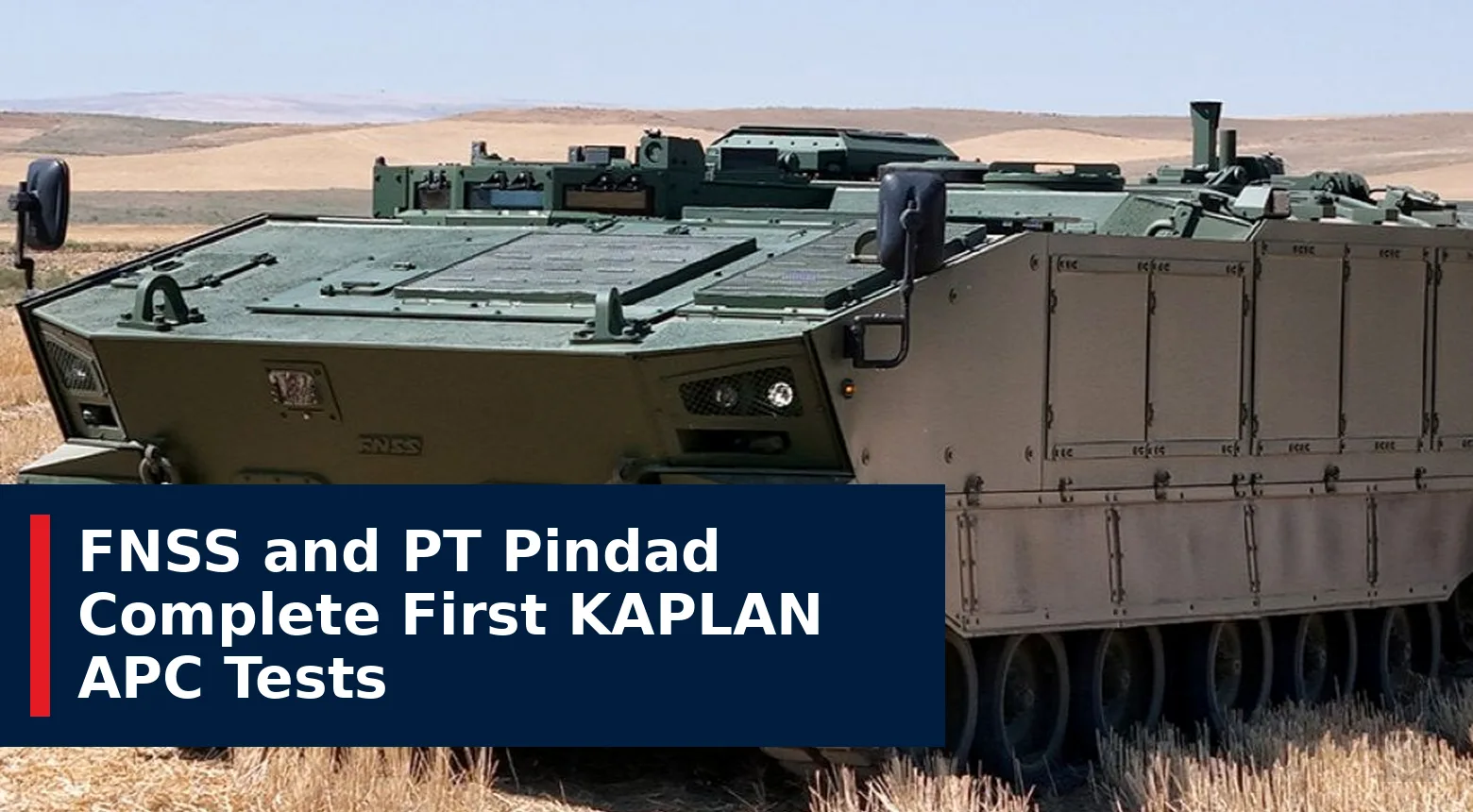
The first KAPLAN APC completed pre-delivery acceptance tests in Türkiye under the FNSS-PT Pindad programme for Indonesia.
First vehicle passes pre-delivery tests
The first KAPLAN tracked armoured personnel carrier has completed pre-delivery acceptance tests at FNSS facilities in Türkiye with participation from Indonesian partner PT Pindad. The vehicle, also described as Harimau APC, was built under the KAPLAN APC Development and Production Agreement following a contract between PT Pindad and Indonesia's Ministry of Defence for a 30-tonne-class tracked personnel carrier.
Pre-delivery acceptance is an important quality gate but not final customer acceptance. The first vehicle must still be shipped to Indonesia and tested with the end user before the contractual handover is complete. The companies did not disclose the contract value, total programme quantity beyond the two described production vehicles, delivery date or final weapon configuration. Those omissions limit any claim about fleet-scale adoption.
A second vehicle shifts production to Indonesia
Production of the second KAPLAN APC is continuing at PT Pindad's facility in Indonesia. That split is central to the programme's technology-transfer objective: FNSS builds and verifies the first example, while the partner applies the design, processes and training to local manufacture. The model follows cooperation established through the earlier KAPLAN MT, known in Indonesia as Harimau, medium-tank programme.
Successful localisation requires more than final assembly. PT Pindad must control welding, integration, supplier quality, test procedures and configuration records to the same standard as the first vehicle. The proportion of locally sourced subsystems and the responsibilities for future support have not been disclosed. Performance of the second vehicle during acceptance will therefore be a useful indicator of whether knowledge transfer has become a repeatable production capability.
A modular 13-person platform
FNSS describes KAPLAN APC as a new member of its tracked-vehicle family, designed to carry 13 personnel including driver, commander and gunner. The architecture uses modular ballistic and mine protection, an open electronic system and provision for battlefield management and 360-degree day-and-night situational awareness. An active-protection system can be fitted depending on customer requirements.
The vehicle is intended to accept manned or uncrewed turrets with weapons including 30mm or 35mm cannon, 120mm mortars and anti-tank guided missiles. These are integration options, not confirmation that the first Indonesian vehicle carries all of them. Mission variants may include mechanised infantry, reconnaissance, command, medical evacuation, engineering and fire support, subject to separate customer selection and qualification.
Commonality and the route to service
FNSS says KAPLAN APC shares parts and subsystems with KAPLAN MT and with the ZAHA amphibious assault vehicle used by the Turkish Naval Forces. Commonality can reduce spares, training and maintenance burdens, provided the components remain genuinely interchangeable across national configurations. It can also improve reliability by using hardware with an established service history rather than introducing every subsystem anew.
The next decisive milestone is final acceptance in Indonesia, followed by completion and testing of the locally produced second vehicle. Further orders would demonstrate that the configuration meets the army's requirement at fleet scale. For now, the programme has achieved a verified first-vehicle manufacturing and pre-delivery test milestone. It has not yet announced final acceptance, operational service or a broader production run, and those distinctions should remain explicit.
Editorial assessment
Final acceptance in Indonesia will test the vehicle in the customer's environment and against the agreed contractual criteria. Climate, terrain and local communications integration can reveal issues that are not visible during factory trials in Türkiye. The handover should therefore be treated as a separate milestone rather than assumed from successful pre-delivery tests.
A follow-on fleet decision would clarify whether the two vehicles are prototypes, an initial production step or a technology-transfer demonstration. It would also determine whether Indonesian suppliers can justify investment in tooling and workforce. Without recurring quantity, localisation knowledge can be difficult to retain after the first locally built example is completed.