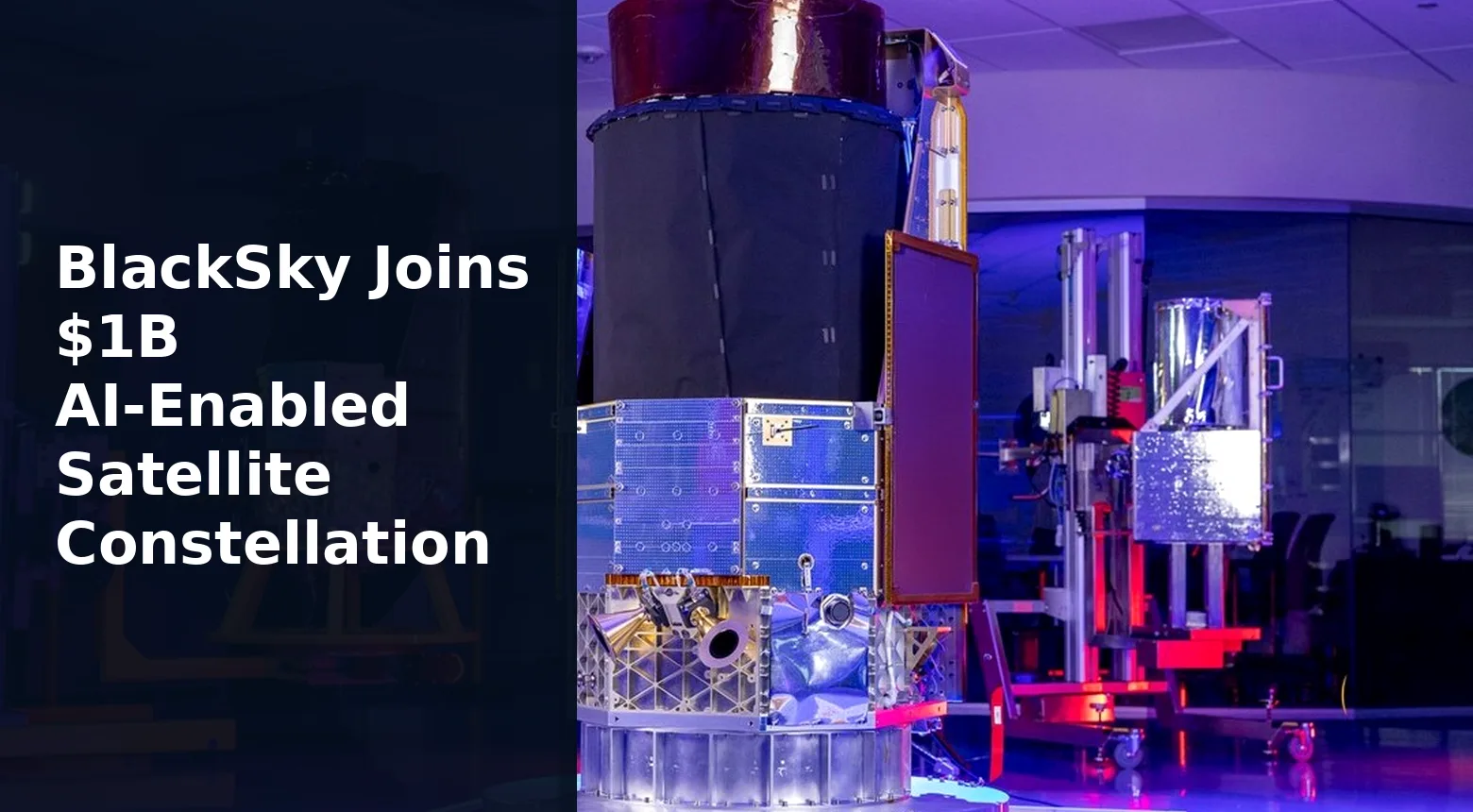
BlackSky has been named the exclusive very-high-resolution electro-optical satellite provider for a planned 50-satellite, AI-enabled constellation backed by a reported $1 billion investment. The announcement defines BlackSky’s intended role but does not disclose a booked contract value, satellite quantity assigned specifically to BlackSky or a complete deployment schedule. The initiative combines optical, radar and other sensors with onboard processing intended to deliver alerts within seconds, linking sovereign space infrastructure in France and the UAE with U.S. imaging technology.
BlackSky has a defined role inside a broader consortium plan
The company says its Gen-3 satellites will provide very-high-resolution electro-optical imagery. Other members are expected to contribute spacecraft hosting, radar or additional sensors, AI models and industrial capacity. The $1 billion figure describes the wider initiative rather than a disclosed BlackSky order.
On-orbit processing is central to the architecture
The concept aims to analyse sensor data in space and send time-sensitive alerts without first downlinking every raw collection for ground processing. That can shorten response times for wildfire detection, infrastructure monitoring or missile-warning applications. Actual latency and reliability will require demonstration across spacecraft, communications links and user networks.
Industrial geography is strategically important
Public reporting links French technology companies, Emirati investment and assembly in Abu Dhabi with BlackSky’s U.S. satellite platform. This structure can distribute capital and production while meeting sovereign-control objectives. It also introduces export-control, cybersecurity and data-governance requirements that will shape customer access.
Announcement is not the same as a fully contracted constellation
The initiative includes a stated investment and initial satellite plan, but contracting, launch and revenue details remain incomplete. Market reporting should separate consortium ambition from signed orders, funded spacecraft and deployed capacity. BlackSky’s own backlog should be updated only from company filings or contract disclosures.
Programme and procurement context
This development should be assessed through its exact maturity level. BlackSky has been named the exclusive very-high-resolution electro-optical satellite provider for a planned 50-satellite, AI-enabled constellation backed by a reported $1 billion investment. The announcement defines BlackSky’s intended role but does not disclose a booked contract value, satellite quantity assigned specifically to BlackSky or a complete deployment schedule. Defence and aerospace programmes move through distinct stages including announcement, evaluation, contracting, production, delivery, acceptance and operational fielding. Treating these as interchangeable can overstate near-term capability and industrial certainty.
For programme managers, the central questions are funded scope, schedule, integration responsibility, supportability, workforce and test evidence. The initiative combines optical, radar and other sensors with onboard processing intended to deliver alerts within seconds, linking sovereign space infrastructure in France and the UAE with U.S. imaging technology. Supplier capacity, secure data access and customer training can delay usable capability even after a public milestone. Later primary documentation should replace assumptions with confirmed quantities, obligations and acceptance results.
Independent confirmation is also important because company releases naturally emphasise programme momentum while omitting commercially sensitive limits. Government contract notices, budget documents, test reports and customer acceptance statements provide different parts of the evidence chain. Where those records are absent, values should be labelled as ceilings or reported estimates, performance figures as manufacturer claims, and schedules as targets. This evidence discipline is especially important when several organisations contribute to one system, because a milestone for one supplier may not represent readiness of the complete operational capability.
Implications / Next
Watch for binding satellite orders, BlackSky backlog recognition, the first launch, on-orbit AI demonstrations and named government users. The planned 50-satellite architecture should not be described as operational.
The item remains a draft pending final image-rights review, CMS media assignment and canonical publication data. A later report should be treated as a new story only if it materially changes the programme status described here.
Further Reading
ASELSAN NATO VLF OTAM Monitoring Upgrade