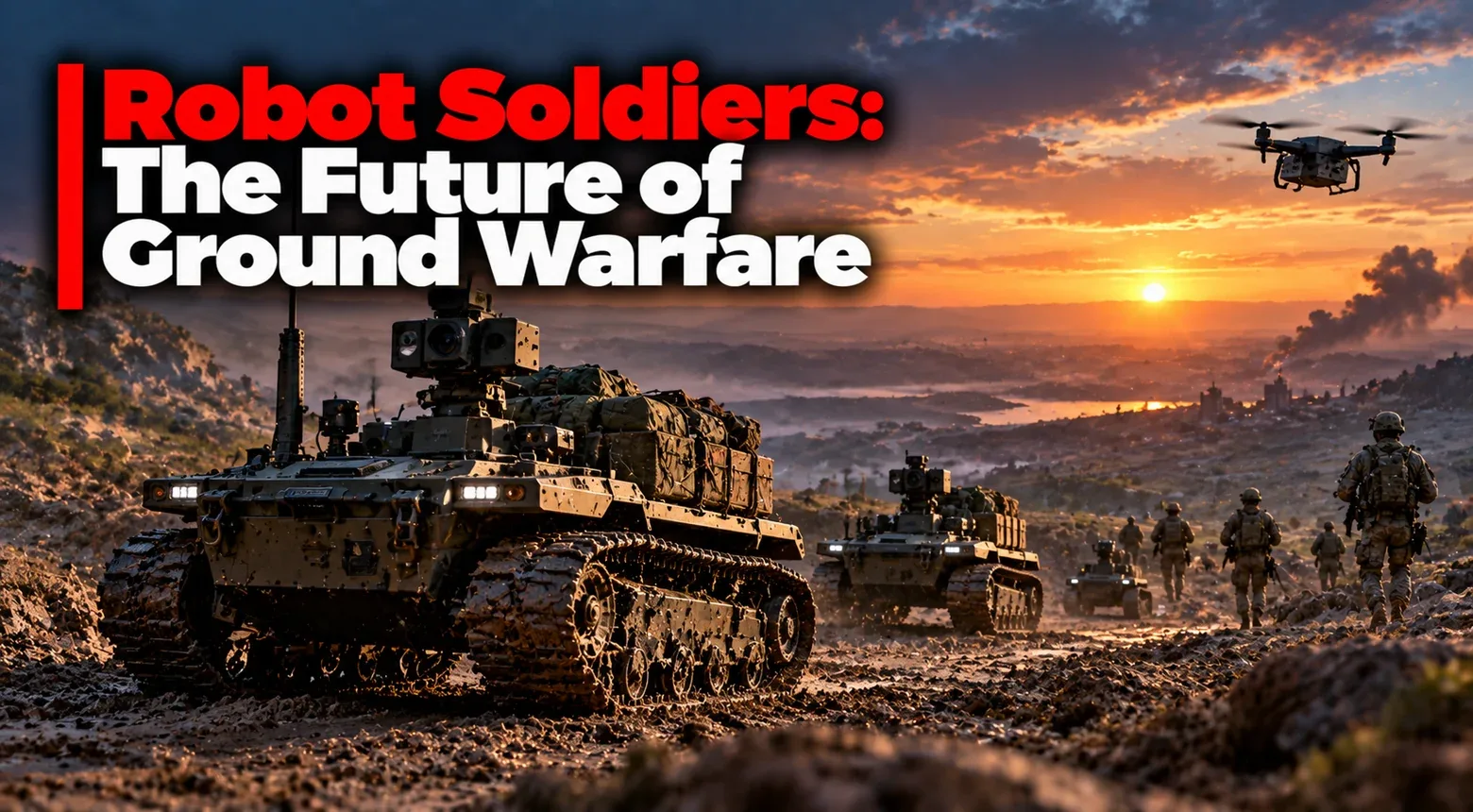
Robot soldiers are becoming a practical part of ground warfare, although most are still remotely operated vehicles rather than independent combatants. On 7 September 2026, Ukraine's Ministry of Defence reported approximately 112,000 unmanned ground vehicle (UGV) logistics and evacuation missions during January–August, while recent US Army demonstrations have paired robotic vehicles with remotely controlled weapons. The shift matters because armies are increasingly asking machines to move supplies, recover casualties and enter dangerous areas before personnel—but the evidence does not show that autonomous robots can replace infantry. Ukraine's official mission data and the US Army's Hunter WOLF demonstration provide a more useful starting point than science-fiction comparisons.
Key Facts
- Ukraine, January–August 2026: Approximately 112,000 logistics and evacuation UGV missions were recorded in the DELTA system, according to the Ministry of Defence's 7 September release.
- Monthly growth: Recorded missions rose from 7,511 in January to 25,143 in August—about 3.3 times the January total, according to the same release.
- Procurement: Ukraine reported more than 22,000 ground robotic systems contracted by 31 July 2026. Contracts are not equivalent to deliveries or fielded inventories.
- Amphibious mission: On 29 September 2026, Ukraine reported a domestically developed amphibious UGV had travelled more than 40 km across land and water during a logistics task.
- US demonstration: An armed Hunter WOLF UGV was demonstrated with the 101st Airborne Division in April 2026; the Army published details on 21 August.
- Human–machine research: A US Army laboratory report dated 30 September 2026 described a simulation involving 13 soldiers and two robotic combat vehicles, not a live battlefield deployment.
- Control: Remote driving, assisted navigation and autonomous target engagement are distinct capabilities; none should be inferred from a platform's uncrewed designation alone.
Ground Robots Are Already Changing Front-Line Logistics
The clearest evidence for the rise of robot soldiers in 2026 concerns work that does not require a weapon. According to Ukraine's 7 September Ministry of Defence update, its DELTA reporting system recorded 7,511 UGV logistics and evacuation missions in January and 25,143 in August. The ministry described roughly 112,000 such missions for the first eight months of the year. These are operational reports from a combatant government; they are useful evidence of the scale claimed, but the independently audited number of completed missions has not been established in the cited public release.
Crucially, 112,000 is a mission count, not the number of individual vehicles, successful casualty evacuations or combat sorties. A single vehicle can complete repeated journeys; tasks also vary in duration, payload and exposure. The ministry's monthly series therefore indicates rising reported employment, rather than automatically proving a proportional increase in fleet size or battlefield effectiveness.
What the figures do show is a shift in the problem armies are choosing to automate. A ground robot can carry food, water, batteries and ammunition through an area where a manned vehicle might be exposed. It can also support casualty evacuation, although the availability of a carrier does not remove the need for medical care, route access or human judgement. The Ukrainian figures show why logistics is becoming an early route to adoption: commanders can assess whether a delivery was made without first relying on an experimental autonomous targeting function.
On 29 September 2026, the ministry reported that one Ukrainian-designed amphibious UGV completed a logistics journey exceeding 40 km across both land and water. That was an example of mission-specific engineering rather than evidence that all ground robots can negotiate rivers. Similarly, the Varkhan UGV's approval for supply on 5 October established a recognised logistics design; approval for supply should not be conflated with an independently confirmed quantity delivered.
Are These Really Autonomous Robot Soldiers?
The phrase robot soldiers is useful for explaining the trend but imprecise as a technical classification. An unmanned ground vehicle has no crew on board. It may be driven continuously by an operator, follow a programmed route under supervision or perform narrowly defined navigation functions. Those levels of control are not interchangeable. Autonomy in mobility also does not imply that a weapon can select targets or decide when to use force without human involvement.
The distinction matters for public understanding and military assurance. A remotely operated armed vehicle can keep its crew outside immediate danger while retaining a person responsible for the weapon. A navigation system may automatically avoid an obstacle while another human remains responsible for the vehicle's route. A fully autonomous engagement system raises different legal, technical and accountability questions. In an 8 October 2026 explainer, the International Committee of the Red Cross defined autonomous weapon systems in terms of selecting and applying force without further human intervention and highlighted the resulting humanitarian concerns.
Consequently, images of an armed UGV are not evidence of autonomous lethal decision-making. Public claims about 'AI-powered robots' should be assessed against specific disclosed functions: who steers, who identifies a target, who authorises fire, and what happens when a control link is lost. Those are measurable system attributes rather than marketing labels.
US Army: Armed Platforms Are Being Tested, Not Universally Fielded
The US Army's 21 August 2026 account of the Hunter WOLF demonstration describes how the DEVCOM Armaments Center and industry partner BLADE prepared a previously logistics-oriented UGV with a wireless Common Remotely Operated Weapon Station and a remotely operated .50-calibre machine gun. Soldiers of the 101st Airborne Division experimented with the platform in April at the Joint Readiness Training Center at Fort Polk, Louisiana.
The demonstration matters because it joins a modular ground vehicle, communications equipment and a remotely controlled weapon into a single test system. It does not establish fleet-wide US Army procurement, combat deployment or permission for independent target engagement. Army officials described continued interest in making operators supervisors of partially automated systems while preserving positive human control over lethal decisions.
The wider experiment is about teams, not machines acting alone. A US Army Research Laboratory technical note published on 30 September 2026 summarised a two-week simulation-based air–ground teaming study with 13 soldiers, two robotic combat vehicles, a manned control vehicle, a future vertical-lift platform and associated effects. Researchers reported promising coordination and manageable subjective workload under the study conditions. The simulated environment, limited sample and short trial duration mean these outcomes cannot be treated as proof of a combat-ready mixed formation.
This is an important counterweight to earlier promises that robots would quickly substitute for large numbers of crewed armoured vehicles. Real integration requires reliable communications, mobility across complex terrain, resilient navigation and a doctrine for who controls which machine at which moment. Demonstrating a platform is an earlier milestone than operational acceptance, which is itself different from sustained employment across multiple units.
European Programmes: Modularity and Industrial Scale
European suppliers are also positioning UGVs as adaptable platforms rather than single-purpose robot infantry. On 18 June 2026, Estonia's Milrem Robotics and France's CNIM Systèmes Industriels announced a memorandum of understanding on engineering reconnaissance payloads for Milrem's THeMIS UGV. The companies referred to previous deliveries of systems combining their technologies to Ukraine and indicated that another batch was planned. Their memorandum is a cooperation framework, not a disclosed firm procurement order with a published unit count and price.
A separate industrial development came on 18 June 2026, when Ukraine's defence ministry announced implementation agreements with Germany covering, among other projects, joint production of Termit UGVs in Germany. The ministry said the project would support production and delivery of several thousand vehicles with German financing. That language describes the intended scale; the public announcement did not verify that several thousand units had already been manufactured or delivered.
These programmes illustrate two procurement approaches: upgrading a reusable robotic base with different payloads, and scaling a defined platform through multinational industrial cooperation. Neither approach guarantees battlefield success. For programme offices, interoperability, spares and repair capacity may matter as much as a headline payload specification, particularly when systems have to survive mud, debris, uneven surfaces and repeated transport.
What Different Unmanned Ground Vehicles Actually Do
| UGV mission | Publicly documented 2026 example | Procurement or operational question |
|---|---|---|
| Resupply and transport | Ukrainian DELTA logistics mission reporting | How reliably does a vehicle deliver the required load? |
| Casualty evacuation | Ukrainian ministry reports routine evacuation support | Can a patient be moved safely with appropriate care and supervision? |
| Amphibious resupply | Reported Ukrainian journey exceeding 40 km | Which terrain and water conditions were demonstrated? |
| Armed support | US Army Hunter WOLF technical demonstration | Who controls the weapon, and what operating approval exists? |
| Engineering reconnaissance | Milrem–CNIM THeMIS cooperation framework | Has a customer ordered a specified, tested configuration? |
| Mixed-formation teaming | US Army laboratory simulation involving 13 soldiers | Does the concept work outside simulation in contested terrain? |
Source note: The examples have different evidence levels. A completed mission, a manufacturer announcement, a technical demonstration, a memorandum of understanding and a laboratory simulation must not be presented as equivalent fielded capabilities.
Why Ground Robots Are Harder Than They Look
Unlike aircraft, ground robots must make their way through highly irregular surfaces. A platform that navigates a training road may encounter deep mud, broken masonry, vegetation, trenches, steep banks and narrow passages in a damaged urban environment. Even when a vehicle has adequate theoretical load capacity, access to the destination can prevent the mission from being completed. A stationary machine may become an obstacle, need recovery or expose other personnel to risk.
Electronic warfare and communications availability introduce another limitation. Remote operation depends on a workable link or an approved fallback behaviour. More onboard autonomy may reduce some communications burdens, but adds software assurance, sensor, mapping and perception challenges. Battery endurance, thermal management, recovery arrangements and maintenance are equally important. The open-source evidence does not support a universal operational range, autonomy level or price for the category as a whole.
There is also a hidden personnel cost. Removing a driver from a dangerous vehicle does not eliminate operators, technicians, software teams, logistics planners and maintenance crews. The US Army laboratory's study of workload is therefore pertinent: the research question is whether a team can coordinate several machines without overloading its human members. A small, successful demonstration offers evidence for further testing, not a guaranteed force-structure saving.
Procurement Economics: The Price of the Robot Is Not the Cost of the Mission
The most useful commercial comparison is not simply whether a UGV costs less than a crewed vehicle. Total ownership and mission costs include sensors, payloads, operator stations, communications, repair parts, transport, energy, training, cybersecurity, loss replacement and technical support. Public 2026 programme announcements do not disclose a sufficiently comparable, fully burdened price series to claim an average cost per combat-capable robot soldier. Reporting a fabricated industry-wide figure would obscure major differences between a small logistics carrier and an armed armoured platform.
Ukraine has begun to institutionalise procurement pathways. On 12 February 2026, its Defence Procurement Agency said ground robotic systems became available for normal ordering through DOT-Chain Defence, initially listing seven models from six domestic manufacturers. By 31 July 2026, the ministry reported that more than 22,000 ground robotic systems had been contracted since the start of the year. A contract total is an acquisition commitment; it does not measure the accepted inventory, serviceability rate or number of machines operating at once.
The industrial issue is how rapidly a military can buy useful equipment, certify interfaces, collect field feedback, fix faults and replace losses. Modular architectures may permit faster adaptation, while standardised configurations can improve sustainment and production scale. These benefits can conflict: too many bespoke variants may make spare parts and training more difficult, even when each individual vehicle looks effective in a demonstration.
Human Control, Accountability and the Strongest Counterargument
The most consequential question is not whether armed robots can exist, but what authority they have. An uncrewed vehicle equipped with a remote weapon station is still subject to applicable law of armed conflict and rules of engagement. The ICRC's October 2026 account of autonomous weapons distinguishes systems that select and apply force without further human intervention and identifies significant humanitarian and legal concerns. National positions on permissible autonomy differ, making a one-size-fits-all 'robot soldier' category particularly misleading.
The strongest counterargument to a rapid robotic transformation is that automation can shift danger and workload rather than eliminate them. UGVs remain susceptible to mechanical failure, control disruption and interception. A commander may have to allocate personnel to protect, retrieve or maintain them. Robots can support reconnaissance, supply and selected armed tasks, but they cannot automatically hold terrain, process detainees, reassure civilians, perform all forms of medical care or substitute for the full judgement of a trained ground force.
Defence Agenda has previously addressed the wider convergence of drones, ground robots and AI-enabled military networks. Its coverage of the autonomous-weapons definition debate explains why levels of human control require precise language, while reporting on US Army NGC2 integration problems offers an additional reminder that connecting promising technologies to fielded command networks can be as difficult as building the platforms themselves.
Implications / Next: Five Indicators That Matter
The next chapter in robotic ground warfare is more likely to be measured in logistics readiness and reliable human–machine teamwork than in humanoid 'robot armies'. Defence organisations should watch five observable indicators: accepted deliveries rather than signed orders; mission completion and recovery rates rather than mission announcements; repeatable operation in poor terrain and degraded communications; audited human-control arrangements for armed systems; and documented sustainment costs per useful mission.
For Ukraine, the question is whether rapid contracting and mission growth translate into durable fleets with trained operators and dependable support. For the US Army, technical demonstrations and research must mature into testable system requirements and procurement decisions. European manufacturers will need to show whether modular payload partnerships and co-production agreements lead to deliverable, interoperable systems. These milestones would be stronger evidence of military transformation than promotional images of armed robots alone.
Conclusion
Robot soldiers are entering the force as useful machines that support people, not as autonomous replacements for them. Ukraine's rising UGV mission counts demonstrate demand for practical ground robotics; US research and demonstrations show why weapon integration, control and human workload remain demanding. The decisive advantage will go to forces that can field, sustain and supervise reliable robotic systems as part of combined arms—not those that treat autonomy as a substitute for logistics, doctrine or command responsibility.
Further Reading
- Defence Agenda — Drone Warfare 2026: AI, Robots and Swarms
- Defence Agenda — Autonomous Weapons Debate Faces a Definition Gap
- Defence Agenda — US Army NGC2 Legacy-Network Integration
- Ukraine Ministry of Defence — UGV mission growth, 7 September 2026
- US Army — Hunter WOLF armed-UGV experiment, 21 August 2026
- US Army Research Laboratory — Air–ground teaming, 30 September 2026
- Ukraine Ministry of Defence — Amphibious UGV mission, 29 September 2026
- ICRC — Autonomous weapons FAQ, 8 October 2026