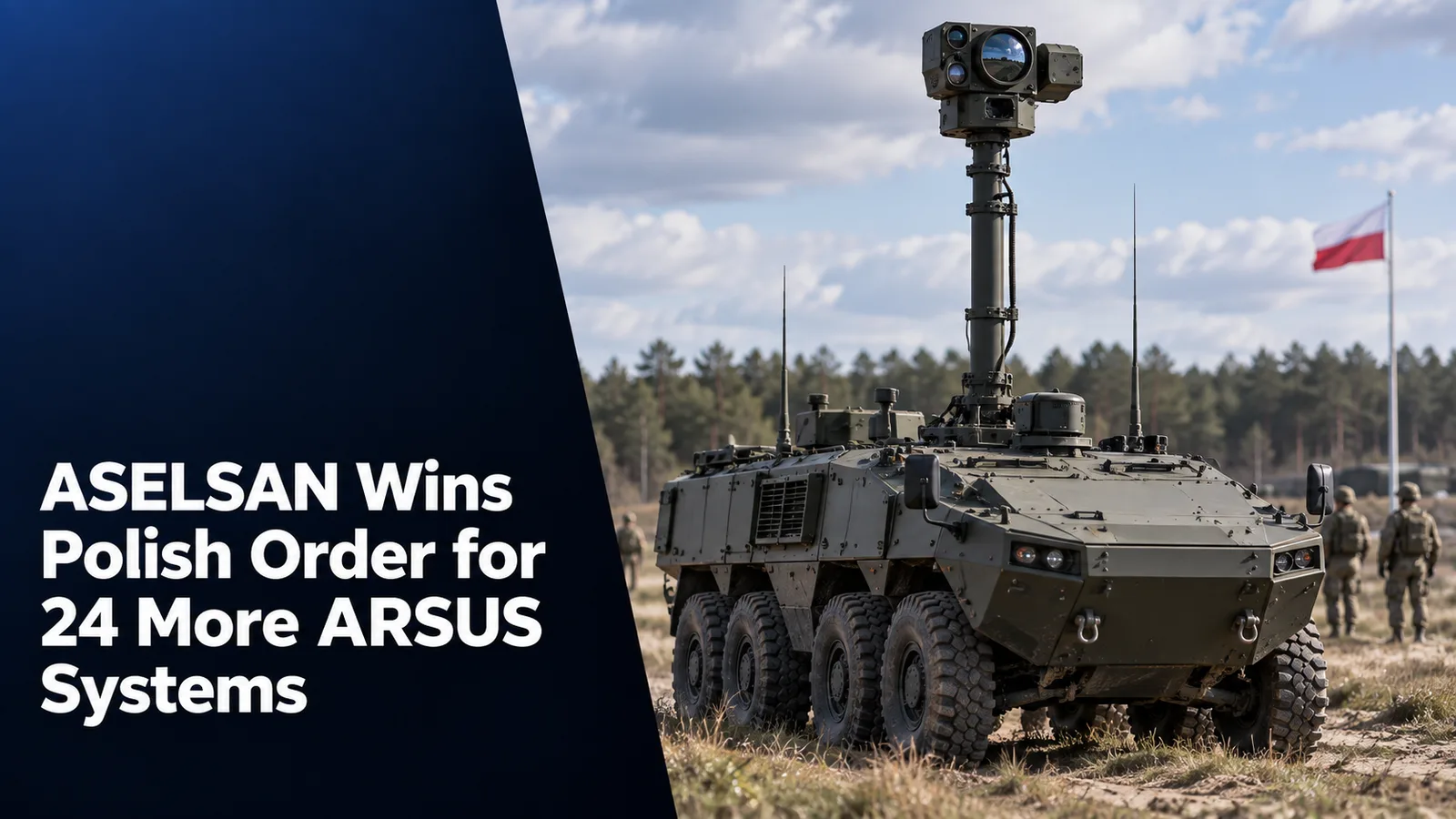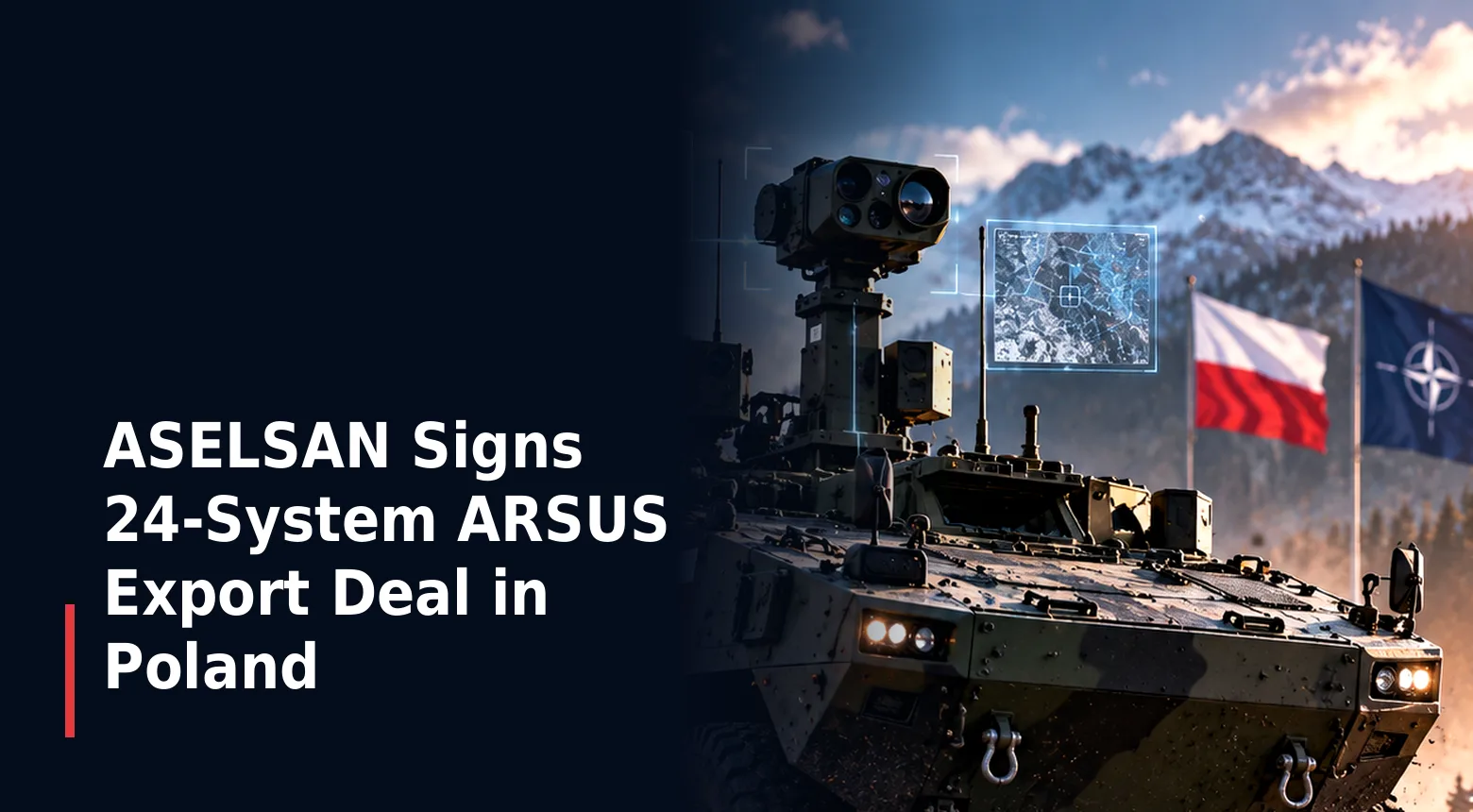
ASELSAN signed an agreement with Poland's AMZ Kutno at MSPO 2026 for 24 additional ARSUS reconnaissance and surveillance system sets, the Turkish manufacturer confirmed in a release dated 8 September 2026. The deal extends an existing partnership supporting Polish military reconnaissance vehicles, with deliveries planned in 2028–2029 rather than immediate operational fielding.
The 24-set order expands a 2024 partnership
ASELSAN said it signed the new export contract with Polish manufacturer AMZ Kutno on 8 September 2026 during the MSPO defence exhibition in Kielce. The firm identified an additional 24 ARSUS reconnaissance and surveillance system sets intended for the Polish Armed Forces. ASELSAN placed the transaction within an existing 2024 framework agreement and said deliveries of the additional sets were planned for 2028–2029.
The specific order should not be confused with all potential deliveries under the wider framework, whose timeline extends to 2035. A framework can establish cooperation and a path for later orders without making every future quantity a firm commitment. The manufacturer did not publish a contract value for the newly confirmed 24 sets in the source examined, so deriving unit prices or total programme revenue would be speculative.
ARSUS integrates sensors into reconnaissance vehicles
ARSUS is a reconnaissance and surveillance architecture intended to support mobile battlefield observation and target information. Reporting on the programme connects the system with the LOTR Kleszcz reconnaissance vehicle produced by AMZ Kutno. A sensor mast and integrated electro-optical equipment can allow crews to collect information while using terrain or vegetation for partial concealment, but exact system performance depends on configuration and mission conditions.
For a reconnaissance unit, the sensor package is only one part of a useful capability. Observations need to be processed, georeferenced, protected and sent to commanders or fire-support users quickly enough to influence decisions. Communications resilience and vehicle integration matter as much as camera range or mast height. Public confirmation of a contract does not establish that every future vehicle configuration has completed operational acceptance testing.
The agreement illustrates Turkish-Polish industrial cooperation
The export award links an established Turkish electronics supplier to a Polish vehicle maker serving domestic military requirements. Such integration arrangements are often more durable than one-off equipment sales because they create requirements for interfaces, documentation, production scheduling, software support and customer training. ASELSAN also points to its local office and wider activities in Poland as parts of its approach to the market.
From a defence-industrial perspective, repeat orders can offer a clearer indication of demand than exhibition displays alone. Nevertheless, local content and technology-transfer obligations should not be assumed unless the firms disclose them. The signed contract establishes the announced supply relationship and quantity; further claims about Polish manufacture, export rights or licensed intellectual property require specific primary-source evidence.
Delivery and acceptance will define the next milestone
The reported 2028–2029 delivery period provides a programme schedule for the additional 24 sets, although public information does not provide an annual production breakdown or detailed integration acceptance plan. The customer will need to verify mechanical interfaces, power, electromagnetic compatibility, secure communications and software configuration when the equipment is installed on operational vehicles.
MSPO 2026 served as the signing venue, not proof that the new batch is already in Polish service. The next reportable events should be factory completion, first shipment, vehicle integration tests and formal Polish customer acceptance. Until then, the September 2026 development is a confirmed export contract building on a longer-term framework rather than a completed delivery programme.
Implications / Next
Track deliveries in 2028–2029, integration on the LOTR Kleszcz platform, and the precise value of any later orders. The two earlier illustrated cover concepts concerning ASELSAN and Polish vehicles are variants of one event and are packaged together, not as duplicate articles. The Polish requirement should also be judged against sensor networking, fleet integration and software support rather than the contract headline alone. Reconnaissance effectiveness depends on how quickly observations can be processed, shared and acted upon by the supported formation. Equipment deliveries will be the next visible procurement milestone, while customer acceptance and deployed availability will determine the actual operational contribution of the newly ordered ARSUS sets.