The MTC Programme Returns to a Visible Certification Track
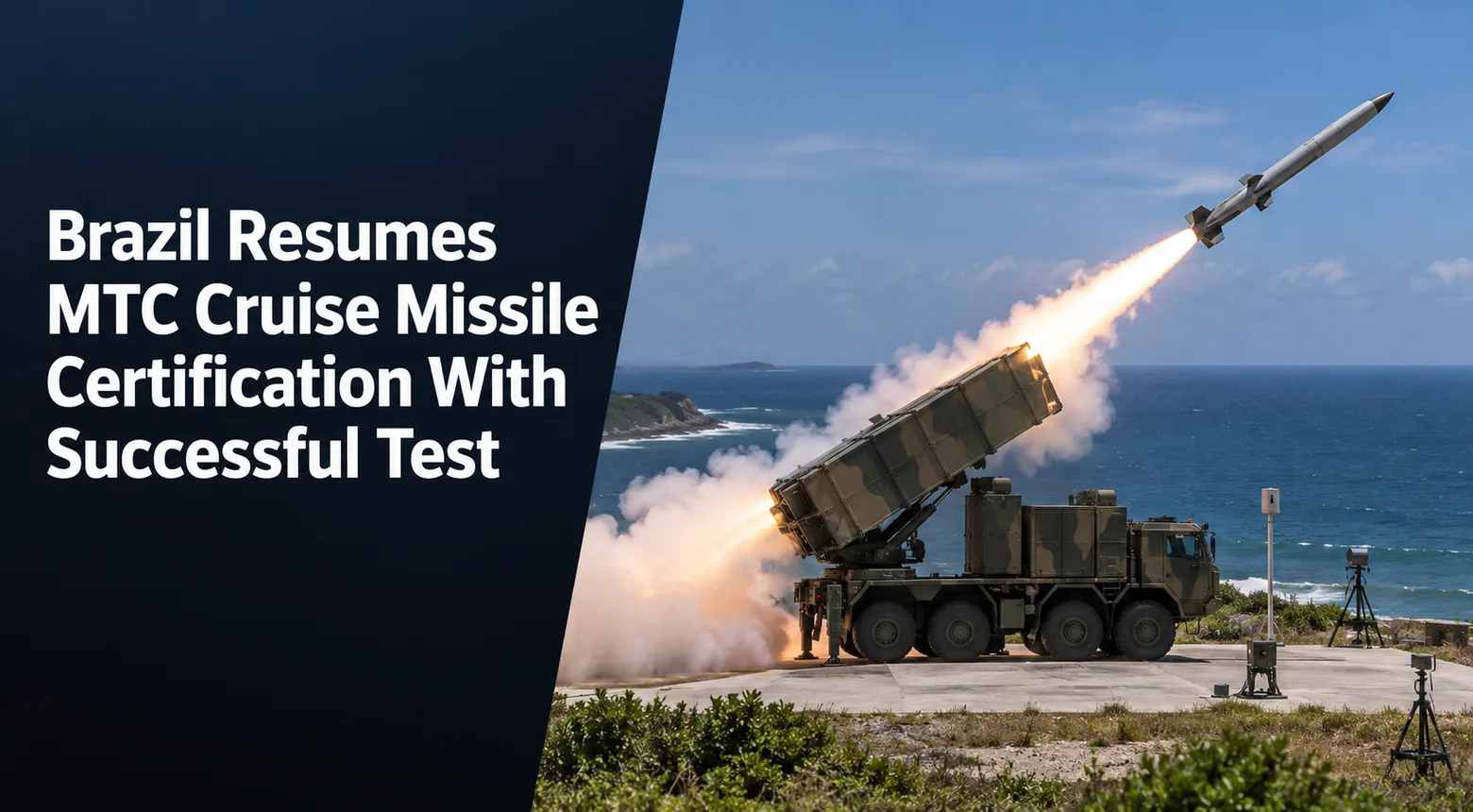
Avibras Aeroco and the Brazilian Army conducted a successful firing of the Míssil Tático de Cruzeiro, or MTC tactical cruise missile, on 26 August 2026 at the Army Evaluation Centre’s Marambaia test range in Rio de Janeiro. Avibras says the event met the objectives established for this certification phase and involved teams from the company, the Army Projects Office, manufacturing and technology organisations and the FOGOS strategic programme. The firing restores visible momentum to a weapon programme that has faced delays alongside Avibras’s prolonged financial difficulties.
The distinction between testing and fielding is important. The MTC is not a newly operational mass-produced weapon simply because the flight was successful. The event is a certification milestone designed to demonstrate that the missile and its launch ecosystem can meet required performance and safety criteria. Further verification, production planning, acceptance activity and customer decisions remain necessary before the programme can be described as fully mature.
ASTROS Gains a Deep-Strike Layer Beyond Conventional Rockets
The MTC belongs to the ASTROS family, extending a launcher architecture best known for rockets into the cruise-missile mission. Avibras states that the weapon can engage targets at ranges of up to 300 km, giving Brazilian land forces a theatre-level precision-strike option beyond traditional tube artillery and many rocket systems. A cruise missile also offers a different trajectory and guidance problem from ballistic rockets, allowing route planning and low-altitude flight profiles that can support strikes against defended fixed targets.
For the Army, the strategic value is not just range. A nationally controlled long-range weapon can reduce dependence on foreign export approvals, allow mission-data adaptation to Brazilian requirements and create an indigenous base for future upgrades. However, that sovereignty depends on more than the airframe. Engines, seekers, navigation, electronics, warhead production, software and test infrastructure all need to remain supportable if the programme is to deliver credible long-term operational independence.
Avibras’s Industrial Recovery Is Part of the Missile Story
The missile test also carries industrial significance because Avibras has spent years navigating a severe financial crisis. A technically successful programme does not automatically solve corporate liquidity, supplier arrears or workforce problems, but renewed test activity demonstrates that critical engineering teams and the Army relationship remain active. If the MTC moves into sustained production, it could become an anchor programme for rebuilding the company’s order book and preserving Brazil’s guided-weapons expertise.
The risk is that certification advances faster than the industrial base can recover. Long-range missiles depend on specialised suppliers, controlled materials, electronics and propulsion components that must be available repeatedly, not only for isolated test rounds. Brazil will therefore need to align procurement funding with production capacity if the MTC is to progress from occasional milestones into a deployable inventory.
Implications / Next
The next evidence to watch is completion of the certification sequence, a confirmed production decision and quantities for Army acquisition. Follow-on firings under different profiles would also provide a clearer picture of programme maturity, particularly if the Army publishes acceptance criteria or confirms operational-unit integration with ASTROS launchers.
If those steps are achieved, MTC could give Brazil one of the more consequential indigenous long-range strike capabilities in Latin America and support export ambitions for the wider ASTROS family. A production decision would also test whether the programme can sustain recurring manufacture rather than isolated engineering rounds, which is the point at which industrial resilience becomes operationally meaningful. Until then, the 26 August event should be treated as a successful re-entry into certification rather than proof that the missile has completed its development cycle.