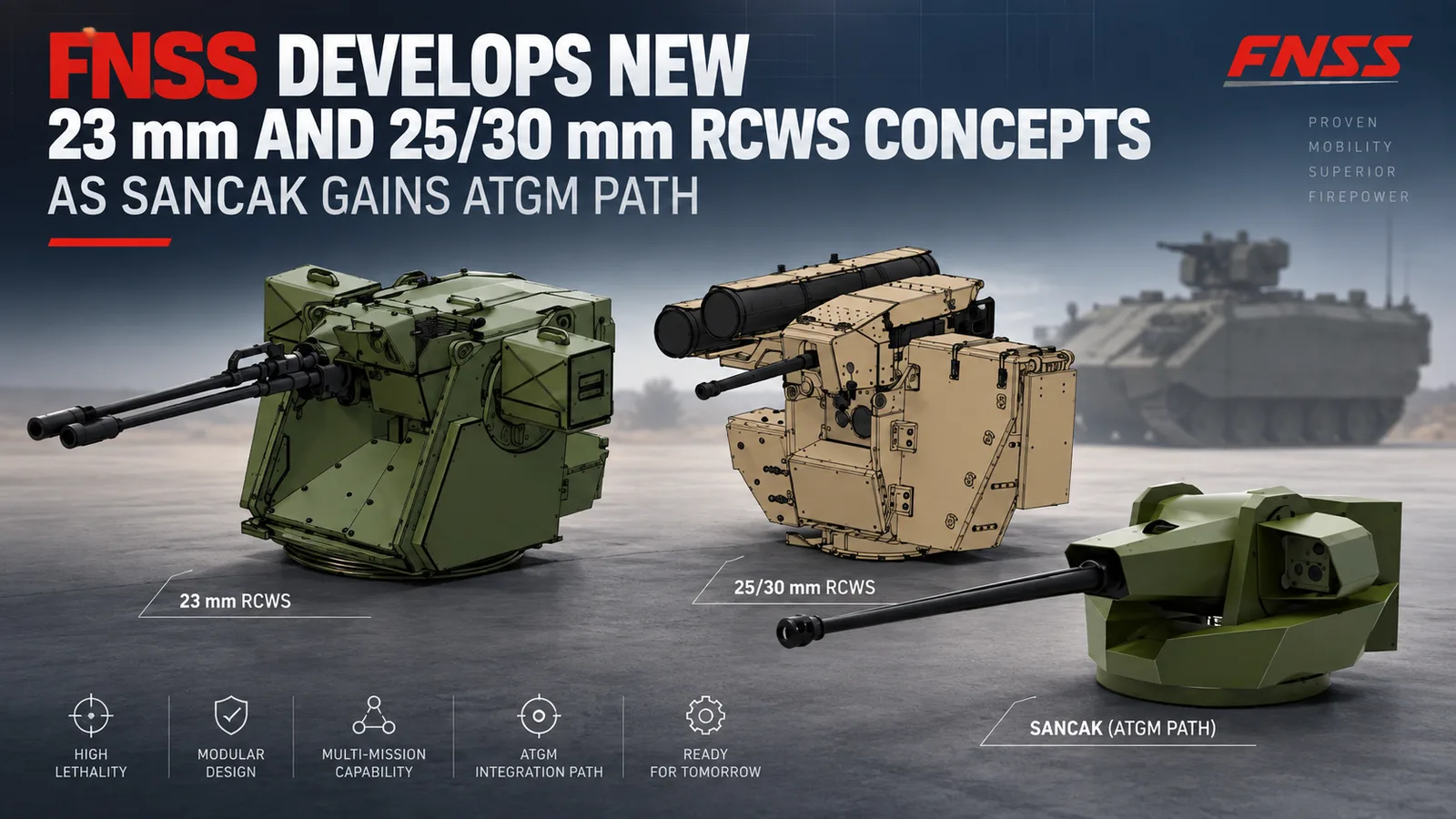
FNSS is expanding its remote-controlled weapon-system portfolio with two newly disclosed medium-calibre concepts and a modified SANCAK configuration featuring anti-tank guided missile launchers.
Designs reported from the Türk Patent database show one RCWS built around the twin-barrel 23×152 mm ZU-23-2 cannon and a second design intended for a 25×137 mm or 30×173 mm Bushmaster-type chain gun. A separate SANCAK-derived design adds ATGM launchers to the baseline light-calibre weapon station. These should be treated as development concepts rather than fielded products until FNSS formally confirms configuration, customer and programme status.
Key Facts
- Developer: FNSS
- New concept 1: 23 mm RCWS based on ZU-23-2
- New concept 2: 25/30 mm RCWS using a Bushmaster-type chain gun
- Additional development: ATGM-equipped derivative of baseline SANCAK
- Patent timing reported: Q2 2026 for 23 mm; Q4 2025 for 25/30 mm
- Existing SANCAK baseline: 7.62 mm, 12.7 mm or 40 mm AGL
- Existing dedicated AT system: SANCAK AT
- Status: Development/patent concepts; no new award announced
The New Designs Broaden FNSS’s Weapon-Station Portfolio
FNSS already fields baseline SANCAK with 7.62 mm, 12.7 mm and 40 mm automatic grenade launcher options, while its wider catalogue includes SANCAK 30, ÇAKA 30/AT, TEBER-II 30/40 and SANCAK AT.
The newly reported designs point to two additional directions: a 23 mm system that reuses a widely distributed legacy cannon and a Western-standard 25/30 mm system centred on a chain gun.
This would let FNSS address users whose requirements sit between heavy-machine-gun-class RCWS and heavier turret systems.
The 23 mm Concept Reuses the ZU-23-2
SSBülten and TURDEF report that one design integrates the twin-barrel ZU-23-2 23×152 mm cannon into a modern remote-controlled architecture.
The reported design retains the gun’s basic ammunition-feed concept and uses two 50-round ammunition boxes positioned side by side.
Its potential logic is clear: many users in Eastern Europe, the Middle East, Africa and Asia still hold substantial ZU-23-2 inventories. A modern RCWS built around an existing cannon could add remote operation, stabilisation, electro-optical sights and digital fire control without forcing the customer to replace the weapon itself.
That export rationale remains analysis. FNSS has not publicly identified a customer or production programme.
The 25/30 mm Concept Targets Western Standards
The second patent-derived system reportedly uses a Bushmaster-type chain gun in either 25×137 mm or 30×173 mm class.
Those ammunition families are widely used on Western infantry fighting vehicles, reconnaissance platforms and naval mounts.
The exact cannon model is not publicly confirmed. It should therefore be described as Bushmaster-type rather than assigned to a specific M242, Mk 44 or another model without direct evidence.
SANCAK 30 Already Covers a Different 30 mm Class
FNSS already displayed SANCAK 30 at IDEF 2025 on PARS 4×4. That turret uses the CANiK VENOM LR firing 30×113 mm ammunition.
The new 25/30 mm patent concept appears to address a different ammunition family by moving toward 25×137 mm or 30×173 mm chain-gun standards.
This distinction matters because 30×113 mm is a lighter ammunition class than 30×173 mm and imposes a different set of recoil, ammunition-storage and platform-integration requirements.
The New SANCAK ATGM Concept Is Not the Existing SANCAK AT
FNSS already manufactures SANCAK AT, a dedicated remote-controlled anti-tank turret developed for the Weapon Carrier Vehicle programme.
FNSS says SANCAK AT can carry two ready-to-fire missiles and a coaxial 7.62 mm machine gun. Its official technical page lists KORNET-E, MIZRAK-O/OMTAS, SKIF and other missile compatibility depending on configuration.
The newly reported design is different. SSBülten describes it as a modified version of the baseline SANCAK light-calibre RCWS fitted with ATGM launchers.
Defence Agenda therefore treats this as a SANCAK-derived ATGM concept rather than another reference to the established SANCAK AT turret.
Baseline SANCAK Is Already Operational
FNSS states that SANCAK can carry M2 12.7 mm, Mk19 40 mm AGL, M240 7.62 mm or FN MAG58 7.62 mm weapons through a universal mount.
The system is remote-controlled and ballistically protected, and FNSS offers a SANCAK RE-LOAD configuration allowing ammunition to be replenished from inside the vehicle.
The company says SANCAK is in service with the Turkish Armed Forces and the Oman Armed Forces.
PARS IV 6×6 Uses Two Independent SANCAK Stations
The PARS IV 6×6 Special Operations Vehicle mounts two independent SANCAK stations, one front and one rear, for simultaneous surveillance and engagement in different directions.
FNSS lists 7.62 mm, 12.7 mm and 40 mm AGL options for these mounts.
An ATGM-equipped SANCAK derivative could therefore extend anti-armour reach on light or medium armoured vehicles, but no public source confirms that PARS IV 6×6 itself has been selected for this new configuration.
FNSS Has Applied Similar Modularity to ÇAKA
The ÇAKA family provides precedent for evolving a light RCWS into heavier and missile-equipped variants.
FNSS’s ÇAKA 30/AT-O combines a 30 mm cannon with two ready-to-fire long-range ATGMs, while ÇAKA AT-K combines a 12.7 mm machine gun with two short-range guided anti-tank missiles.
The new SANCAK design appears to follow a similar modular-firepower philosophy for land-focused platforms.
Existing SANCAK AT Provides a Mature Reference
FNSS lists the existing SANCAK AT at approximately 600 kg. The turret has two-axis electric stabilisation and a gunner sight comprising thermal imaging, daylight camera and a laser rangefinder with a published 10,000 m measurement range.
The system was developed for Türkiye’s Weapon Carrier Vehicle programme and integrated on KAPLAN STA and PARS 4×4 anti-tank vehicles.
This existing experience reduces technical risk when FNSS adapts missile integration, fire control and target-tracking knowledge to other weapon-station families.
The Missile for the New SANCAK Derivative Is Undisclosed
The patent-derived modification is described with ATGM launchers, but no missile type has been publicly confirmed.
It should not automatically be identified with OMTAS, KORNET-E, SKIF or another weapon already integrated on SANCAK AT.
FNSS has repeatedly emphasised modular missile integration across its turret families, but the exact launcher count, interface, range and fire-control architecture of the new concept remain unknown.
Patent Disclosure Does Not Equal Product Launch
The two medium-calibre systems and the modified SANCAK were reported from Türk Patent records by Turkish defence media.
A design filing can indicate active engineering work or intellectual-property protection, but it does not prove that the design has completed development, live-fire testing or customer qualification.
FNSS’s current official product catalogue does not yet list the ZU-23-2 RCWS or the 25/30 mm Bushmaster-type system as fielded products.
The correct editorial status is therefore emerging development concept.
Industrial Impact
The wider pattern is portfolio modularity. FNSS can combine different weapon, sensor and missile packages with its PARS, KAPLAN and third-party vehicle platforms without forcing every customer into a single turret architecture.
This matters for export business because customers often have different ammunition stocks, preferred missiles, local-content requirements and platform constraints.
SANCAK itself illustrates the model: it first entered service with Oman and later became a core weapon station on Türkiye’s PARS IV 6×6 Special Operations Vehicle.
Limitations and Counterpoint
No FNSS press release reviewed for this package formally launches the two patent-derived RCWS concepts as production systems.
The exact Türk Patent filing numbers were not published in the supplied article.
The 23 mm system’s final weight, stabilisation performance, sensor package and vehicle compatibility are undisclosed.
The 25/30 mm concept’s exact cannon model, ammunition configuration and intended platform are also undisclosed.
The missile type and launcher architecture of the modified SANCAK concept are not confirmed.
Export-market potential should be treated as analysis rather than evidence of negotiations with specific countries.
Implications / Next
The main indicators are a formal FNSS unveiling, live-fire testing, integration on a PARS/KAPLAN or third-party platform, disclosure of the ATGM used on the SANCAK derivative and any first customer announcement.
Conclusion
FNSS appears to be widening its remote weapon portfolio in three directions at once: modernising a legacy 23 mm cannon, developing a Western-standard 25/30 mm chain-gun station and adding guided anti-tank capability to the baseline SANCAK architecture.
The concepts fit FNSS’s established modular integration strategy, but maturity remains the critical boundary. They are visible through patent-related reporting, while production customers, qualification results and contract values remain undisclosed.