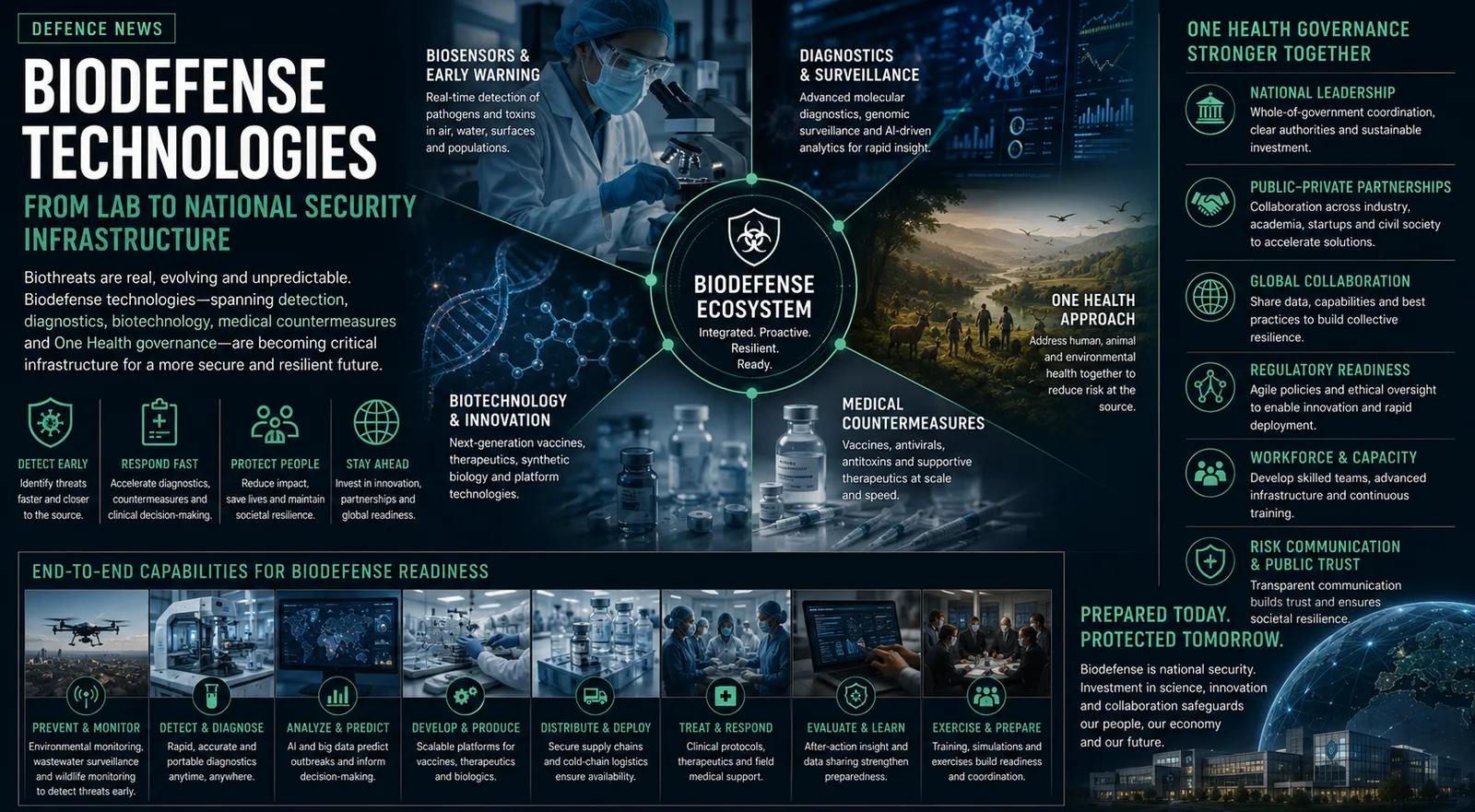
Biodefense technologies are becoming part of national-security infrastructure as biological risks move across defence, public health, agriculture, food security, environmental protection and civil resilience.
A SAHA Blog analysis frames biodefense as a field inspired by natural biological protection mechanisms. The article argues that biological defence is not limited to military protection against biological agents. It also includes technologies that support health security, early warning, environmental monitoring, agriculture, food safety and emergency response.
This wider definition is important. Biological risk can emerge from natural outbreaks, laboratory accidents, deliberate misuse, agricultural disease, environmental contamination or the dual-use application of life-science tools. Therefore, biodefense must be treated as a whole-of-society capability, not only a specialist military function.
Biodefense Technologies Turn Biology Into Security Capability
Biodefense technologies convert biological knowledge into protection. They include biosensors, diagnostic tools, medical countermeasures, detection systems, decontamination methods, protective equipment, laboratory infrastructure, surveillance platforms and data-analysis tools.
The SAHA Blog article highlights the biological foundations of this field: immune response, stress response, antioxidant mechanisms, DNA repair, pathogen recognition and biological monitoring. These natural mechanisms can inspire engineered systems that detect, prevent or mitigate biological threats.
The defence value is clear. A biological incident can disrupt troops, hospitals, borders, logistics, food systems and public confidence. A strong biodefense system gives decision-makers earlier warning, better diagnostics, faster response and stronger recovery capacity.
CBRN Defence Is the Military Framework
In military planning, biodefense usually sits inside the wider CBRN defence framework. NATO describes chemical, biological, radiological and nuclear threats as major risks to Allied populations, territories and forces. Its CBRN defence approach includes military capabilities, civil resilience, training, exercises, medical support, detection, warning, reporting, protection and decontamination.
This matters because biological threats do not respect organisational boundaries. A biological incident may begin as a public-health problem, then become a military readiness problem, a border-security problem, a logistics problem and a strategic-communications problem.
Therefore, modern biodefense must connect armed forces, health ministries, emergency agencies, laboratories, industry, agriculture authorities, customs, intelligence services and local governments.
Early Detection Is the First Line of Defence
The first requirement of biodefense is early detection. The earlier an unusual biological signal is identified, the more time authorities have to contain spread, protect personnel and prepare medical response.
Biosensors are central to this mission. They can help identify biological agents, environmental anomalies or contamination risks. Laboratory diagnostics then confirm what has been detected and support decisions on treatment, isolation, decontamination or operational restrictions.
The future of early detection will depend on combining field sensors, laboratory testing, clinical reporting, environmental monitoring, wastewater surveillance, genomic tools and AI-enabled pattern analysis. The goal is not to replace expert judgement. The goal is to give experts better warning signals and faster evidence.
Medical Countermeasures Are Strategic Assets
Vaccines, antivirals, antibiotics, antitoxins, diagnostics, personal protective equipment and life-support products are no longer only health-sector items. In a biological crisis, they become strategic assets.
The U.S. Public Health Emergency Medical Countermeasures Enterprise defines medical countermeasures broadly, covering pharmaceutical interventions such as vaccines and therapies as well as non-pharmaceutical tools such as diagnostics, protective equipment, decontamination systems and clinical decision-support tools.
For defence organisations, the lesson is direct. Military readiness depends on medical readiness. Forces must be able to detect biological risk, protect personnel, maintain operations, treat casualties and support civilian authorities during major incidents.
COVID-19 Changed the Biodefense Debate
The COVID-19 pandemic changed how governments think about biodefense. It showed that biological incidents can disrupt economies, transport systems, hospitals, military readiness, supply chains and public trust at the same time.
The SAHA Blog article correctly treats the pandemic as a warning. Preparedness cannot begin after an outbreak starts. Stockpiles, laboratory capacity, surveillance systems, trained personnel, emergency planning and industrial mobilisation must exist before a crisis.
The strongest biodefense systems will therefore be built during peacetime. They will combine routine public-health surveillance with defence planning, crisis simulation, medical countermeasure production and civil-military coordination.
Synthetic Biology Creates Opportunity and Risk
Synthetic biology is one of the most important drivers of modern biodefense. It can support faster vaccine development, new diagnostics, engineered materials, environmental sensing and advanced therapeutics. It can also create new security risks if powerful tools are misused.
This is why the WHO’s guidance on responsible life-sciences use is highly relevant. It stresses biosafety, laboratory biosecurity and oversight of dual-use research as pillars of biorisk governance.
For defence and civilian authorities, the challenge is balance. Overly restrictive policy can slow beneficial innovation. Weak governance can increase misuse risk. The right model supports responsible research while strengthening screening, risk assessment, laboratory standards, ethics and accountability.
One Health Expands the Defence Perimeter
Biodefense cannot focus only on humans. Many biological risks sit at the intersection of human, animal, plant and environmental health. This is why the One Health approach is becoming more important for national security.
WHO defines One Health as an integrated and unifying approach that aims to balance and optimise the health of people, animals, plants and ecosystems. For biodefense, this means surveillance must include agriculture, wildlife, livestock, food chains, water systems and environmental signals.
This is particularly important for countries with large agricultural production, high urban density, active trade routes and exposure to natural disasters. A biological threat may appear first in animals, crops, water, soil or supply chains before it becomes a national crisis.
Biodefense Is Also an Industrial Capability
Biodefense technologies require industrial depth. A country needs laboratories, sensor producers, diagnostic companies, biotechnology firms, pharmaceutical manufacturers, protective-equipment suppliers, software developers, cold-chain logistics and data infrastructure.
This makes biodefense relevant for defence industry. Electronics, sensors, secure communications, robotics, command software, protective systems, simulation, data analytics and rapid manufacturing all have roles in biological security.
The industrial question is not only who can produce during a crisis. The deeper question is who can maintain readiness between crises. Biodefense markets are difficult because demand can be irregular. Therefore, governments may need long-term procurement, stockpile rotation, public-private partnerships and dual-use commercial pathways.
Türkiye Has a Clear Biodefense Opportunity
Türkiye has a clear opportunity to strengthen biodefense through its defence, health, biotechnology, electronics, software and emergency-management ecosystems. The SAHA Blog article points to the need for cooperation among government institutions, health systems, R&D engineers and industry.
This cooperation should be structured around practical missions: early detection, biological diagnostics, CBRN protection, decontamination, mobile laboratories, emergency logistics, medical countermeasure manufacturing, training and public-risk communication.
Türkiye’s wider defence ecosystem can also contribute through robotics, unmanned systems, secure data networks, command-and-control software, AI analytics, rugged electronics, protective systems and deployable infrastructure.
Unmanned Systems Can Reduce Exposure
Unmanned systems will become more important in biodefense. Biological incidents can create contaminated environments where human responders face unnecessary risk. Robots, UAVs and unmanned ground vehicles can support reconnaissance, sampling support, mapping, logistics and remote monitoring.
The value is not only physical distance. Unmanned systems can collect data repeatedly, operate in difficult terrain, support perimeter monitoring and feed information into command systems. However, they must be integrated with laboratory confirmation and human decision-making.
This makes biodefense a natural dual-use market for defence companies working on autonomy, sensors, rugged platforms and C4ISR integration.
Biodefense Needs a Digital Backbone
Biological security depends on data. Detection reports, laboratory results, hospital signals, environmental monitoring, supply-chain data, animal-health reports and emergency-response updates must move quickly and securely.
A national biodefense architecture therefore needs a digital backbone. It should connect laboratories, hospitals, military medical units, emergency agencies, border authorities, agricultural bodies and command centres.
Cyber security is essential. Biological data can be sensitive, commercially valuable and operationally important. Systems must protect privacy, prevent manipulation, secure laboratory networks and maintain availability during crises.
The Main Risk Is Fragmented Responsibility
The biggest weakness in biodefense is often fragmented responsibility. Health ministries, defence institutions, agriculture agencies, laboratories, local governments and private companies may all own part of the problem, but no single actor can solve it alone.
This creates gaps in planning, funding, data sharing, standards and response authority. A biological incident can move faster than bureaucracy. Therefore, roles must be defined before a crisis.
A stronger biodefense model requires national-level coordination, regular exercises, interoperable reporting systems, joint procurement, shared laboratory standards and clear escalation procedures.
Strategic Communication Is Part of Biodefense
Biological incidents create uncertainty. That uncertainty can be exploited through panic, rumours, hostile information activity and false attribution. NATO’s CBRN policy highlights strategic communications as an important enabler of CBRN response.
This is especially relevant for biodefense. Public trust affects testing, vaccination, movement restrictions, hospital behaviour and compliance with emergency measures. Confused communication can weaken response even when technical systems are strong.
Therefore, biodefense planning should include trusted spokespersons, clear public information channels, misinformation monitoring, transparent evidence standards and crisis communication exercises.
Export Controls and Ethics Must Be Built In
Biodefense technologies are often dual-use. Biosensors, diagnostic platforms, genomic tools, synthetic biology methods, laboratory equipment and data systems can support public health and security. Some can also create misuse risks.
This means companies and public institutions need governance by design. Export-control checks, end-user screening, laboratory biosecurity, research ethics, access control, audit logs and responsible data management must be built into the ecosystem.
Biodefense should not slow beneficial biotechnology. It should make biotechnology safer, more trusted and more resilient against misuse.
A Practical Roadmap for Biodefense Growth
A practical roadmap should begin with national risk mapping. Authorities should identify the biological risks most relevant to human health, military readiness, agriculture, food systems, borders, industry and the environment.
The second step is detection capacity. Türkiye should strengthen biosensors, diagnostic networks, mobile laboratories, environmental monitoring and data-fusion tools.
The third step is medical readiness. Vaccines, therapeutics, diagnostics, protective equipment, decontamination systems and clinical support tools should be treated as strategic assets.
The fourth step is industrial coordination. Defence firms, biotechnology companies, universities, hospitals and public agencies should work around validated use cases, shared standards and pilot projects.
The fifth step is governance. Biosafety, biosecurity, dual-use research oversight, export controls, privacy protection and crisis communication must be included from the beginning.
Conclusion
Biodefense technologies are becoming essential to national resilience. They connect biosensors, diagnostics, medical countermeasures, laboratory systems, CBRN protection, data platforms, One Health surveillance and civil-military coordination.
The strategic lesson is clear. Biological risks can emerge naturally, accidentally or deliberately. They can affect soldiers, civilians, animals, plants, supply chains and economies. Therefore, biodefense must be built as an integrated capability before the next crisis arrives.
For Türkiye, the opportunity is to connect defence industry, health technology, biotechnology, emergency management and digital infrastructure into a stronger national biodefense ecosystem. The countries that master this integration will be better prepared not only for biological attacks, but also for pandemics, agricultural crises, environmental hazards and future biosecurity risks.
For further Defence Agenda coverage, read our defence technology, CBRN defence and defence industry sections. Related analysis includes dual-use defence technologies and innovation, 5G military communications and next-generation weapon systems and future warfare technologies and military strategy.
Further Reading
- SAHA Blog: Biyosavunma — Doğanın Gücünden İlham Alıyor
- NATO: Weapons of mass destruction and CBRN threats
- NATO: Chemical, Biological, Radiological and Nuclear Defence Policy
- WHO: Responsible use of the life sciences
- U.S. National Biodefense Strategy and Implementation Plan
- ASPR: Public Health Emergency Medical Countermeasures Enterprise
- DTRA: Cooperative Threat Reduction and Biological Threat Reduction Program
- WHO: One Health