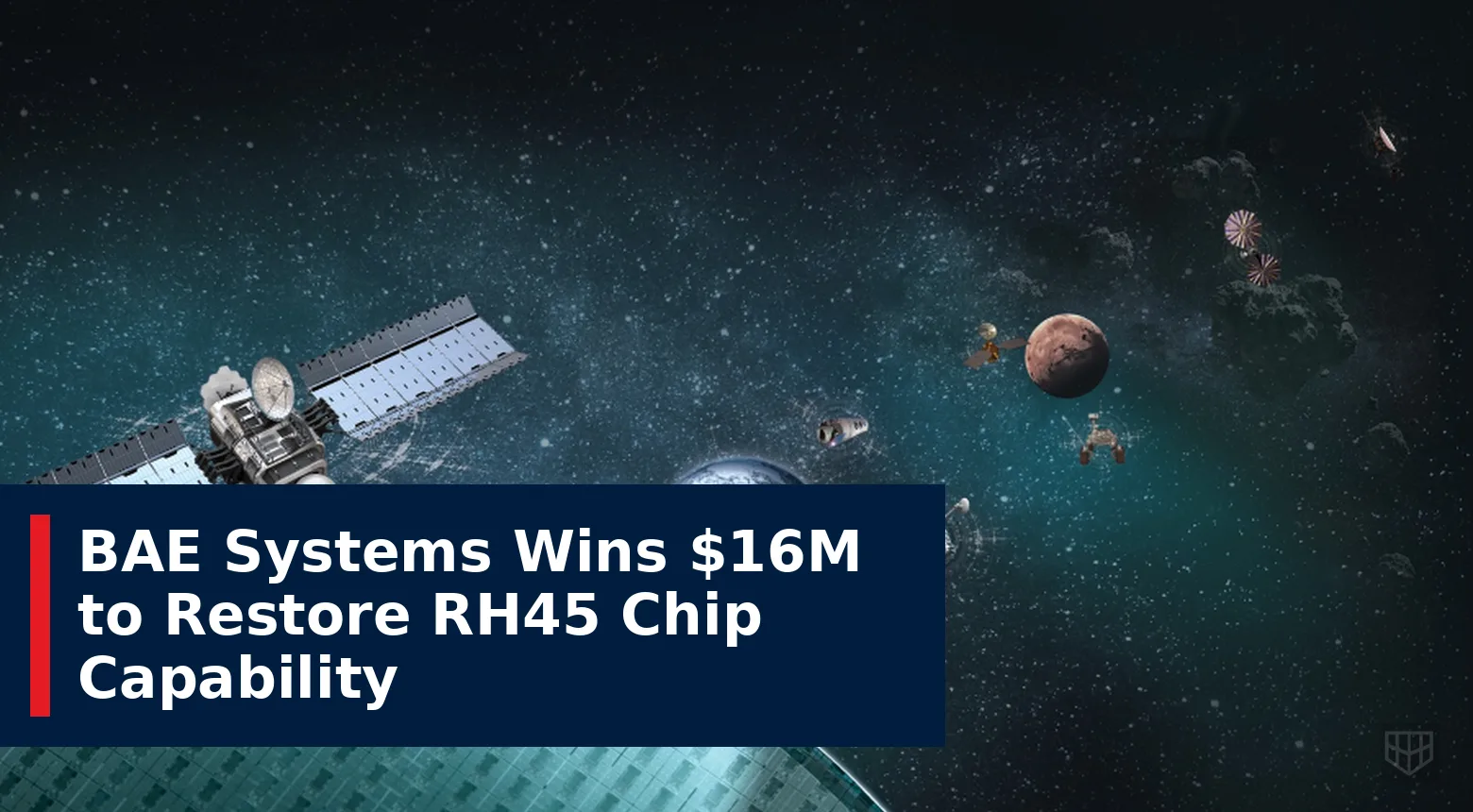
BAE Systems has received $16 million in US DPA Title III funding to re-establish and qualify its RH45 radiation-hardened chip capability.
Title III funding for RH45
BAE Systems has received $16 million through the US Defense Production Act Title III programme to demonstrate and qualify its RH45 semiconductor technology. The work will re-establish the company's RH45 application-specific integrated-circuit Storefront, a library and support environment that allows customers to create mission-specific chips from qualified building blocks. The award was made through the Department of War's Warfighting Investments, Resourcing, and Execution directorate.
The action is best understood as industrial-base restoration. It does not purchase a satellite, payload or fixed number of chips for an operational constellation. Funding supports the capability needed to design, manufacture and qualify radiation-hardened devices so that later programmes can order them with lower technical and supply risk. Public reporting does not specify the delivery schedule for the first newly qualified production parts.
A commercial process adapted for space
RH45 is based on GlobalFoundries' 45-nanometre silicon-on-insulator technology at the company's Malta, New York, facility. BAE Systems combines that commercial manufacturing foundation with circuit libraries, packaging, screening and assurance for radiation environments. The Storefront is intended to work with industry-standard design tools, allowing customers to target specialised functions without creating an entirely new semiconductor process for each mission.
Using a mature commercial node can improve performance and design flexibility compared with older radiation-hardened electronics, but commercial origin does not make a device space-qualified by itself. Total ionising dose, single-event effects, temperature cycling, packaging reliability and mission lifetime all require evidence. Qualification results and the range of available logic, memory and interface functions will determine how broadly customers can adopt the library.
Domestic supply and trusted manufacturing
BAE Systems says the programme reinforces its manufacturing relationship with GlobalFoundries and creates a secure US route for critical microelectronics. RH45 work is associated with BAE Systems' Space Systems group in Manassas, Virginia, a Department of War Category 1A Microelectronics Trusted Source covering design, aggregation, brokering, packaging, assembly and testing. That chain is intended to reduce reliance on difficult-to-replace overseas capacity.
Supply resilience involves more than wafer fabrication. Radiation-hardened devices depend on trusted intellectual property, design tools, packaging materials, test equipment and engineering expertise that may have only a few qualified providers. A restored Storefront can preserve access to the process and libraries, but long-term value will require recurring customer demand and periodic technology refresh rather than a one-time qualification campaign.
Applications and next milestones
BAE Systems identifies planetary exploration, communications, weather, surveillance and national-security spacecraft as potential applications. The company is also integrating RH45 technology into single-board computers including its Endura SBC. Those statements describe possible product pathways; they do not mean that every named mission has selected RH45. Individual programmes will still perform component selection and system-level radiation analysis.
The next milestones are completion of demonstration and qualification, availability of the Storefront to designers and disclosure of production orders. Data on radiation tolerance, yield, lead time and recurring price would allow a stronger assessment of competitiveness. For now, the award is a targeted investment in a trusted design-and-manufacturing capability whose strategic value lies in preserving access to specialised space electronics before a supply interruption affects a major programme.
Editorial assessment
The programme also illustrates why leading-edge commercial performance is not the only measure of strategic semiconductor value. A 45nm process is mature by consumer-market standards, yet it can remain highly relevant where radiation tolerance, long service life and trusted manufacture outweigh transistor density. Space customers often value predictable behaviour more than frequent process changes.
DPA Title III funding is intended to remove industrial shortfalls rather than replace normal demand indefinitely. A successful outcome would leave BAE Systems and GlobalFoundries able to compete for funded spacecraft designs after the government-supported qualification closes. Orders from several missions would provide the best evidence that the capability is commercially and operationally sustainable.