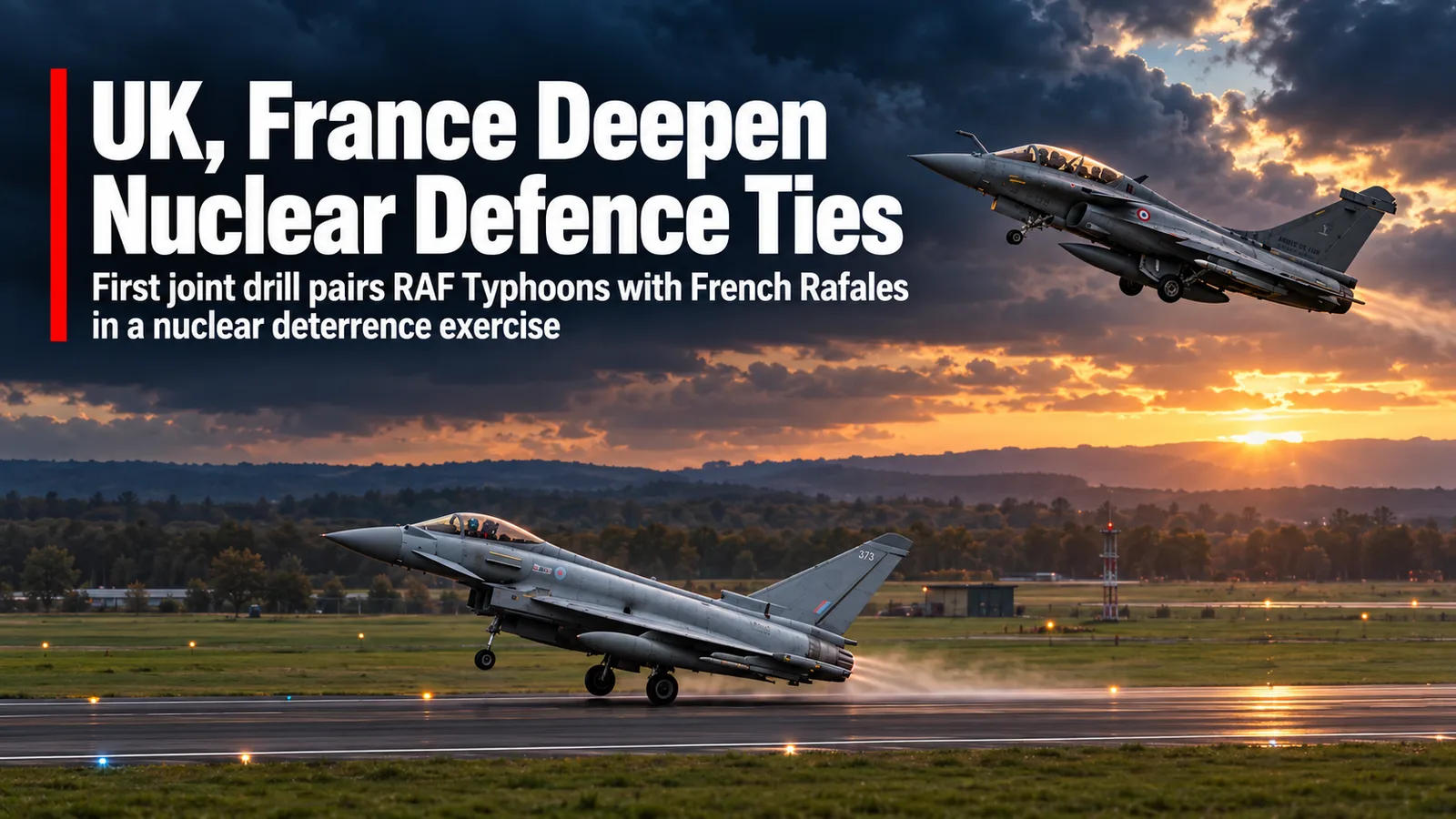
The UK-France nuclear exercise Rummy brought Royal Air Force Eurofighter Typhoons into a French airborne nuclear-deterrence drill for the first time on 20–21 October 2026. British fighters escorted French Rafales undertaking a simulated nuclear-strike mission over the Mediterranean, the UK Ministry of Defence announced on 23 October. The mission involved no nuclear weapons and did not combine the countries’ sovereign nuclear-release authorities. It nevertheless marks an operational step in the coordination promised under the 2025 Northwood Declaration, with implications for European deterrence and allied air-force interoperability.
Key Facts
- Exercise: Rummy; a French nuclear air exercise involving RAF aircraft for the first time
- Dates: 20–21 October 2026; announced 23 October 2026
- Aircraft: French Rafale fighters and RAF Eurofighter Typhoons
- Mission: Simulated French nuclear strike with British fighter escort
- Location: Departure from Saint-Dizier Air Base, France; operations over the Mediterranean
- Nuclear weapons: None involved in the exercise
- Political framework: Northwood Declaration, 10 July 2025; national nuclear decision-making remains independent
Exercise Rummy Brings RAF Fighters into a French Nuclear Drill
According to the UK Ministry of Defence’s 23 October 2026 announcement, French Rafales launched from Saint-Dizier Air Base and rehearsed an airborne nuclear-strike mission while RAF Typhoons provided escort. The activity took place over the Mediterranean during the two-day Exercise Rummy. London described it as the first participation by British Typhoons in a French nuclear air exercise—not the first UK-French air exercise of any kind.
The distinction matters because the rehearsal concerned a defined nuclear-deterrence mission, but did not involve live nuclear munitions. Public reporting provides the aircraft types, the simulated mission, the base and the broad geographical area. It does not disclose the full order of battle, the precise sortie profile, technical communications standards or quantitative measures of performance.
Defense News reported, citing the French armed forces chief, that A330 multi-role tanker transport aircraft also participated. That detail adds an air-mobility dimension to the reported drill, although the official UK release does not state tanker numbers or national allocations.
Why the Rafale–Typhoon Escort Matters
A fighter escort is a conventional protection role around a strike package. In this case, British aircraft supported a mission rehearsed by French nuclear-capable fighters; the British aircraft were not described as nuclear weapon-delivery platforms. Coordinating different national air forces in such a scenario can test practical issues such as timing, identification, mission planning and flight-package integration without merging the strategic weapons systems themselves.
The announcement is evidence that the air forces conducted the exercise together. It is not independent evidence that every wartime procedure or communications pathway has been validated. Neither government has published performance benchmarks, readiness scores or technical findings from Rummy, so claims of complete operational integration would go beyond the disclosed record.
Northwood Declaration Moves from Policy to Practice
The two governments signed the Northwood Declaration on 10 July 2025, agreeing that their independent nuclear forces could be coordinated while remaining under sovereign control. The declaration provided for a Nuclear Steering Group covering policy, capabilities and operations. The broader Lancaster House 2.0 agreement linked this agenda to stronger conventional interoperability, joint planning and defence-industrial cooperation.
The bilateral Nuclear Steering Group held its first meeting in Paris on 10 December 2025, according to a Cabinet Office release issued on 18 December. British and French representatives also observed a French strategic-air exercise at that stage. Rummy is therefore better understood as a subsequent operational participation milestone than as the beginning of bilateral nuclear discussions.
The political message is coordination between Europe’s two national nuclear powers. The limit is equally important: nuclear command decisions have not been transferred to a joint headquarters, NATO has not been given a new bilateral launch authority, and neither country has announced a shared nuclear force.
What It Means for NATO and European Deterrence
For NATO, Rummy demonstrates a potential contribution from interoperable conventional aviation to the credibility and protection of national strategic forces. It also gives London and Paris a more concrete demonstration of their willingness to coordinate in a crisis. The governments present this as a contribution to Euro-Atlantic security, rather than as an alternative NATO command structure.
A more sceptical assessment is also necessary. A single announced exercise can carry substantial political signalling value, but it cannot by itself prove the resilience of bilateral planning during a prolonged conflict. Nuclear deterrence rests on political judgement, survivable forces, reliable communications and credible command arrangements—many of which are intentionally not observable in an open-source drill announcement.
The exercise may therefore strengthen the appearance of allied cohesion while leaving essential questions about the scope, frequency and constraints of future coordination unanswered. That is not necessarily a failure; strategic sensitivity limits public disclosure. It does mean analysts should distinguish confirmed activity from inferred doctrine.
The UK Nuclear Investment and F-35A Context
The MOD linked Rummy to a stated £63 billion investment across four years in the wider UK defence-nuclear enterprise, including the Dreadnought deterrent submarines, SSN-AUKUS attack-submarine work, a new warhead and associated infrastructure. The government also reiterated plans to acquire 12 F-35A aircraft and participate in NATO’s nuclear mission. These are separate programme tracks, not capabilities demonstrated by RAF Typhoons in Rummy.
The difference between nuclear-powered and nuclear-armed platforms should not be blurred. The proposed SSN-AUKUS boats are nuclear-powered attack submarines, not an additional British strategic ballistic-missile deterrent. Defence Agenda has separately covered the UK’s planned first SSN-AUKUS steel cut in 2027 and the expanding UK nuclear workforce—both relevant to the production and industrial capacity behind the government’s broader spending commitments.
For the RAF’s longer-term force structure, the question is how current Typhoon interoperability, future F-35A nuclear-task participation and next-generation airpower fit together. Defence Agenda’s reporting on the Storm Fighter collaborative combat aircraft programme provides additional context on the UK’s evolving airpower plans; it should not be read as a component of Exercise Rummy.
Implications and Next Steps
The next meaningful evidence would be announcements of follow-on exercises, a published pattern of recurring bilateral training, or more explicit descriptions of arrangements for planning, deconfliction and crisis consultation. The UK and France have not publicly announced dates for a further Rummy iteration, and no procurement contract or new shared nuclear command body was announced as a result of this drill.
For decision-makers, the appropriate conclusion is narrower than the headline rhetoric but still consequential: a 2025 political commitment to coordinate independent nuclear forces produced a publicly confirmed mixed RAF–French air mission in October 2026. The exercise is a measurable interoperability milestone; its contribution to deterrent credibility will depend on whether the two nations build sustained, repeatable coordination around it.
Further Reading
- Defence Agenda — UK Nuclear Workforce Tops 100,000
- Defence Agenda — UK Plans First SSN-AUKUS Steel Cut in 2027
- Defence Agenda — Storm Fighter CCA Programme
- UK Ministry of Defence — Exercise Rummy, 23 October 2026
- UK and France — Northwood Declaration, 10 July 2025
- UK Cabinet Office — Nuclear Steering Group, 18 December 2025
- Defense News — UK-France Airborne Nuclear Drill, 23 October 2026