First Export Order Moves LOCUST Into the International Market
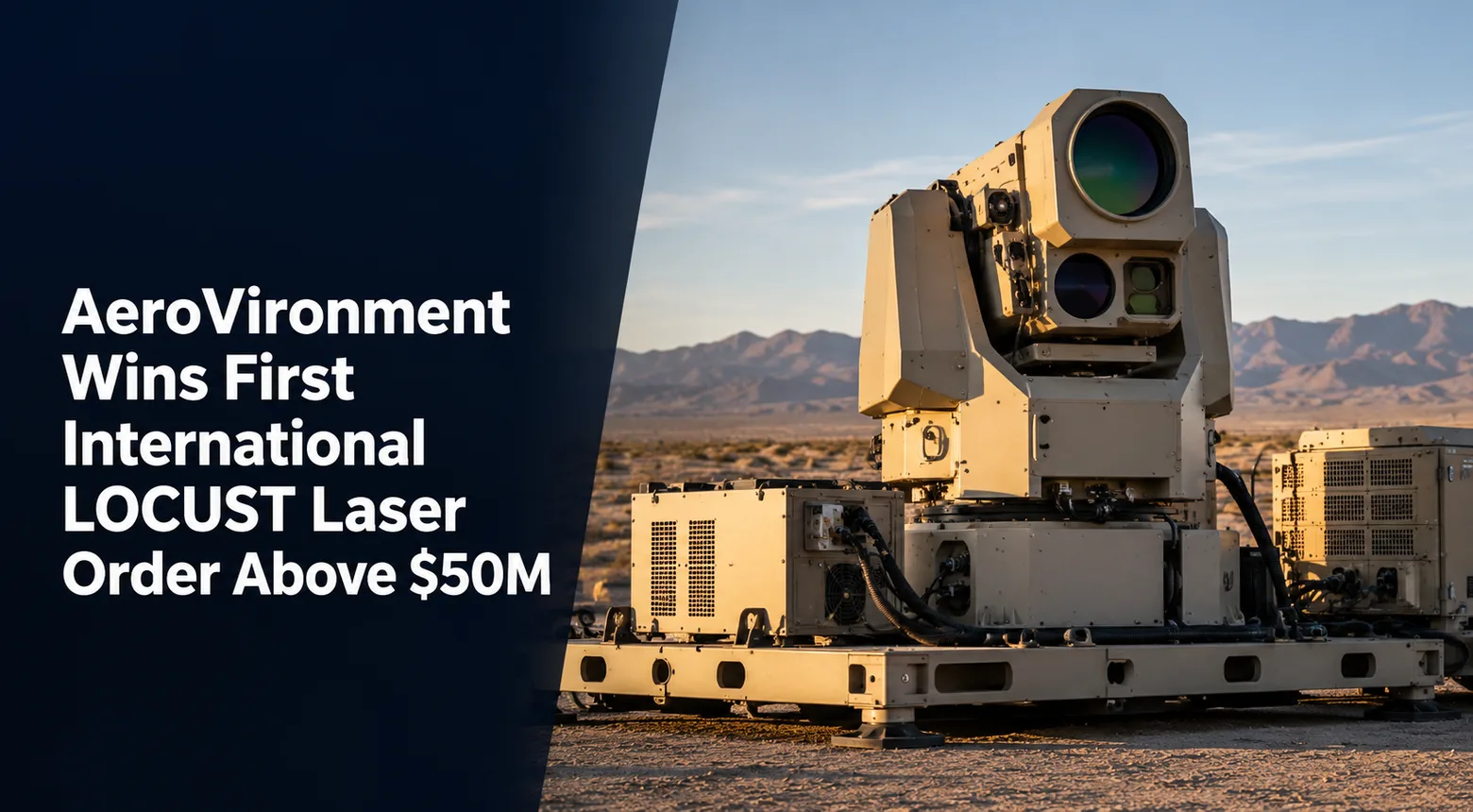
AeroVironment has received the first international purchase order for its LOCUST laser weapon system, with the direct commercial sale valued at more than $50 million. The company announced the order on 8 September 2026 and said it covers an initial delivery of LOCUST systems together with associated support. The buyer, system quantity, delivery schedule and deployment location were not disclosed, limiting any reliable estimate of unit price or the scale of the receiving force.
The milestone matters because directed-energy systems have spent years moving between research programmes, limited operational trials and production-transition efforts. A foreign customer committing more than $50 million indicates that at least one defence user is prepared to adopt the technology beyond an experimental demonstration. The order also gives AeroVironment a reference customer outside the United States at a time when counter-UAS demand is being driven by large numbers of inexpensive drones and by the poor cost exchange created when premium interceptor missiles are used against low-cost air threats.
LOCUST Targets the Cost-per-Engagement Problem
High-energy laser systems are attractive for counter-UAS missions because the marginal cost of an engagement can be dominated by electrical power, maintenance and component life rather than by a single-use missile. That does not make lasers universal replacements for kinetic effectors. Weather, atmospheric attenuation, line of sight, dwell time, target characteristics, cooling and power generation still constrain performance, which is why directed energy is increasingly positioned as one layer within a broader air-defence architecture rather than as a stand-alone shield.
LOCUST sits inside that layered logic. AeroVironment markets the system for detecting, tracking and defeating drones with directed energy, allowing missiles and guns to be reserved for targets or conditions where a laser is less effective. The operational value will therefore depend heavily on sensor integration, target prioritisation and the speed with which the system can transition between engagements. In a saturation scenario, the decisive metric is not simply beam power but how many threats the complete kill chain can detect, classify and defeat over time.
U.S. Army Production Provides an Industrial Baseline
The export order follows AeroVironment’s selection for a U.S. Army Enduring-High Energy Laser contract valued at $464.8 million. The company presents that award as a production contract covering multiple systems, creating a domestic manufacturing baseline that can also support foreign demand. International customers generally place greater confidence in systems that have a committed home-market production path because spares, upgrades, software support and supplier continuity are less dependent on a one-off export batch.
At the same time, export execution introduces different integration requirements. Power architecture, command-and-control interfaces, rules for weapons employment, local radar connectivity and national certification can vary by customer. The undisclosed nature of the buyer means it is not yet possible to judge whether LOCUST will be delivered as a relatively self-contained site-defence system or integrated into a larger national air-defence network. That difference will shape both operational impact and follow-on commercial potential.
Implications / Next
The next important milestones are confirmation of deliveries, exercised options and any second international customer. If multiple users adopt LOCUST, AeroVironment could move from a U.S.-centric production line into a broader export ecosystem for directed-energy counter-UAS systems. That would increase pressure on competitors to demonstrate not only beam performance but manufacturing scale, supportability and integration with existing sensor and command networks.
The order also reinforces a broader transition in short-range air defence. Militaries increasingly want a mix of electronic warfare, guns, low-cost missiles, intercepting drones and directed energy so that commanders can match the effector to the target and preserve expensive munitions. LOCUST’s commercial test will therefore be whether it can occupy a repeatable place in that layered architecture rather than remain a specialised high-technology purchase.