Koral’s Launcher Appears Publicly for the First Time
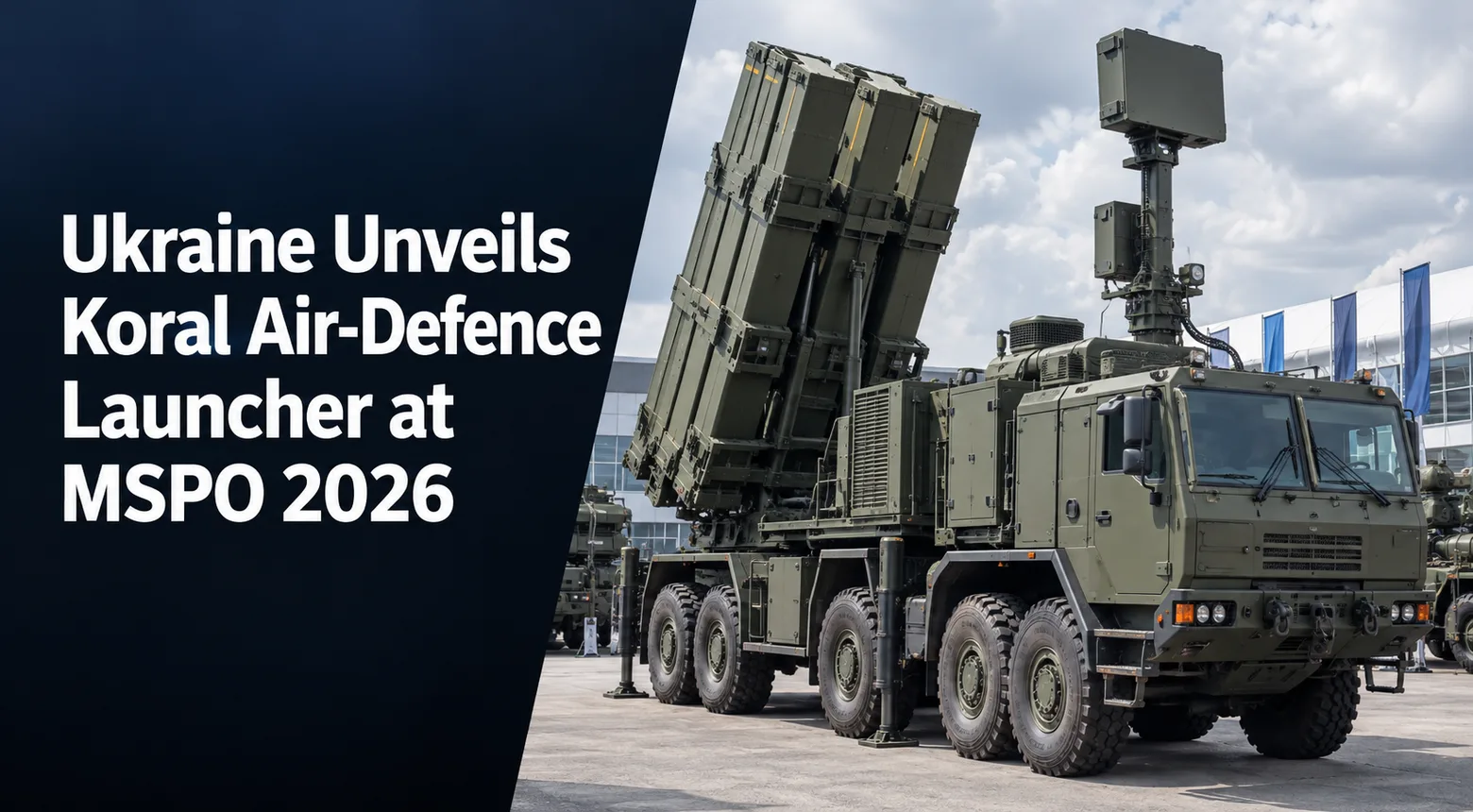
Ukraine has publicly displayed the launcher associated with its Koral surface-to-air missile programme for the first time at MSPO 2026 in Poland. Militarnyi reported the unveiling on 8 September using imagery released by Ukraine’s state defence-industrial organisation, showing a self-propelled launcher on a Czech Tatra truck chassis. Interfax-Ukraine separately reported the same development and published technical data attributed to the developer. The appearance provides new evidence that the long-running Koral project has progressed beyond a missile mock-up into a vehicle-level system concept.
The milestone should still be described carefully. A public launcher image does not confirm that Koral has completed trials, entered serial production or been fielded by Ukrainian air-defence units. The correct status is a development and exhibition milestone. That is important because Ukraine has urgent operational demand for interceptors, but wartime urgency can compress the visibility between prototypes, limited combat evaluation and formal production.
Published Specifications Point to a Multi-Role Interceptor
Reported developer data places the missile at about 450 kg with a 36 kg warhead. Guidance is described as a combination of inertial navigation, radio correction and an active radar seeker, a configuration that would allow the missile to receive mid-course updates before using its own seeker in the terminal phase. The weapon is intended to engage aerial and ballistic targets, while exceptional employment against radar-contrast ground or surface targets has also been mentioned.
Those characteristics suggest a more ambitious role than a simple short-range point-defence missile, although public information is still insufficient to define engagement range, altitude, radar architecture or the performance envelope against ballistic threats. Claims of anti-ballistic capability are especially sensitive because effective interception depends on sensor quality, reaction time, interceptor kinematics and battle-management integration, not only on the missile’s seeker and speed. Until Ukraine publishes test evidence, the anti-ballistic role should remain a stated design objective rather than a proven operational capability.
The Programme Reflects Ukraine’s Drive for Indigenous Air Defence
Koral development dates back to 2016 and originally appeared in documentation connected with a ship-based air-defence concept. The project later re-emerged publicly through missile mock-ups and now a self-propelled launcher. That evolution reflects Ukraine’s broader effort to expand domestic air-defence production while continuing to rely on Western Patriot, SAMP/T, IRIS-T and other imported systems. Local production offers potential advantages in supply security, adaptation speed and wartime replenishment if the industrial base can manufacture interceptors at meaningful scale.
The challenge is integration. A surface-to-air missile system is a network of radars, command posts, launchers, data links and support equipment, not simply a launcher truck. Ukraine would need to demonstrate that Koral can receive tracks from a suitable sensor architecture, manage engagements under electronic attack and sustain production of seekers, propulsion and guidance electronics. Wartime battlefield experience can accelerate iteration, but it also places pressure on quality control and manufacturing capacity.
Implications / Next
The next decisive milestones are a documented live firing from the displayed launcher configuration, confirmation of the associated radar and command architecture, and evidence of serial production or unit-level delivery. Those steps would move Koral from an exhibition reveal toward an operationally credible indigenous air-defence programme.
If Ukraine can field Koral in useful numbers, it could reduce dependence on limited foreign interceptor stocks and provide a nationally controlled layer against aircraft, cruise missiles and potentially some ballistic targets. The MSPO 2026 appearance is therefore strategically important, but it is best understood as a visibility milestone in a programme whose testing and production maturity remain only partially public.