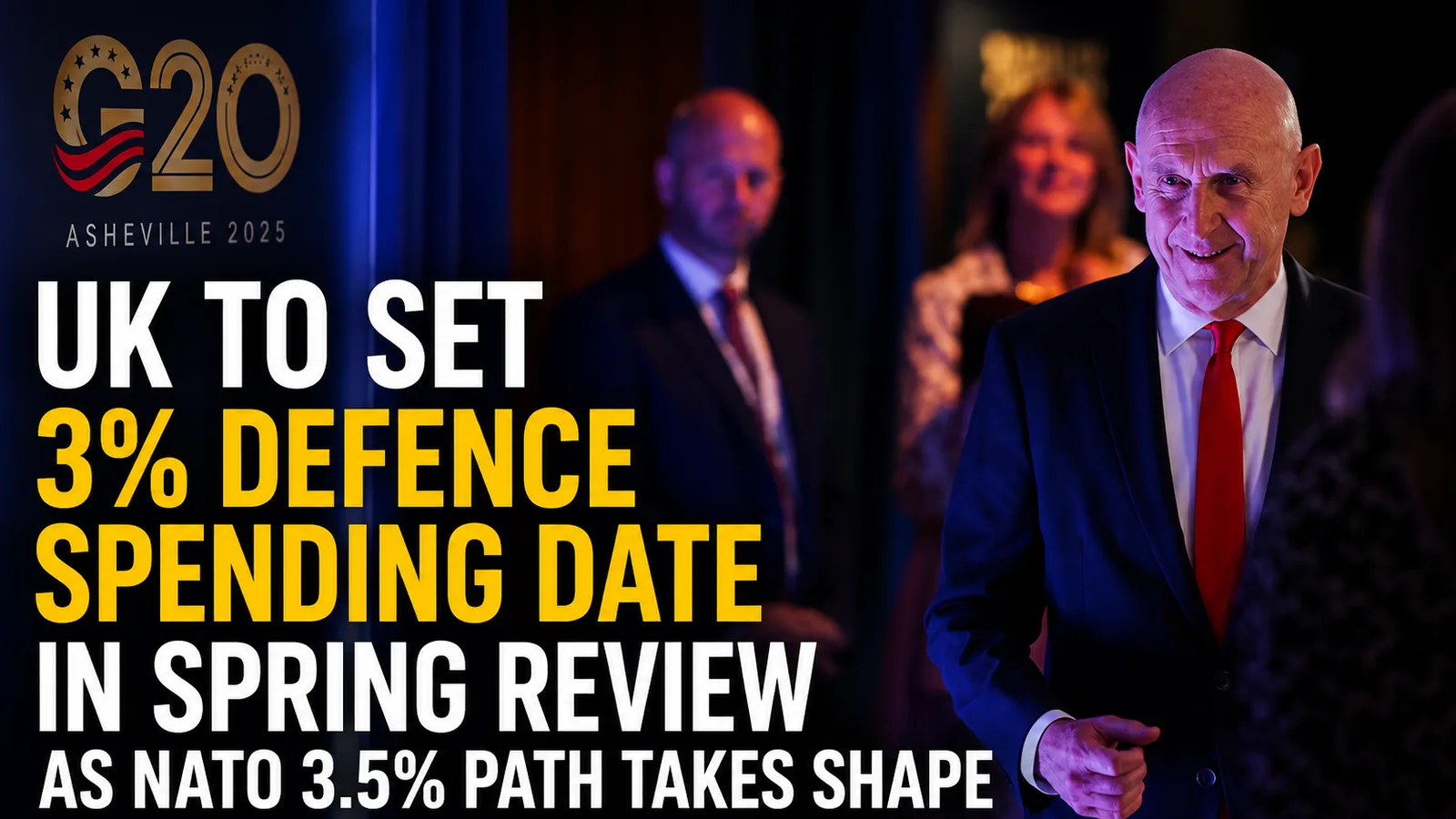
Britain will set a specific target date for reaching 3% of GDP on defence at its spring 2027 Spending Review, Chancellor John Healey said on 1 September, as the government prepares a longer-term path toward NATO’s 3.5% core-defence spending commitment by 2035.
The announcement adds a timetable decision to a spending trajectory that has already moved substantially during 2026. The UK’s Defence Investment Plan now provides for core NATO defence spending of 2.7% of GDP from 2027/28 through 2029/30, while the government remains committed to 3% in the next Parliament and 3.5% by 2035.
The New Commitment Is a Date for 3%
Reuters reported that Healey told The Times at the G20 finance ministers meeting in North Carolina that the spring Spending Review would set out a “clear path” toward NATO’s 2035 commitment and establish a target date for the intermediate 3% milestone.
This is a more specific commitment than the language used in earlier government documents, which generally tied 3% to the next Parliament and to fiscal and economic conditions.
The Spending Review will therefore become the next major decision point for UK defence planning because it must translate a political ambition into a dated spending trajectory and departmental settlement.
The June 2026 Defence Investment Plan Already Raised the Near-Term Baseline
The UK government’s Defence Investment Plan, published on 30 June 2026, established a £298 billion Ministry of Defence spending framework over the four financial years from 2026/27 through 2029/30.
The plan added £15 billion above the previous settlement and said the government would spend more than £60 billion extra on defence over four years compared with maintaining the plans inherited from the Spring Budget 2024 baseline.
Under the DIP, core NATO defence spending is expected to reach 2.7% of GDP from 2027/28 and remain at that level through 2029/30.
This means the spring review is not starting from the older 2.5% benchmark. The immediate funded trajectory has already moved higher.
The 3% Step Will Require Another Material Funding Increase
The Office for Budget Responsibility previously estimated that reaching 3% of GDP in 2029/30 would require an additional £17.3 billion compared with the baseline used in its March 2025 forecast.
Reuters cited the same figure in the context of Healey’s renewed push to establish a date for the target.
The £17.3 billion should be treated as a historical OBR estimate tied to a specific 2029/30 baseline and GDP forecast. It is not a fixed invoice for every possible path to 3%.
The actual funding requirement will depend on nominal GDP, inflation, the NATO spending definition, intelligence expenditure counted as defence, and the year in which the government chooses to cross the 3% line.
The £4.7 Billion Figure Is a Different Funding Issue
Reuters also reported that Healey faces a £4.7 billion funding requirement associated with the existing Defence Investment Plan.
Official Treasury material provides important context. When the government announced the £15 billion DIP package in June, it said £10.3 billion of the funding had already been identified and that a further £4.7 billion over four years would be confirmed at Budget 2026.
The amount was distributed in the funding table as £1.8 billion in 2026/27, £1.1 billion in 2027/28, £1.0 billion in 2028/29 and £0.9 billion in 2029/30.
That £4.7 billion should therefore not be confused with the additional cost of reaching 3%. It is part of the financing mechanism for the already announced £15 billion DIP uplift.
The October 2026 Budget Comes Before the Spring Review
Healey’s first Budget as Chancellor is scheduled for 28 October 2026, according to Reuters.
That event matters immediately because the government has already said the remaining £4.7 billion of DIP funding would be identified at Budget 2026.
The October Budget and spring 2027 Spending Review therefore serve different functions.
The Budget must close or clarify the financing of the existing near-term Defence Investment Plan. The subsequent Spending Review is expected to establish the longer trajectory toward 3% and 3.5%.
NATO’s New Framework Is 3.5% Plus 1.5%
At the 2025 Hague Summit, NATO allies agreed a new framework under which members aim to spend at least 3.5% of GDP annually on core defence requirements by 2035, plus up to 1.5% on defence- and security-related resilience.
The UK government has committed to the overall 5% national-security framework.
The 1.5% component can include areas such as resilience, critical infrastructure and other security-related spending that falls outside the core defence budget.
This distinction matters because a headline statement that Britain will spend “5% on defence” would be inaccurate. The 5% NATO pledge is composed of a 3.5% core-defence element and a separate 1.5% wider security and resilience component.
The Government’s Current DIP Reaches 4.2% Under the Wider NATO Definition
When announcing the Defence Investment Plan in June 2026, the government said the package would take Britain to 4.2% under the wider NATO national-security framework.
The remaining path to 5% therefore extends beyond the conventional Ministry of Defence settlement.
This will require coordination across defence, infrastructure, energy security, cyber resilience and other departments whose spending may qualify under NATO’s broader methodology.
The Spring Review Will Be an Industrial Signal as Much as a Budget Event
For industry, the value of the spring review will depend on whether it converts percentage targets into multi-year procurement certainty.
The Defence Investment Plan already allocates large sums to drones and autonomous systems, combat air, missiles, munitions, shipbuilding, nuclear programmes, space, cyber and infrastructure.
Prime Ministerial statements accompanying the plan included more than £5 billion for drones and autonomous weapons and £8.6 billion of UK investment in the Global Combat Air Programme over four years.
A dated 3% trajectory could provide suppliers with a clearer demand signal for factories, workforce, long-lead components and supply-chain investment.
Budget Growth Does Not Automatically Equal Additional Procurement
Higher defence spending can be absorbed by several categories that do not immediately translate into new equipment orders.
Personnel costs, nuclear infrastructure, estate, maintenance, training, readiness, ammunition replenishment and inflation all compete with new-platform procurement.
The House of Commons Library noted that much of the additional funding added in 2026 was intended to improve day-to-day readiness, including training and the availability of ships and aircraft.
This is why the composition of the future 3% settlement matters as much as the headline percentage.
The Strategic Defence Review Assumes Sustained Higher Spending
The 2025 Strategic Defence Review was built around a long-term shift toward warfighting readiness, NATO-first planning, greater use of autonomy and digital systems, and defence as an engine of economic growth.
Its recommendations assumed spending would move toward 3% of GDP in the next Parliament when fiscal conditions allowed.
The Review also acknowledged that additional money must be accompanied by procurement reform and stronger budget control.
The spring 2027 review will therefore test whether the fiscal trajectory can keep pace with the force-design ambitions already announced.
3% by 2030 Has Become a Political Benchmark
Reuters reported that Healey had previously argued Britain should reach 3% by 2030 and said the target was necessary given the deteriorating security environment.
He left his previous role as defence minister after failing to secure funding for that timetable, according to Reuters, before becoming Chancellor in July 2026.
The spring review will show whether the 2030 date is restored, delayed or replaced with another milestone.
Until that review is published, 3% by 2030 should be described as Healey’s previous preferred timetable rather than current funded government policy.
Fiscal Rules Remain the Main Constraint
Healey has said he intends to maintain the borrowing rules inherited from his predecessor, Rachel Reeves.
That places defence expansion inside the same fiscal framework governing other departments and investment priorities.
A sustained move from 2.7% toward 3% and then 3.5% cannot therefore be analysed only as a defence-policy decision. It is also a question of taxation, borrowing, spending reprioritisation and nominal economic growth.
The June DIP already demonstrated this trade-off by using departmental capital-budget reductions, asset sales, Treasury support and planned Budget 2026 funding to finance the £15 billion uplift.
The UK Is Already One of NATO’s Largest Cash Spenders
The government says Britain will remain NATO’s third-largest defence spender in cash terms behind the United States and Germany under the current four-year plan.
Percentage-of-GDP rankings tell a different story because several eastern and northern European allies are already spending larger shares of their economies on defence.
The UK’s future significance therefore comes from the combination of a large economy, nuclear forces, carrier aviation, combat-air development, submarines, missiles and an established defence-industrial base.
Moving toward 3.5% would increase the absolute procurement pool substantially even if Britain did not become NATO’s highest spender by GDP share.
Industry Will Watch the Mix Between Sovereign and Collaborative Programmes
Britain’s next spending settlement will affect both sovereign and multinational programmes.
GCAP, nuclear submarines, munitions, air and missile defence, autonomous systems, long-range strike and the future surface fleet all depend on stable multi-year budgets.
The UK is also leading or participating in European cooperative efforts including deep precision strike and low-cost air-defence initiatives.
A clearer spending path can improve partner confidence because multinational programmes depend on each government maintaining its share of funding over long periods.
Limitations and Counterpoint
No new 3% target date has yet been announced.
The spring 2027 Spending Review is expected to establish that date, meaning any current assumption that 3% will definitely be reached by 2030 remains speculative.
The £17.3 billion OBR figure is an estimate tied to a 2029/30 scenario and should not be treated as the final cost of the future spending path.
The £4.7 billion DIP financing figure is part of the existing four-year package, not the total additional cost of NATO’s 3.5% target.
Likewise, the 5% NATO commitment includes 1.5% of wider security and resilience expenditure and is not equivalent to 5% of GDP being assigned directly to the Ministry of Defence.
Implications / Next
The first milestone is the 28 October 2026 Budget, where the government is expected to identify or confirm the remaining £4.7 billion financing required for the existing Defence Investment Plan.
The second is the spring 2027 Spending Review, which Healey says will set the date for reaching 3% and establish the path toward 3.5% by 2035.
The third is the composition of the settlement. Industry will need to see how much of the increase is directed toward procurement, stockpiles and production capacity versus personnel, estate, nuclear and readiness costs.
The fourth is NATO’s 2029 review of the new 3.5% plus 1.5% framework, which could adjust the trajectory or classification of spending before the 2035 deadline.
Conclusion
Britain’s defence-spending debate has moved from whether spending will increase to how quickly the country will progress from an already funded 2.7% trajectory toward 3% and ultimately NATO’s 3.5% core-defence target.
Chancellor John Healey’s 1 September statement makes the spring 2027 Spending Review the next decisive milestone because it is expected to convert the 3% ambition into a dated commitment.
The immediate fiscal issue is narrower: £4.7 billion of the existing Defence Investment Plan funding package still has to be confirmed through Budget 2026.
For the UK defence sector, the strategic question will be whether those higher percentages translate into stable multi-year orders and manufacturing capacity rather than remaining only top-line budget commitments.