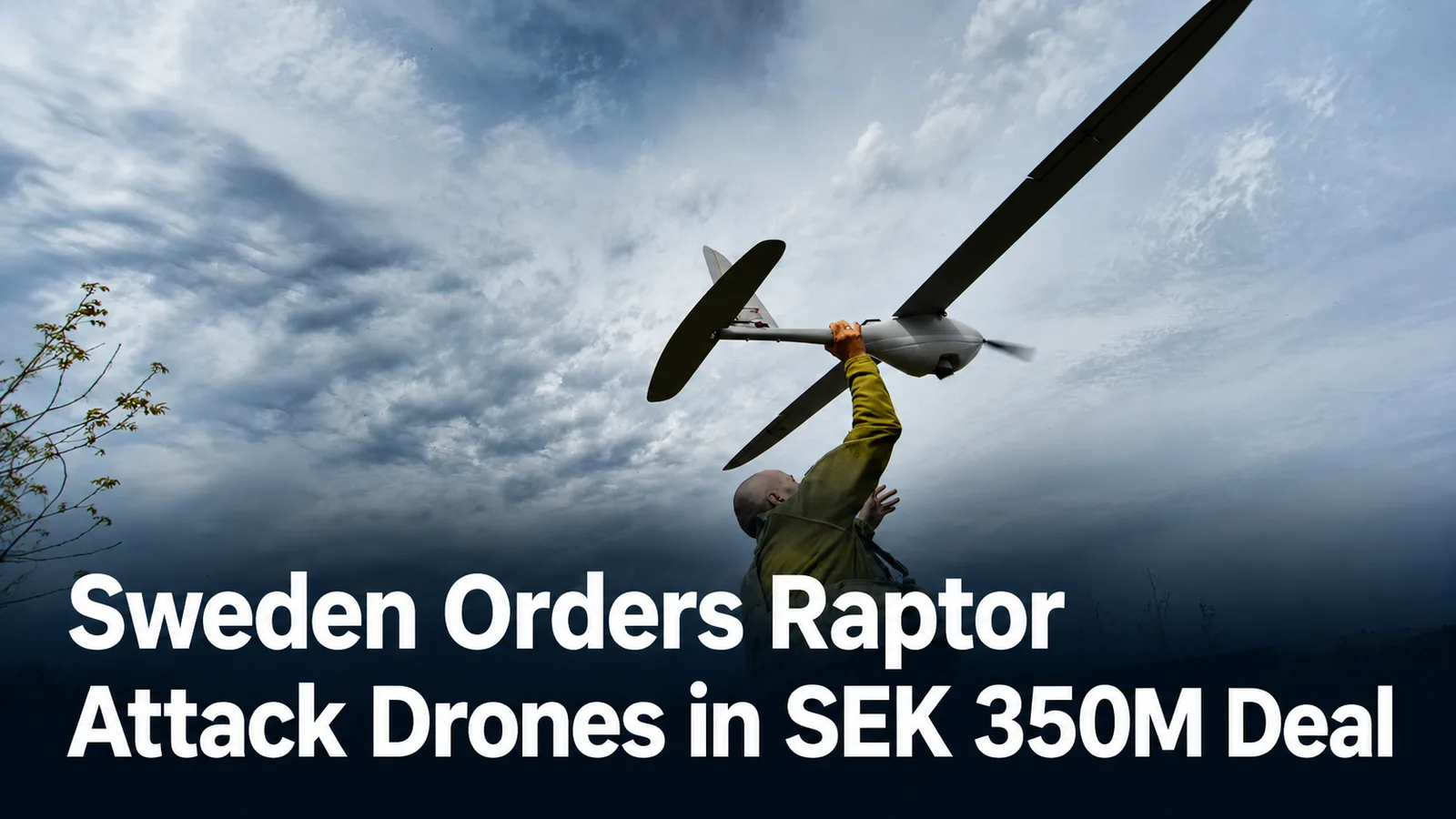
Sweden Raptor drone procurement has opened a new chapter for the Swedish Armed Forces, with the Swedish Defence Materiel Administration ordering an integrated reconnaissance and loitering-munition system from Danish manufacturer Nordic Wing for approximately SEK 350 million.
FMV announced the procurement on 19 August 2026. The package combines Nordic Wing’s ASTERO intelligence, surveillance and reconnaissance UAV with the company’s RAPTOR one-way attack system, allowing one aircraft to locate and monitor targets while one or more strike drones can be assigned against them.
The acquisition matters because it gives Swedish ground forces a dedicated long-range uncrewed strike capability rather than simply adding another reconnaissance drone. Initial deliveries are scheduled for 2027, while Swedish officials have already described the procurement as a first step toward a more diverse future inventory of unmanned systems informed heavily by lessons from the war in Ukraine.
Key Facts
- Contract value: Approximately SEK 350 million.
- Supplier: Nordic Wing ApS of Denmark.
- Systems: ASTERO ISR reconnaissance UAV and RAPTOR loitering munition/attack drone.
- Delivery: Initial systems are scheduled to reach the Swedish Armed Forces in 2027.
- Operational concept: ASTERO provides reconnaissance and target information while RAPTOR provides the strike component.
- RAPTOR range: Nordic Wing publishes a maximum range of up to 200 km; the final Swedish configuration has not been fully disclosed.
- Support package: Control equipment, training simulators and specialised field-maintenance workshop containers are included.
Sweden Buys Its First Dedicated Attack-Drone System
The procurement represents a capability change rather than a routine expansion of Sweden’s existing drone fleet.
Swedish forces already operate unmanned aircraft for reconnaissance, surveillance and other support missions. The new Nordic Wing procurement adds a purpose-built one-way attack capability able to engage targets well beyond the immediate tactical contact line.
SVT reported on 19 August 2026 that the SEK 350 million contract had been signed earlier that week and described the acquisition as the first time the Swedish Armed Forces would receive this class of attack drone.
Jonas Lotsne, FMV’s head of army materiel, characterised the acquisition as the opening of a new chapter for Sweden’s armed forces.
The significance lies in connecting reconnaissance and strike inside the same relatively lightweight system architecture.
ASTERO Provides the Eyes, RAPTOR the Strike Layer
The procurement is designed as a paired reconnaissance-and-effects system.
ASTERO performs the ISR role, locating, observing and supporting identification of battlefield activity.
RAPTOR then provides the long-range one-way strike component.
FMV’s concept therefore resembles an organic reconnaissance-strike complex rather than two unrelated drone purchases.
A reconnaissance aircraft can remain available to search a wider area and maintain situational awareness without sacrificing itself during every engagement, while the loitering munition can be committed only when an appropriate target is identified.
This separation can preserve higher-quality ISR coverage while giving the unit a responsive precision-strike option.
RAPTOR Offers a Reported 200 km Strike Radius
Nordic Wing markets RAPTOR as a hand-launched fixed-wing one-way attack UAV with a range of up to 200 km.
The company presented the system publicly during DALO Industry Days 2026 and describes it as capable of operating together with ASTERO for coordinated reconnaissance and strike missions.
The manufacturer also states that the architecture is designed for operations in GNSS-denied or degraded environments and supports coordination between multiple unmanned platforms.
Those claims are relevant to the Swedish requirement because electronic warfare resilience has become a central design factor for tactical UAVs.
However, the 200 km figure is a manufacturer-published maximum. FMV has not publicly released a complete performance specification for the exact configuration entering Swedish service.
The quantity of RAPTOR munitions purchased has also not been publicly disclosed.
ASTERO Gen 4 Brings Four-Hour ISR Endurance
The reusable reconnaissance component is considerably different from the strike vehicle.
Nordic Wing lists ASTERO ISR as a man-portable fixed-wing aircraft weighing approximately 4.5 kg with up to four hours of endurance.
The aircraft is hand-launched and can recover through deep-stall or belly-landing procedures.
Manufacturer information for the latest generation highlights GPS-denied navigation software, jamming-resistant radio systems and anti-jamming hardware.
The company also offers electro-optical and infrared payloads supporting real-time imagery, object tracking and geolocation.
Nordic Wing says ASTERO has been used in Ukraine since early 2023, providing the manufacturer with battlefield feedback for subsequent product development.
Ukraine Is Directly Shaping Swedish Procurement
Swedish military officials make little attempt to separate the procurement from lessons generated by the war in Ukraine.
Ukraine has demonstrated how drones can compress the reconnaissance-to-strike cycle at tactical level, allowing comparatively small units to detect, track and engage high-value targets over increasingly long distances.
It has simultaneously demonstrated how rapidly specific drone technologies become vulnerable to electronic warfare, interception and tactical adaptation.
This explains why Sweden does not intend to standardise its entire future unmanned-force structure around one system.
Lennart Widerström, head of the Swedish Land Warfare Centre, told SVT that the Nordic Wing purchase should be viewed as a first step and that Sweden expects to acquire systems from several different suppliers as the technology continues to evolve.
Light Forces Are an Early Operational Priority
The new system is primarily intended for ground formations, with Swedish reporting highlighting light and highly mobile units as early beneficiaries.
This is operationally logical.
Light forces traditionally have fewer organic long-range precision effects than heavy brigades supported by large artillery systems.
A portable reconnaissance-and-loitering-munition package can give those units considerably greater reach without requiring a large launcher vehicle or extensive supporting infrastructure.
The result can be particularly relevant to dispersed Nordic operations, where units may need to cover wide areas while remaining mobile and difficult to target.
The Procurement Includes More Than Aircraft
Sweden is not simply purchasing air vehicles.
The SEK 350 million package also includes the infrastructure required to operate and sustain the system.
SVT reports that the agreement covers control equipment, simulators for training and exercises and specially manufactured workshop containers for field maintenance.
This is important because rapid drone procurement can fail to translate into sustained combat capability if training, repair, batteries, communications equipment and spare parts are treated as secondary considerations.
Nordic Wing itself markets mobile composite-repair workshops intended to return damaged UAVs to service in the field.
The Swedish procurement therefore appears structured around deployable system availability rather than airframe delivery alone.
Quantity Remains Undisclosed
One of the largest remaining information gaps is fleet size.
Neither the publicly available FMV material nor the supporting Swedish reporting reviewed for this article provides a confirmed split between ASTERO reconnaissance aircraft and RAPTOR loitering munitions.
The contract value therefore cannot be converted reliably into a unit price.
The package contains reusable UAVs, expendable munitions, control systems, simulators, maintenance facilities and support equipment, making a simple division of SEK 350 million by an assumed number of drones misleading.
Future deliveries or Swedish Armed Forces unit announcements may provide a clearer indication of operational scale.
Nordic Wing Has Built Its Products Around EW Resilience
Electronic warfare is one of the strongest themes across Nordic Wing’s current product positioning.
The Danish company says ASTERO development has been influenced by close cooperation with Ukrainian formations operating in heavily contested electromagnetic environments.
Updates to Generation 4 included stronger radio capabilities, additional electronic-warfare features and software intended to sustain navigation when satellite positioning is degraded.
Nordic Wing also says its development and manufacturing are based in Denmark and that it prioritises European suppliers for key components.
This gives the Swedish acquisition a second strategic dimension: the system is sourced from another Nordic and NATO country while using a supply-chain model intended to reduce external dependencies.
A Danish Supplier Gains a Major Nordic Reference Customer
The contract is also significant for Nordic Wing.
The Værløse-based company remains considerably smaller than Europe’s established defence primes but has expanded rapidly around demand for battlefield unmanned systems.
Its 2025 financial reporting said ASTERO demand generated record production and delivery volumes and that the company was preparing further production expansion during 2026.
The company also reported that development of RAPTOR followed its approval as a weapons manufacturer.
A Swedish military procurement provides Nordic Wing with an important NATO reference customer close to its domestic production base.
The Nordic Market Is Becoming More Integrated
Sweden’s NATO membership has reinforced an already accelerating trend toward Nordic defence integration.
Sweden, Denmark, Finland and Norway increasingly coordinate procurement, exercises and force planning while operating inside the same Alliance framework.
For smaller and rapidly evolving technologies such as drones, cross-border Nordic sourcing can provide shorter supply chains and easier operational cooperation than relying exclusively on distant suppliers.
The Nordic Wing award is therefore notable not only because Sweden is acquiring an attack drone but because it is doing so from an emerging Danish unmanned-systems producer.
Loitering Munitions Are Becoming Organic Brigade Fires
The wider military trend is increasingly clear: loitering munitions are migrating from specialist experimental organisations into routine land-force structures.
Defence Agenda’s Drone Warfare 2026 assessment identified this shift as one of the most important structural consequences of the Ukraine war.
Reconnaissance UAVs provide persistent tactical visibility, while loitering munitions allow a unit to act on that information without waiting for a separate artillery or aviation engagement.
Sweden’s ASTERO–RAPTOR pairing operationalises that logic at procurement level.
RAPTOR Occupies a Different Class From Small FPV Drones
The Swedish procurement should not be conflated with acquisition of inexpensive short-range FPV quadcopters.
RAPTOR is a fixed-wing long-range system intended to reach much greater operational depth.
That means its cost structure, communications requirements, navigation architecture and target set differ substantially from the small FPV drones now ubiquitous in Ukraine.
Both categories can be important, but they solve different operational problems.
A diverse unmanned inventory may consequently contain very cheap short-range systems alongside more sophisticated long-range reconnaissance and strike aircraft.
The 200 km Class Creates Operational Depth
If the Swedish configuration approaches Nordic Wing’s published 200 km maximum range, RAPTOR would give participating units access to targets substantially beyond conventional close combat.
This opens potential mission sets against command nodes, logistics elements and other high-value military targets located further behind an adversary’s immediate front.
It also increases the importance of reliable target identification and network connectivity because the operator may be geographically distant from the target area.
The strategic value is therefore not range alone. The reconnaissance-strike network must provide sufficiently accurate and timely information for that range to be useful.
Electronic Warfare Will Be the Primary Battlefield Test
The largest operational risk is likely to be the electromagnetic environment.
Long-range unmanned aircraft are exposed to GNSS interference, spoofing and command-link disruption over a substantial portion of their route.
Manufacturers increasingly respond through inertial navigation, alternative navigation methods, stronger datalinks and onboard autonomy.
Nordic Wing specifically markets both ASTERO and RAPTOR around degraded-navigation and electronic-warfare resilience.
Those capabilities will need to be demonstrated against realistic threats after the Swedish systems enter service. Manufacturer specifications alone cannot establish effectiveness against a capable adversary’s evolving jamming systems.
Drone Obsolescence Is Driving a Multi-Vendor Strategy
Swedish officials have also acknowledged a procurement problem unique to rapidly evolving unmanned systems: technological obsolescence.
A conventional military platform can remain broadly stable for years between upgrades. Battlefield drone technology can change significantly within months.
Software, radio frequencies, navigation methods, sensors and countermeasures evolve in response to enemy adaptation.
That argues against purchasing enormous quantities of one frozen configuration and storing them for extended periods.
Sweden’s stated intention to procure several different drone systems suggests a portfolio approach in which capability can be refreshed incrementally as technology changes.
The Procurement Mirrors a Wider European Shift
Sweden is not alone in moving loitering munitions toward larger inventories.
European and NATO armies are increasing investment in one-way attack drones as the distinction between artillery, missiles and unmanned aviation becomes less rigid.
Defence Agenda has tracked similar developments in STM’s ALPAGU deliveries and the emergence of much longer-range systems such as Baykar’s MIZRAK loitering munition.
The systems occupy different weight and range classes, but the underlying procurement logic is similar: armies increasingly want organic precision effects that can search, wait and engage within a digitally connected battlefield.
Counter-UAS Investment Will Grow in Parallel
The expansion of Swedish offensive drone capability is occurring alongside rapid investment in drone defence.
On 2 April 2026, FMV ordered a mobile modular counter-UAS system from Saab for approximately SEK 2.6 billion, with deliveries scheduled for 2027–2028.
The two procurements illustrate the emerging two-sided drone economy.
Sweden needs inexpensive and scalable ways to employ unmanned systems offensively while simultaneously building layered sensors and effectors able to defeat equivalent threats.
The cost curve between drones and their countermeasures will remain a major force-design issue throughout this decade.
Implications / Next
The first milestone will be delivery during 2027. That will move the procurement from contract award into unit-level introduction, training and tactical development.
The second is fleet quantity. FMV has not publicly disclosed how many ASTERO aircraft or RAPTOR munitions are included in the SEK 350 million package.
The third is operational allocation. Light and highly mobile ground formations are expected to be an early focus, but subsequent deliveries could broaden the system across additional Swedish Army units.
The fourth is electronic-warfare testing. Actual operational resilience in GNSS-denied and heavily jammed environments will be more important than nominal maximum range.
The fifth is follow-on competition. Swedish officials explicitly expect several unmanned systems from different suppliers rather than one platform dominating the future inventory.
Finally, procurement scale will determine whether RAPTOR becomes a specialist deep-strike asset or a routinely available battlefield munition. A first contract establishes the capability; recurring production orders would indicate that Sweden intends to build meaningful wartime mass.
Conclusion
Sweden’s SEK 350 million Nordic Wing order is significant because it adds an offensive element to an unmanned-aircraft inventory previously centred primarily on reconnaissance and surveillance.
ASTERO provides the persistent ISR layer. RAPTOR gives participating ground units a one-way precision-strike system with manufacturer-published reach of up to 200 km. Control systems, simulators and mobile repair infrastructure turn the purchase into a complete deployable capability rather than an airframe-only transaction.
The procurement also shows how rapidly Ukraine is changing European force structure. Sweden is not waiting for one perfect unmanned system to mature before fielding a capability. It is buying an existing Nordic platform, planning rapid delivery and already signalling that other systems will follow.
The unresolved questions are scale and resilience. FMV has not disclosed the number of aircraft or loitering munitions, while operational performance under intense electronic warfare will only become clear through training and field use.
Nevertheless, the direction is unambiguous. From 2027, Swedish light ground forces are expected to gain an organic reconnaissance-and-strike capability able to reach far beyond their immediate tactical frontage — establishing the first layer of what is likely to become a much larger Swedish unmanned warfare portfolio.
Further Reading
- FMV: Sweden Purchases Reconnaissance and Loitering-Munition Systems
- SVT: Swedish Armed Forces to Receive Attack Drones in 2027
- Nordic Wing: ASTERO ISR
- DALO Industry Days: Nordic Wing RAPTOR
- Defence Agenda: Drone Warfare 2026 — AI, Robots and Swarms
- Defence Agenda: MIZRAK Loitering Munition
- Defence Agenda: STM Completes ALPAGU Loitering Munition Deliveries
- Defence Agenda: MKE Unveils Next-Generation Loitering Munitions