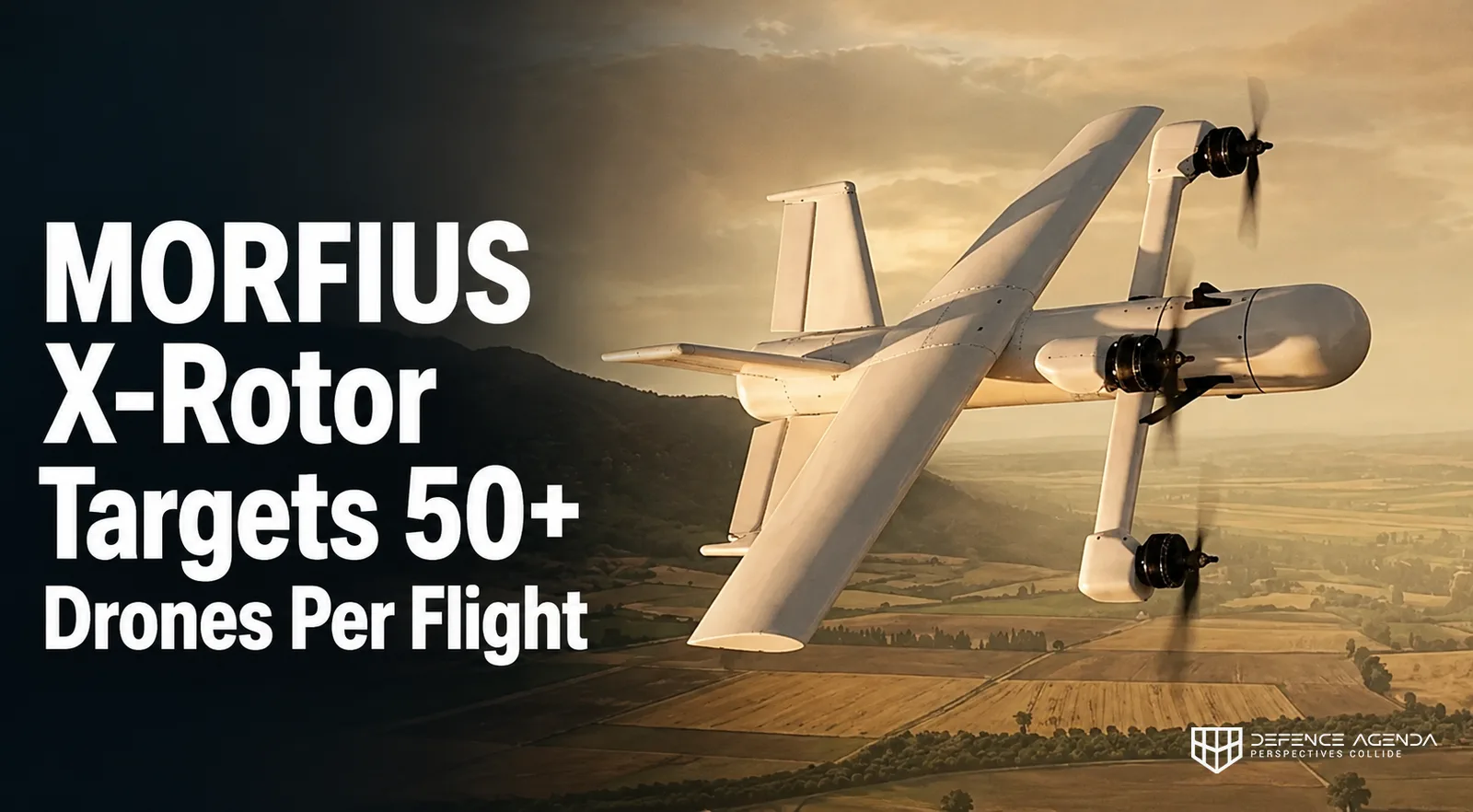
MORFIUS X-Rotor is taking Lockheed Martin’s high-power microwave counter-drone concept toward a reusable operational architecture, with the company claiming the airborne system can neutralise more than 50 hostile drones during a single flight.
The system is intended to address one of the hardest problems in modern air defence: how to defeat large numbers of relatively inexpensive unmanned aircraft without consuming an equally large number of costly kinetic interceptors. Lockheed Martin describes MORFIUS X-Rotor as a ground-launched, recoverable and reusable airborne high-power microwave, or HPM, system built around a “one-to-many” engagement model.
The latest configuration has drawn renewed attention following The War Zone’s examination of MORFIUS. The underlying programme, however, has been evolving for years through Army, DARPA and Lockheed Martin counter-UAS work rather than appearing as an entirely new technology in 2026.
Key Facts
- Developer: Lockheed Martin Missiles and Fire Control.
- Configuration: MORFIUS X-Rotor, unveiled publicly on 20 July 2026.
- Effector: Airborne high-power microwave counter-UAS payload.
- Claimed capacity: Lockheed Martin says the system can neutralise more than 50 hostile drones in one flight.
- Reuse: Designed for field recovery and reuse rather than destruction after every engagement.
- Integration: Lockheed Martin describes MORFIUS as sensor- and command-and-control-agnostic and says it does not require a dedicated fire-control radar.
- Status: Prototype production is being accelerated, with further flight testing planned after trials in Arizona, California and Oklahoma.
MORFIUS X-Rotor Changes the Counter-UAS Exchange Ratio
The most important feature of MORFIUS is not simply that it uses directed energy.
Its more consequential design objective is to break the traditional one-interceptor-per-target relationship.
Conventional air defence normally requires an individual projectile or missile to be assigned to each incoming target. That model becomes economically and logistically difficult when the threat consists of dozens or hundreds of inexpensive drones.
A reusable airborne HPM system potentially changes that calculation because the same platform can create electronic effects against multiple unmanned aircraft during one sortie.
Lockheed Martin is explicitly marketing MORFIUS as a “one-to-many” system, saying the X-Rotor configuration can deliver more than 50 drone defeats per flight.
The figure is a manufacturer claim rather than an independently published operational test result. The company has not publicly disclosed the precise target mix, engagement geometry or conditions under which the 50-plus figure was established.
High-Power Microwave Attacks the Electronics, Not the Airframe
MORFIUS differs fundamentally from an interceptor drone that physically collides with its target or carries an explosive warhead.
High-power microwave systems use electromagnetic energy to produce effects against electronic components and systems.
For a drone, the vulnerable functions may include flight electronics, communications, navigation or other electronic subsystems. The precise effect depends on the target architecture and the HPM system involved.
The attraction for counter-swarm operations is that the effector does not necessarily need to achieve a physical collision with every target.
This potentially allows one airborne system to engage multiple closely spaced threats and then return for recovery.
The X-Rotor Is Designed to Be Recovered
Reusability is the second major element of Lockheed Martin’s 2026 configuration.
Lockheed Martin said on 20 July 2026 that MORFIUS X-Rotor is designed for field recovery and reuse.
That matters because many emerging interceptor drones are themselves expendable. Even when cheaper than a conventional surface-to-air missile, an interceptor that is destroyed during every engagement still creates a recurring inventory burden.
A recoverable MORFIUS instead moves part of the counter-UAS cost equation toward sortie generation, maintenance and electrical-energy replenishment.
The actual lifecycle cost has not been publicly disclosed, so claims of a low cost per kill should remain understood as manufacturer positioning until procurement and operational data become available.
MORFIUS Does Not Depend on a Dedicated Fire-Control Radar
Lockheed Martin also describes MORFIUS as sensor- and command-and-control-agnostic.
The company says the system can work with different command-and-control architectures and does not require a unique fire-control radar to guide it through an engagement.
This is potentially important for layered air defence.
Counter-UAS buyers increasingly want effectors that can plug into existing radar, electro-optical and command networks rather than requiring a dedicated sensor stack for every weapon.
An open integration approach can also allow one sensor network to assign different threats to guns, missiles, electronic warfare, lasers, interceptor drones or HPM systems depending on target type and engagement economics.
The Programme Has Been Flying Since 2017
MORFIUS X-Rotor is the latest stage of a longer development programme.
Lockheed Martin says earlier MORFIUS variants have been flying since 2017.
The system became publicly associated with U.S. Army counter-swarm work several years ago through the Mobile Radio Frequency-Integrated Unmanned Aircraft System Suppressor, Tube-Launchable, or MORFIUS-TL.
In 2020, the U.S. Army Rapid Capabilities and Critical Technologies Office said it was evaluating MORFIUS-TL as a high-power microwave counter-UAS interceptor for on-the-move counter-swarm operations.
The evaluation programme included progressively more demanding demonstrations culminating in soldier-operated field testing.
DARPA Used MORFIUS in Mobile Force Protection
MORFIUS was also integrated into DARPA’s Mobile Force Protection programme.
The War Zone reported in June 2021 that DARPA had demonstrated MORFIUS as one of several interceptor options inside the MFP architecture.
The programme was designed to protect mobile forces against unmanned aircraft while allowing different sensors and interceptors to operate under a common command architecture.
That earlier work is directly relevant to Lockheed Martin’s current emphasis on sensor and command-system independence.
The strategic concept has remained consistent: MORFIUS should function as one effector inside a layered counter-UAS network rather than as a completely stand-alone air-defence system.
Prototype Production Is Now Accelerating
The 2026 development phase moves the programme closer to potential operational procurement.
Lockheed Martin says it is accelerating prototype production of both MORFIUS and its HPM payload.
The company is also planning another series of flight tests following recent work in Arizona, California and Oklahoma.
Those trials examined flight, intercept and lethality conditions, according to Lockheed Martin.
No publicly released schedule currently establishes when MORFIUS X-Rotor will enter formal service, how many systems will be procured or which U.S. military service would become the first operational customer.
The next test campaign should therefore be treated as a programme-maturity indicator rather than evidence that full operational fielding has already occurred.
Why an Airborne HPM Effector Matters
Many directed-energy counter-UAS systems are ground based.
Putting the HPM effector on an airborne platform changes the engagement geometry.
A mobile interceptor can potentially move closer to the threat rather than requiring the electromagnetic effect to be generated entirely from the defended asset.
It can also reposition as the swarm moves and extend the defensive layer beyond the immediate perimeter of a base, convoy or high-value installation.
The trade-off is that the microwave payload must fit inside the size, weight and power limits of an unmanned aircraft while still providing useful military effect.
That compactness challenge is one of the reasons MORFIUS has drawn attention since its earlier demonstrations.
Counter-Swarm Defence Needs One-to-Many Effectors
Mass drone attacks are increasingly creating saturation problems for traditional air-defence systems.
A radar may be able to detect dozens of incoming threats, but the defensive architecture still needs enough effectors to deal with them.
Missiles remain essential against larger or more capable targets, but firing premium interceptors against large numbers of inexpensive UAVs can produce an unsustainable cost exchange.
Defence Agenda has previously examined how the drone cost-exchange ratio is reshaping air defence procurement. Sustainable architectures increasingly require low-cost guns, electronic warfare, interceptor drones and directed-energy systems below the conventional missile layer.
MORFIUS fits directly into that lower-cost, high-capacity defensive logic.
Directed Energy Solves a Different Problem Than Interceptor Drones
The counter-drone market is currently developing several competing approaches.
Interceptor drones physically attack another UAV. Electronic warfare attempts to disrupt navigation or communications. Guns and missiles provide kinetic defeat. Lasers concentrate energy on individual targets. HPM systems instead aim to create electromagnetic effects against electronic systems.
These technologies should not be viewed as mutually exclusive.
Each has different advantages depending on range, target type, weather, collateral constraints, available energy and the size of the incoming raid.
Defence Agenda’s coverage of the STM TUNGA-X interceptor UAV illustrates the alternative drone-on-drone approach, where a high-speed unmanned platform physically engages a hostile aircraft.
MORFIUS instead represents a drone carrying a non-kinetic directed-energy effector.
Türkiye Is Pursuing the Same Layered Counter-UAS Logic
The broader trend is also visible outside the United States.
ASELSAN’s expanded Steel Dome counter-UAS layer combines electronic warfare, interceptor drones, lasers and high-power electromagnetic systems.
Defence Agenda reported that the ASELSAN Steel Dome package includes EJDERHA 210, which uses high-power electromagnetic energy against mini and micro UAV threats, alongside kinetic and laser-based effectors.
The convergence is significant.
Major counter-UAS architectures are increasingly moving away from the idea of finding one universal “drone killer.” Instead, they are combining multiple effectors and allowing command-and-control software to select the most appropriate response.
NATO Demand Is Creating a Large Counter-UAS Market
The procurement environment is also becoming more favourable for systems such as MORFIUS.
At the NATO Summit Defence Industry Forum on 7 July 2026, Allies announced plans for more than $40 billion in counter-drone investment over five years.
Defence Agenda analysed the initiative in NATO Counter-Drone Capabilities Get $40bn Investment.
The investment cycle is expected to cover sensors, command systems, electronic warfare, kinetic interceptors and directed-energy technologies.
A mature reusable airborne HPM system would therefore enter a market where Allied demand is increasingly driven by swarm resilience and cost per engagement rather than simply maximum interception range.
HPM Has Advantages but Is Not a Universal Solution
The one-to-many engagement model is attractive, but HPM should not be interpreted as a universal counter-drone solution.
Drone electronics differ significantly in architecture, shielding, redundancy and vulnerability.
The electromagnetic environment, target spacing and engagement geometry can also affect how useful any directed-energy approach is in practice.
Another issue is battle damage assessment. A kinetic interceptor normally provides a visible physical outcome, while electronic defeat may require sensors to determine whether the target has actually lost mission capability.
This reinforces the need for MORFIUS to operate inside a wider sensor and command architecture capable of tracking the engagement before and after the HPM effect is applied.
The 50+ Drone Claim Needs Operational Context
Lockheed Martin’s headline figure of more than 50 drone kills per flight is commercially significant, but buyers will need considerably more detail during evaluation.
Relevant metrics will include the types of drones defeated, environmental conditions, probability of effect, sortie duration, recovery rate, recharge and turnaround requirements and performance against increasingly resilient electronics.
None of those parameters has been fully disclosed in the public information reviewed for this article.
The 50-plus figure should therefore be treated as Lockheed Martin’s stated performance claim rather than a complete independently verified operational specification.
Reusability Could Be MORFIUS’ Biggest Procurement Advantage
If demonstrated reliably, recoverability may ultimately prove as important as HPM performance.
Counter-UAS forces increasingly need systems that can sustain repeated engagements over hours or days without rapidly exhausting magazines.
Traditional missile batteries carry a finite number of interceptors. Kinetic interceptor drones also require replacement after each successful engagement if they are destroyed with the target.
A reusable MORFIUS could theoretically generate repeated defensive sorties from a smaller inventory.
The procurement calculation would then depend on reliability, maintenance burden, turnaround time and the durability of the HPM payload rather than simply the purchase price of one interceptor.
The Main Programme Risk Is Moving From Demonstration to Field Reliability
MORFIUS has a long test history, but the most difficult phase for many directed-energy programmes is transition from successful demonstrations to repeatable operational performance.
Military users will expect the system to function under heat, dust, wind, electromagnetic interference, transportation shock and repeated launch-and-recovery cycles.
The system also has to integrate into existing air-defence command structures quickly enough to react to short-warning drone raids.
Lockheed Martin’s accelerated prototype-production campaign suggests the programme is now focused on reducing these integration and fieldability risks.
Implications / Next
The next programme milestone will be Lockheed Martin’s upcoming flight-test series.
Those trials should provide a clearer indication of whether the X-Rotor configuration can repeatedly combine launch, autonomous flight, target interception, HPM effects and field recovery inside one operational cycle.
The second indicator will be customer involvement. A formal U.S. military evaluation, procurement award or programme-of-record decision would mark a more significant transition than additional company-funded demonstrations.
The third is integration. MORFIUS’ sensor-agnostic positioning will be most valuable if the system demonstrates rapid connection to multiple radar and command-and-control architectures.
The fourth is cost data. Procurement agencies increasingly evaluate counter-UAS systems around cost per successful engagement and magazine depth, not merely technical performance.
Finally, the system will need to demonstrate effectiveness against evolving drone electronics rather than a static target set. Counter-UAS is an adaptation race, and attackers will increasingly design unmanned systems with electronic resilience in mind.
Conclusion
MORFIUS X-Rotor represents a different approach to counter-swarm economics.
Instead of assigning an expendable interceptor to every incoming drone, Lockheed Martin is attempting to send a reusable unmanned aircraft toward the threat and use an HPM payload to create effects against multiple targets during one sortie.
The company’s claim of more than 50 drone defeats per flight is the headline metric, but the more important attributes may ultimately be reuse, sensor independence and integration into existing command architectures.
MORFIUS also illustrates where layered counter-UAS defence is heading. Missiles, guns, jammers, lasers, interceptor drones and HPM weapons are increasingly being treated as complementary effectors rather than competing stand-alone solutions.
The key question is now whether the X-Rotor can move from years of technology demonstration into a repeatable field capability whose cost, reliability and engagement capacity remain attractive under operational conditions.
For further Defence Agenda coverage, read NATO Counter-Drone Capabilities Get $40bn Investment, ASELSAN Steel Dome Adds New C-UAS Layer, STM TUNGA-X Drone Debuts and Army’s 2026 Counter-Drone Laser Competition.
Further Reading
- The War Zone: Meet MORFIUS, the Drone Designed to Zap Other Drones
- Lockheed Martin: MORFIUS X-Rotor Counter-Drone System
- Lockheed Martin: MORFIUS Counter-Swarm Technology
- U.S. Army: MORFIUS-TL Counter-UAS Prototype Evaluation
- Defence Agenda: NATO Counter-Drone Capabilities Get $40bn Investment
- Defence Agenda: ASELSAN Steel Dome Adds New C-UAS Layer
- Defence Agenda: STM TUNGA-X Drone Debuts
- Defence Agenda: Drone Cost-Exchange Ratio Is Rewriting War