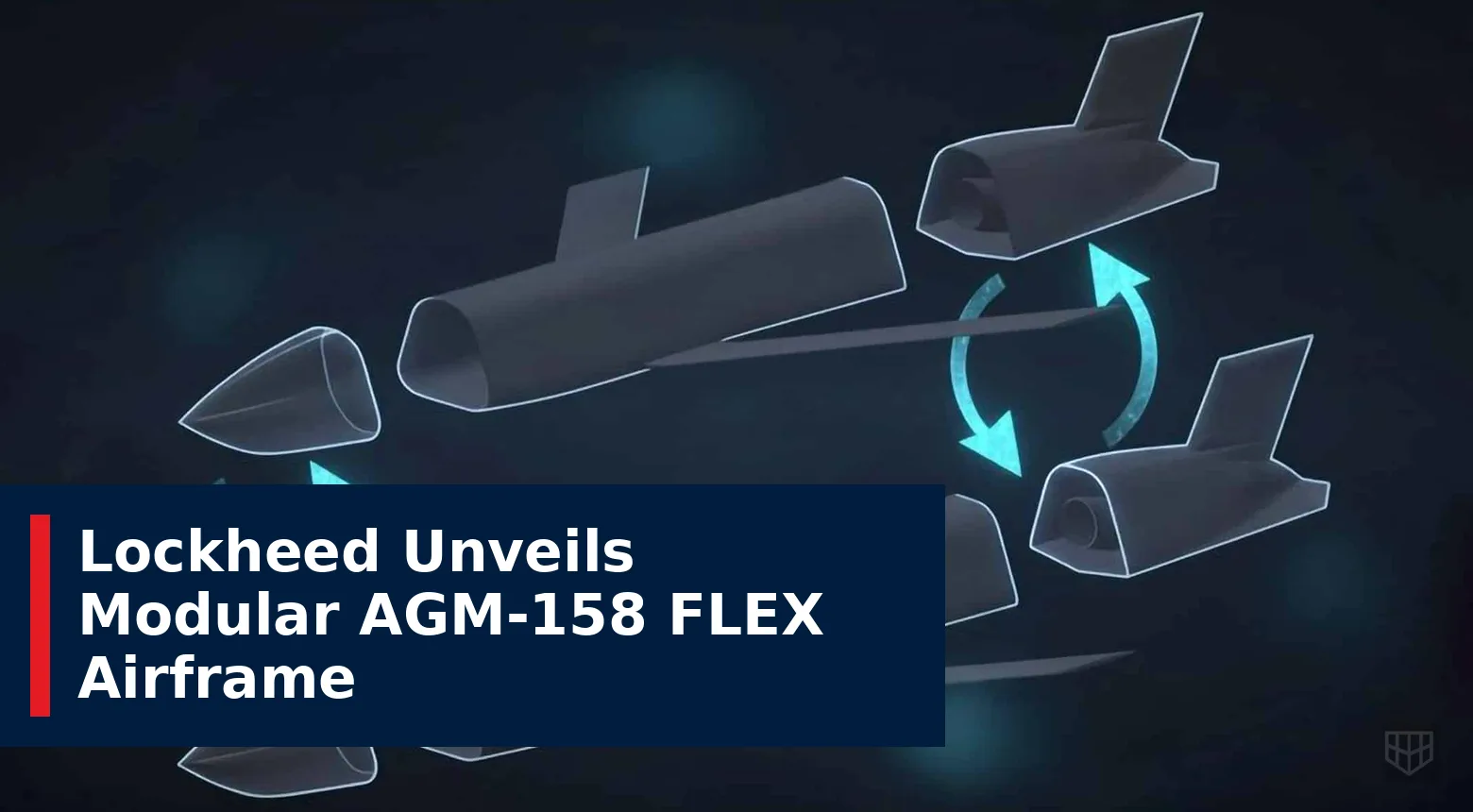
Lockheed Martin has introduced AGM-158 FLEX, a modular airframe concept intended to support multiple JASSM-family configurations and launch methods.
A modular architecture for AGM-158
Lockheed Martin has introduced AGM-158 FLEX, a modular airframe concept for the Joint Air-to-Surface Standoff Missile and Long Range Anti-Ship Missile family. The company says it has invested more than $35 million of internal funding in airframe design, testing, prototype production, subsystem qualification and supplier preparation. FLEX is intended to provide a common structural basis from which customers can configure future weapons without beginning each design from a clean sheet.
This is an industrial and engineering concept, not a newly awarded missile programme covering every proposed variant. Lockheed Martin has not announced a customer quantity, service-entry schedule or unit price for a product named AGM-158 FLEX. The first planned implementation is the larger JASSM-XR configuration. Surface-, ground- and submarine-launched applications remain potential uses that require separate development, qualification and procurement decisions.
Interchangeable sections and two lengths
The architecture uses removable nose sections that can accept different sensor or mission packages and a removable boat tail suited to different launch arrangements. Lockheed Martin also describes a 168-inch configuration consistent with JASSM-ER and a 206-inch version associated with JASSM-XR. Common interfaces are intended to allow change without forcing a complete redesign of the airframe or its production process.
Modularity can shorten engineering cycles only when interfaces remain stable and loads are well understood. A new seeker changes mass distribution, cooling and electromagnetic compatibility, while a different boat tail can alter propulsion integration and launch dynamics. Surface or submarine launch also imposes environments unlike aircraft carriage. FLEX may reduce the amount of repeated work, but it cannot remove safe-separation testing, structural analysis or platform certification.
Reusing the JASSM production ecosystem
Lockheed Martin says FLEX will draw on the existing JASSM and LRASM production line, supplier network, mission-planning infrastructure and software ecosystem. That choice is meant to avoid an entirely new industrial base and to make scaling more affordable. The company opened a 225,000-square-foot automated production facility in 2022 as demand for AGM-158-family weapons increased.
Common production can create purchasing leverage and simplify training, but it also concentrates risk. A shared component shortage could affect several weapon variants at once, and configuration management becomes more demanding as customers select different noses, tails, payloads and software. The company will need a production system that preserves commonality while preventing variant-specific changes from disrupting the whole family.
Obsolescence and future launch options
Lockheed Martin presents FLEX as a way to replace obsolete components and introduce new technology without redesigning the complete missile. Previous demonstrations support part of the launch-method argument: LRASM has been tested from a Mk 41 vertical launcher, while JASSM-ER has been deployed through the Rapid Dragon palletised launch system. These events show adaptation potential, but they do not by themselves qualify the new FLEX architecture for those roles.
The next evidence should include flight tests of a FLEX-based JASSM-XR, funded customer configurations and qualification of any alternative launch tail. Production data will show whether common hardware actually reduces cost and lead time. For now, AGM-158 FLEX is a credible company-funded architecture with prototypes and subsystem work behind it, yet most of its promised flexibility remains to be demonstrated in complete, customer-approved weapons.
Editorial assessment
The common-airframe approach may also change how customers buy upgrades. Instead of waiting for a wholly new missile designation, a government could select a sensor, payload or launch module within an established family. That flexibility will require clear airworthiness and configuration rules so that a mixed inventory remains identifiable, supportable and correctly matched to mission-planning data.
JASSM-XR will be the important proof point because it combines the new architecture with a larger airframe. Successful structural and flight testing would validate the core interfaces before more unusual launch methods are attempted. Conversely, major redesign during XR development would indicate that the promised commonality is less mature than the concept currently suggests.