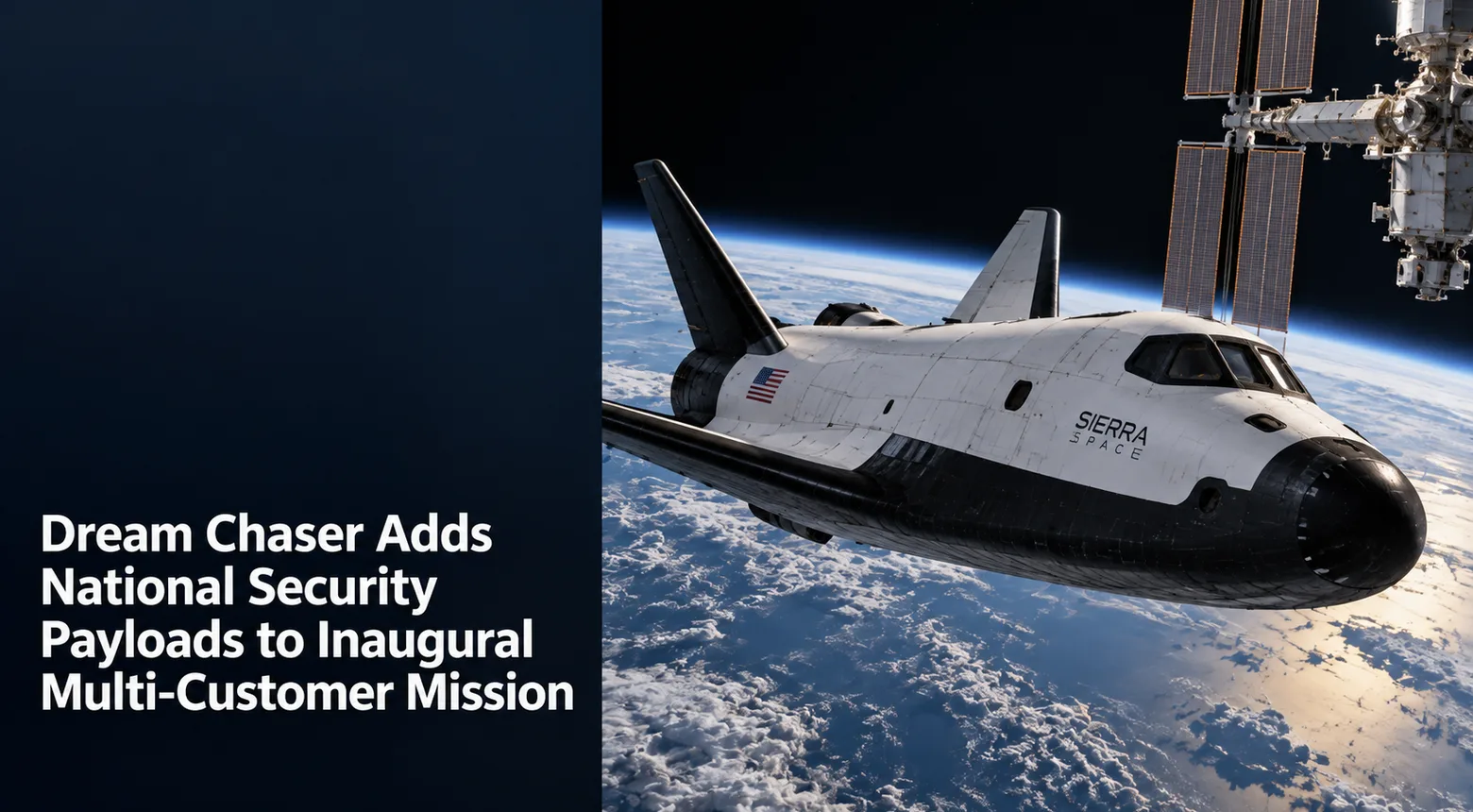
Sierra Space says it has secured contracts to carry undisclosed national-security and commercial payloads on Dream Chaser’s inaugural mission, adding defence-related customers to a flight that is also intended to support civil activity. The company announced the contracts on 2 September 2026 and said it is finalising a manifest that will combine national-security, commercial and civil payloads on one mission.
The change is strategically relevant because Dream Chaser has spent years being framed primarily through NASA cargo-service requirements. A multi-customer inaugural flight would position the reusable lifting-body spacecraft as a broader orbital-transport and test platform from the outset, potentially giving U.S. national-security users another way to place experiments or technology demonstrations in orbit without procuring an entire dedicated mission.
Key Facts
- Sierra Space announced the payload contracts on 2 September 2026.
- The inaugural Dream Chaser mission is planned to serve national-security, commercial and civil customers in one flight.
- The national-security customers and payload details were not disclosed.
- Sierra Space says it is finalising the mission manifest.
- A 25 September 2025 programme update targeted a first free-flight demonstration in late 2026, subject to launch-vehicle availability.
- Dream Chaser is designed for autonomous re-entry and runway landing; performance claims remain manufacturer-stated until demonstrated on the inaugural flight.
Dream Chaser broadens its first mission beyond a single customer
The development is best assessed as a programme milestone rather than a complete operational endpoint. The verified evidence establishes the event described above, while subsequent procurement, integration, readiness or fielding claims require their own confirmation as the programme advances. That distinction is important for comparing announcements across defence programmes, where testing, production, delivery and operational acceptance are separate maturity stages with different evidentiary thresholds.
National-security value is flexibility, but customer details remain undisclosed
Sierra Space has not identified the national-security customers, payload functions, contract values or detailed mission objectives. That limits what can be concluded about the defence significance of the contracts, and the announcement should not be presented as evidence that Dream Chaser has been selected for an operational military space architecture. At this stage, it is a payload-services milestone that expands the customer mix of the first flight.
The company argues that Dream Chaser’s runway-capable recovery, low-g landing environment and autonomous re-entry can support sensitive payload return and rapid access to hardware after landing. Those are manufacturer-stated attributes until the spacecraft completes its first orbital mission, but they could be relevant to experimentation involving materials, sensors, electronics or other payloads that benefit from physical recovery. A reusable spaceplane can also create a different test cadence from expendable capsules if refurbishment and relaunch become routine.
Schedule risk remains the dominant programme variable
Dream Chaser’s first flight has moved through several schedule and mission-profile changes. In September 2025 Sierra Space said it was transitioning the vehicle toward a free-flyer demonstration and targeting late 2026 in coordination with launch-vehicle availability, while continuing to support NASA’s Commercial Resupply Services framework. The 2026 payload announcement strengthens the business case for the inaugural mission but does not remove launch-integration, certification and spacecraft-readiness risks.
The next decisive milestone is therefore not another customer announcement but completion of the launch campaign and successful orbital flight, re-entry and runway landing. Defence customers will be watching whether the vehicle can deliver the promised combination of payload flexibility, on-orbit operations and recoverability on its first mission. Until then, Dream Chaser remains a pre-operational platform with a growing customer manifest rather than a proven national-security transport service.
Implications / Next
The next publication-grade milestone will be the first independently verifiable step that moves the programme beyond the status described here—such as a follow-on test, formal contract action, delivery, operational deployment or completed transaction, depending on the story. Defence Agenda will treat each maturity stage separately and will not infer production, operational capability or procurement completion from an earlier demonstration or announcement. The most useful follow-up evidence will therefore be dated official documentation, customer acceptance, serial-production data or operational activity that can be cross-checked against the current record.