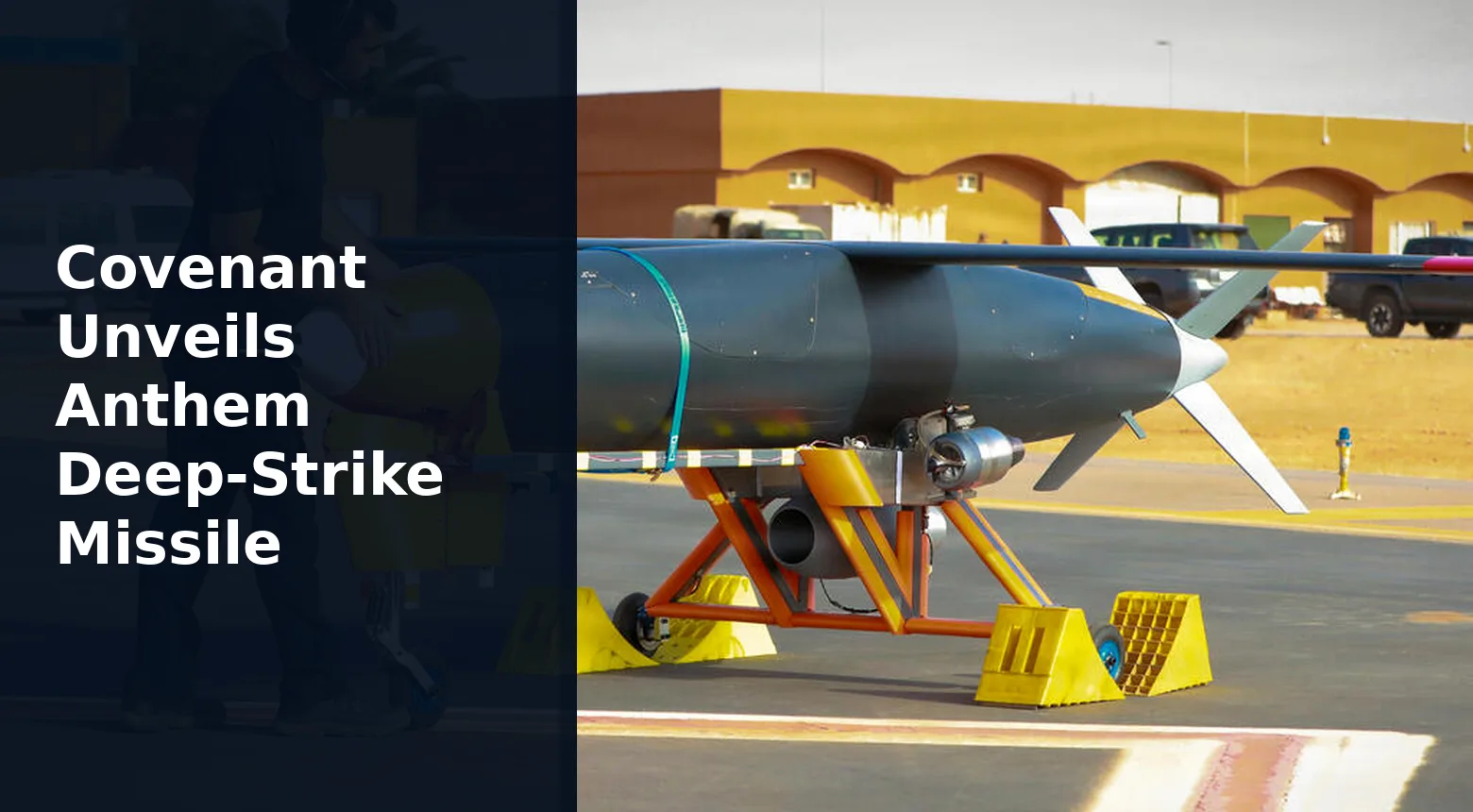
Covenant has publicly unveiled Anthem, a long-range cruise-missile design intended to carry a payload of more than 200 kilograms while using a high proportion of commercially available components. The company reports more than 200 flight tests and plans production in 2027, but no U.S. military programme selection has been announced. Anthem illustrates the push to trade bespoke missile architecture for manufacturability and lower unit cost. Its strategic value will depend on verified range, survivability, production quality and a funded customer rather than the unveiling alone.
The company is pitching a manufacturable deep-strike weapon
Covenant describes Anthem as a heavy-payload, long-range cruise missile designed around commercial supply chains and rapid production. Public reporting places the intended price in the mid-six-figure range, but that figure remains a company target rather than an independently audited procurement cost. A credible comparison must include launcher, mission planning, support equipment and acceptance testing.
Flight-test volume is useful but incomplete evidence
More than 200 reported flights since August 2025 would indicate an unusually rapid development cadence. The public record does not yet provide a complete test matrix, demonstrated range, representative warhead integration or performance under electronic attack. Test count should therefore be treated as evidence of iteration, not proof of combat effectiveness.
Commercial components create both scale and assurance questions
Commercial electronics and manufacturing techniques can shorten lead times and widen the supplier base. They also create requirements for configuration control, trusted sourcing, environmental qualification and cyber assurance. The acquisition challenge is to retain cost and volume advantages without allowing component obsolescence or supply-chain substitution to undermine repeatability.
Interest and orders do not equal a programme of record
Reuters reported company claims of roughly $150 million in orders, while DefenseScoop noted Army interest. Neither establishes an exclusive selection, funded service quantity or operational fielding. Contract type, customer identity, delivery schedule and government acceptance evidence remain the decisive milestones.
Programme and procurement context
This development must be read at its exact maturity level. Covenant has publicly unveiled Anthem, a long-range cruise-missile design intended to carry a payload of more than 200 kilograms while using a high proportion of commercially available components. The company reports more than 200 flight tests and plans production in 2027, but no U.S. military programme selection has been announced. Defence programmes pass through distinct stages: policy announcement, requirement definition, competition, contract, testing, production, delivery, acceptance and operational fielding. Collapsing those stages into a single claim can overstate both near-term military utility and industrial certainty.
For acquisition teams, the decisive evidence is funded scope, customer acceptance, integration responsibility and a supportable schedule. Anthem illustrates the push to trade bespoke missile architecture for manufacturability and lower unit cost. Its strategic value will depend on verified range, survivability, production quality and a funded customer rather than the unveiling alone. Public announcements rarely resolve every dependency. Training, secure data, range access, infrastructure, export approval and supplier capacity can delay useful capability even after a technically successful milestone.
Source discipline is equally important. Company releases naturally emphasise momentum; government notices may describe only funded scope; exercise reports show activity without proving full readiness. Values should be labelled as contract ceilings or estimates when appropriate, performance figures as manufacturer claims until independently demonstrated, and dates as targets unless a customer confirms completion. Later primary records should replace early reporting as the programme matures.
The operational question is not whether the technology can be shown once, but whether users can employ it repeatedly under representative conditions. That requires realistic testing, configuration control, trained personnel, spares and an accountable command chain. Industrial significance also depends on repeatable production and quality assurance rather than prototype output alone.
Implications / Next
Track government contract notices, an identified launch platform, verified range and payload trials, production-line qualification and a funded delivery schedule. Until then, Anthem should be described as a company-developed missile entering the customer-validation phase.
This item remains a draft pending final image-rights review, CMS media assignment and canonical publication data. A later report should be treated as a separate update only if it materially changes the programme status described here.
Further Reading
Hypersonic Missiles vs Layered Defence