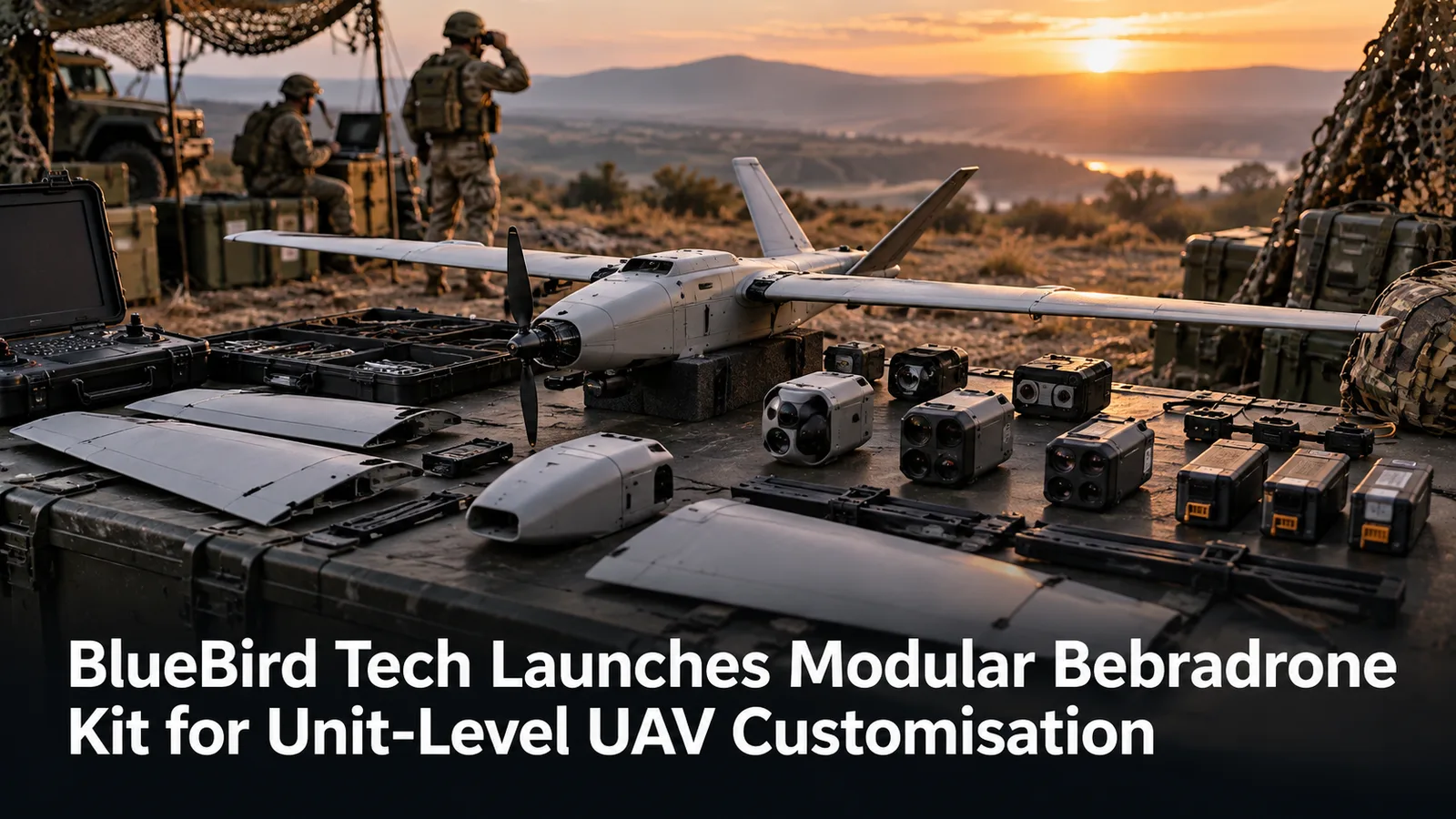
Ukrainian manufacturer BlueBird Tech has launched Bebradrone Kit, a modular fixed-wing UAV platform that allows units to select or install their own communications, video, navigation, flight-control and mission equipment.
The concept is aimed at military teams that already have preferred electronics and do not want to adapt their tactics around a fixed factory configuration.
Modular Architecture and Battlefield Rationale
BlueBird Tech’s Bebradrone Kit is designed around a modular fixed-wing airframe that lets military units choose their own communications, video, navigation, flight-control and mission equipment instead of buying a locked factory configuration. BlueBird offers Base, ARF and Pro build levels: Base provides the structural airframe, ARF adds propulsion and Pro adds a configured ARMADA flight controller, while a custom route allows the company to integrate a customer-specified electronics package. The approach reflects Ukrainian battlefield conditions in which control links, frequencies, cameras, navigation tools and payloads can change faster than the underlying airframe.
That modularity also lets units retain radios, video systems or other electronics they already trust instead of replacing an entire ecosystem whenever the aircraft changes. In an environment shaped by electronic warfare and rapid countermeasure cycles, separating the aerodynamic structure from faster-changing electronics can shorten adaptation time and simplify repair. The trade-off is that there is no single Bebradrone configuration whose performance or resilience can represent every user build.
Performance and Procurement Model
BlueBird publishes a cruise speed of 90 km/h, maximum speed up to 150 km/h, flight time up to 30 minutes, tactical range up to 45 km and payload up to 7.5 kg, with pneumatic-catapult launch. The company explicitly notes that actual performance depends on battery, payload, location, weather, flight mode and the equipment selected by the user, so those figures should be treated as configuration-dependent ceilings rather than guaranteed mission results. The modular kit therefore has to be assessed as a family of builds rather than one fixed military UAS.
UAS Vision reports that military units can submit required specifications, quantity and delivery deadlines through Brave1 Market, which routes requirements to qualified suppliers. That procurement model is designed to shorten the loop between front-line demand and local manufacturing, while the kit’s tiered prices cover different levels of airframe and installed equipment rather than a complete combat system with control station, secure datalink, payload, support equipment and training. Low entry cost is therefore part of the concept, but it is not directly comparable with the price of a fully integrated military UAS package.
Industrial Impact
Bebradrone Kit represents an industrial model shaped by attrition, rapid iteration and field-level modification. Standardising the airframe while allowing electronics and payloads to change independently can make production more repeatable without freezing the system against new jamming threats or unit preferences. If users can replace damaged modules or reconfigure aircraft locally, the concept may also reduce turnaround time between battlefield feedback and the next usable configuration.
Limitations and Counterpoint
No single configuration represents every Bebradrone Kit, so published range, payload, endurance and communications resilience cannot be applied uniformly across all builds. BlueBird says the underlying Bebradrone airframe has combat experience, but the newly packaged kit format should be evaluated by its specific electronics, payload and user configuration. The modular approach improves flexibility, yet it also transfers more integration responsibility to the customer unless BlueBird or another partner performs the final system engineering.
Implications / Next
The next indicators are unit adoption through Brave1, new EW-resistant communications packages and evidence that the modular approach shortens procurement, repair or reconfiguration cycles in combat units. Repeat orders for specific kit levels would show which balance of user customisation and factory integration is proving most useful. Field data may also reveal whether modularity improves survivability against electronic warfare or simply makes replacement and adaptation faster after losses occur.