AFSOC says the AGM-190A Havoc Spear struck two targets during a combat evaluation, advancing a low-cost modular cruise-missile programme.
Two operational test shots
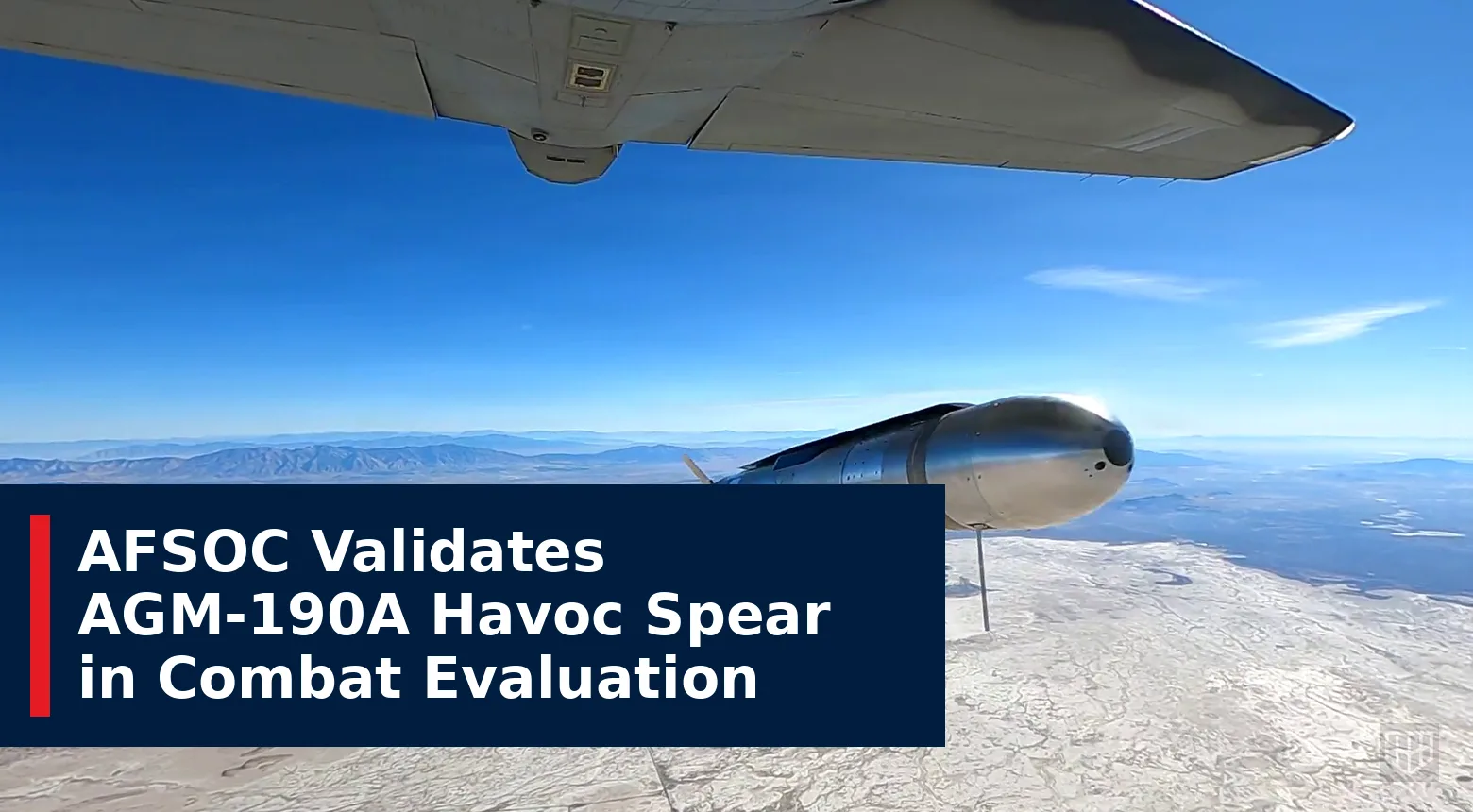
US Air Force Special Operations Command has disclosed that AGM-190A Havoc Spear missiles hit two targets during a combat evaluation conducted in the spring of 2026 in the US Africa Command area of responsibility. Breaking Defense reported that the weapons were launched from an AC-130J Ghostrider. AFSOC described the shots as precise and effective, presenting the event as evidence that the rapidly developed missile can move beyond controlled range activity.
The phrase combat evaluation is important. It indicates that the weapon was employed in an operational environment to collect evidence under realistic conditions, but it does not automatically mean full-rate production, general service entry or clearance on every intended platform. Public reporting did not identify the targets, exact launch conditions, mission route or detailed performance data, and those omissions limit independent assessment.
A modular small cruise missile
Havoc Spear is a mission-adaptable, modular small cruise missile developed through cooperation involving AFSOC and Leidos. Work began under a cooperative research and development agreement in 2022. The concept emphasises a common air vehicle whose payloads, software or mission equipment can be adjusted more quickly than a tightly closed weapon design, allowing the government to respond to different target sets.
Leidos has described the weapon as being in the 200-pound class and capable of flying more than 400 nautical miles. AFSOC has cited a low-rate initial production unit estimate of about $600,000. Both figures are programme statements rather than independently verified operational performance or a final recurring price. Range depends on launch conditions and mission profile, while early-lot prices can change as configuration, quantity and support content mature.
From rapid development to production
US Special Operations Command awarded a $27.2 million action in July 2026 connected with the programme. Reporting indicates that initial low-rate production deliveries are expected around autumn 2027. That schedule leaves work to complete on production-representative configuration, reliability, software, safety certification and the support equipment needed to store, load and employ the missile repeatedly.
Leidos has said its Huntsville facility could support production of up to 15,000 weapons a year. Capacity is not the same as a funded order: output at that scale would require multi-year demand, qualified suppliers, energetic materials, engines, seekers and acceptance testing. The disclosed contract and evaluation demonstrate momentum, but neither establishes that the government has ordered thousands of missiles.
A broader integration ambition
AFSOC wants the design to be usable from more than one aircraft type, and officials have discussed broader application across special-operations and conventional fleets. Each integration will still need safe-separation analysis, carriage hardware, software interfaces, mission planning and flight trials. An AC-130J launch therefore proves one path without confirming compatibility across the entire proposed set of platforms.
The operational case rests on creating useful stand-off reach at a price that permits larger inventories. A smaller cruise missile could be carried in greater numbers or assigned to targets that do not justify a premium weapon, while modularity could shorten adaptation cycles. Its limitations will also matter: payload mass, survivability, navigation in a contested electromagnetic environment and target-recognition performance all shape which missions it can replace or complement.
The next meaningful milestones are repeatable production-representative tests, additional platform releases, an awarded missile quantity and evidence on reliability and cost. The spring engagement is more significant than a routine range firing because it exposes the weapon to operational planning and execution. It should nevertheless be reported as a successful combat evaluation of the current configuration, not as proof that AGM-190A is already a universally fielded cruise missile. Public confirmation of the final seeker, payload and production standard will also be necessary before different trials can be compared on a like-for-like basis.