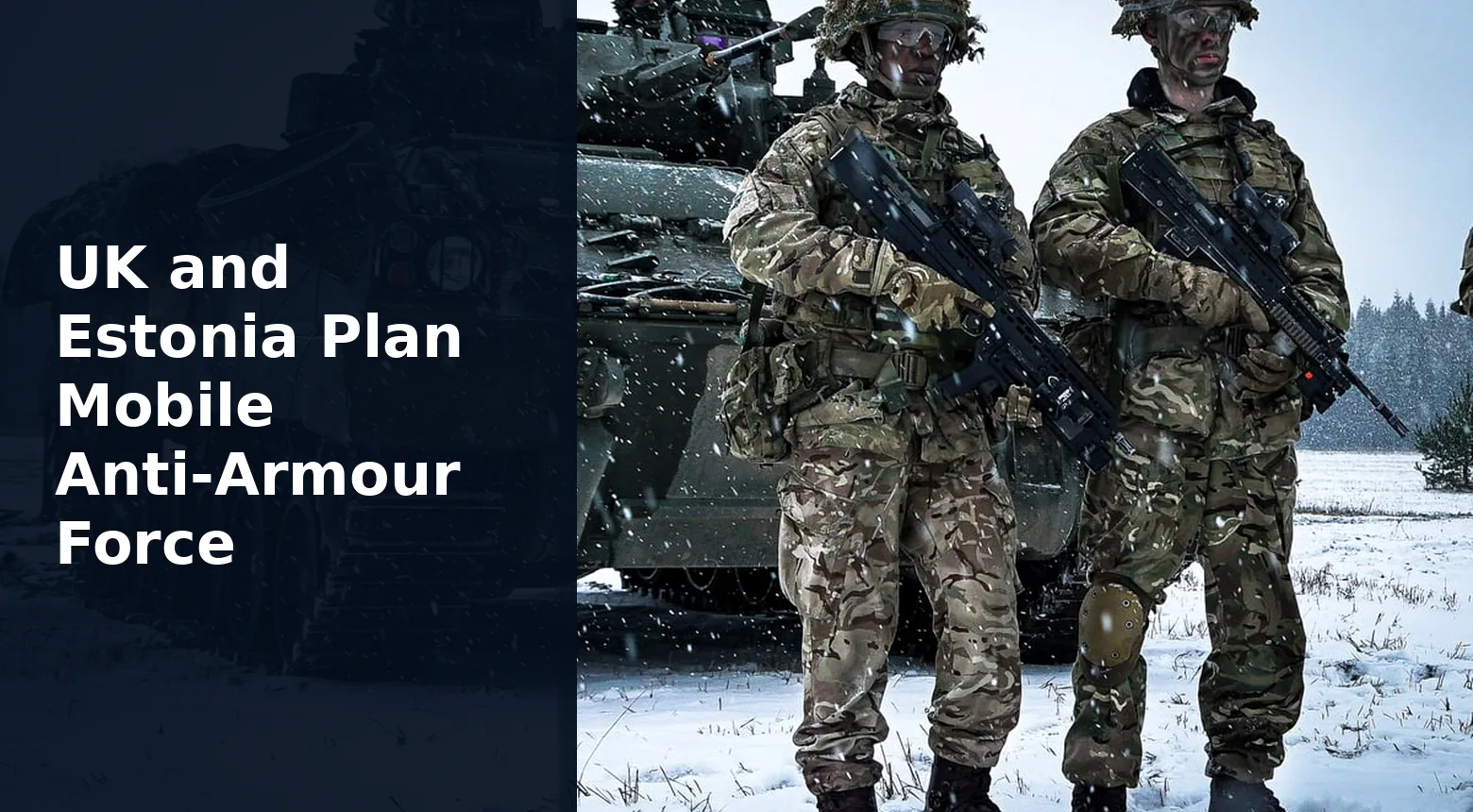
The United Kingdom and Estonia plan to shift the UK’s forward land contribution in Estonia towards a Mobile Anti-Armour Force from April 2027, with the UK presence rising to about 1,200 personnel. The concept combines dispersed troops, drones, digital targeting, anti-tank weapons and longer-range fires; it remains a future force design that must be exercised and validated. The change tests whether a lighter, distributed formation can impose costs on armour while reducing its own signature and mobility burden. It also changes the deterrence signal from a traditional armoured battlegroup to a networked reconnaissance-strike system.
The concept shifts combat mass into a network
The planned force links reconnaissance, uncrewed systems, digital targeting, anti-tank teams and fires rather than concentrating protection and firepower in heavy vehicles. Dispersal can improve survivability and coverage. It also creates greater dependence on communications, navigation and rapid target confirmation.
Mobility and concealment are central assumptions
Small teams can reposition faster and exploit terrain, but they carry less protection and ammunition than armoured formations. The force needs reliable transport, camouflage, electronic discipline and frequent resupply. Exercises must test whether those requirements can be met under persistent drone observation and long-range attack.
The British contribution remains part of an allied structure
The force will operate in Estonia under the bilateral roadmap and wider NATO posture. Estonian terrain knowledge, fires and territorial forces are integral to the concept. Interoperability therefore includes data standards and delegated authorities, not only compatible weapons.
The April 2027 date marks a transition, not proven effectiveness
Increasing the UK presence to about 1,200 personnel and reorganising roles can establish the formation. It cannot demonstrate combat value without demanding exercises and measured results. The new model should be assessed against response time, target-processing speed, survivability and sustained ammunition supply.
Programme and procurement context
This development must be read at its exact maturity level. The United Kingdom and Estonia plan to shift the UK’s forward land contribution in Estonia towards a Mobile Anti-Armour Force from April 2027, with the UK presence rising to about 1,200 personnel. The concept combines dispersed troops, drones, digital targeting, anti-tank weapons and longer-range fires; it remains a future force design that must be exercised and validated. Defence programmes pass through distinct stages: policy announcement, requirement definition, competition, contract, testing, production, delivery, acceptance and operational fielding. Collapsing those stages into a single claim can overstate both near-term military utility and industrial certainty.
For acquisition teams, the decisive evidence is funded scope, customer acceptance, integration responsibility and a supportable schedule. The change tests whether a lighter, distributed formation can impose costs on armour while reducing its own signature and mobility burden. It also changes the deterrence signal from a traditional armoured battlegroup to a networked reconnaissance-strike system. Public announcements rarely resolve every dependency. Training, secure data, range access, infrastructure, export approval and supplier capacity can delay useful capability even after a technically successful milestone.
Source discipline is equally important. Company releases naturally emphasise momentum; government notices may describe only funded scope; exercise reports show activity without proving full readiness. Values should be labelled as contract ceilings or estimates when appropriate, performance figures as manufacturer claims until independently demonstrated, and dates as targets unless a customer confirms completion. Later primary records should replace early reporting as the programme matures.
The operational question is not whether the technology can be shown once, but whether users can employ it repeatedly under representative conditions. That requires realistic testing, configuration control, trained personnel, spares and an accountable command chain. Industrial significance also depends on repeatable production and quality assurance rather than prototype output alone.
Implications / Next
Track the final order of battle, equipment list, exercise outcomes, command relationships and whether the personnel increase is achieved on schedule. Describe the Mobile Anti-Armour Force as a planned and testable concept until operational validation is published.
This item remains a draft pending final image-rights review, CMS media assignment and canonical publication data. A later report should be treated as a separate update only if it materially changes the programme status described here.
Further Reading
ASELSAN NATO VLF OTAM Monitoring Upgrade