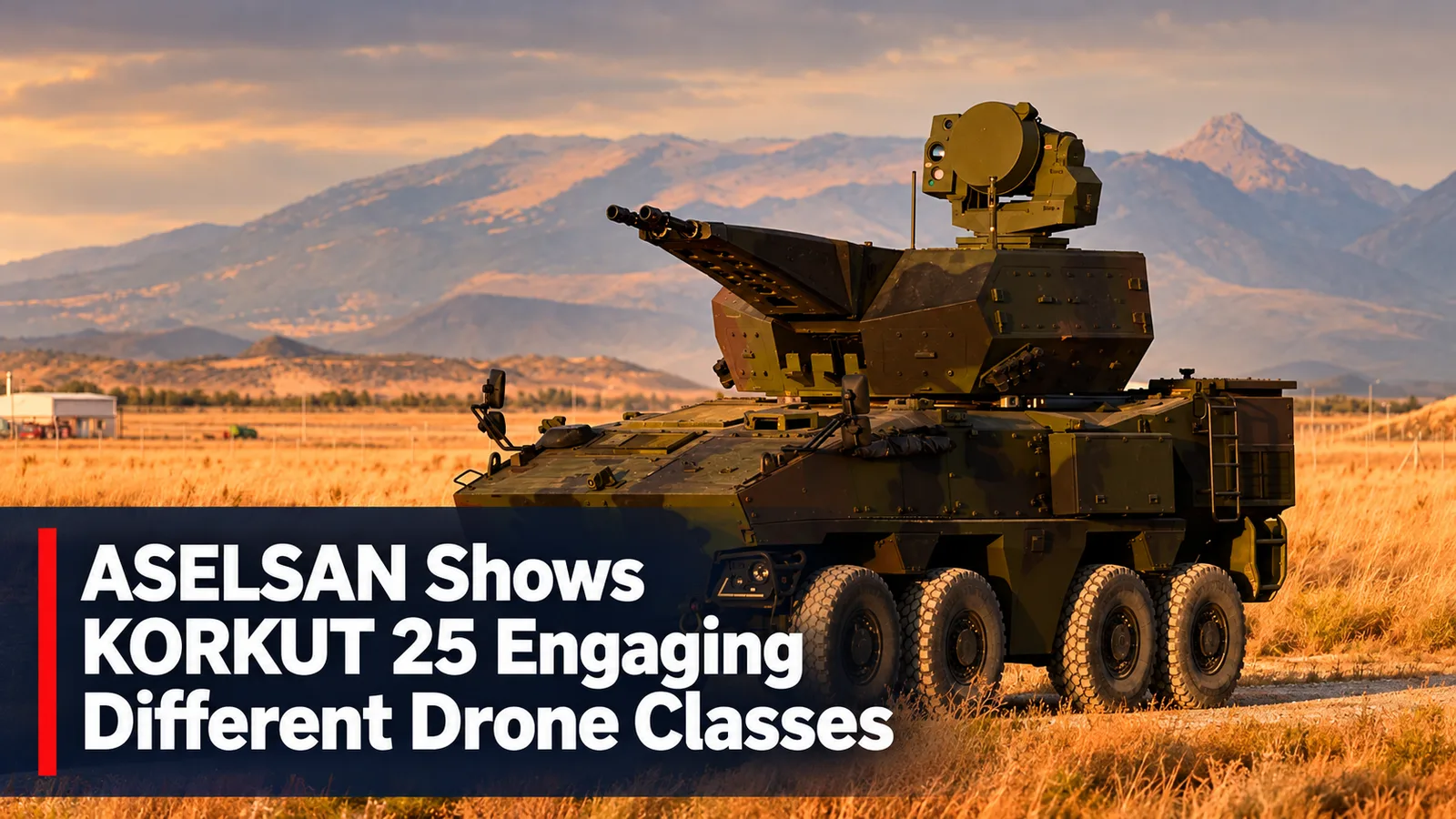
ASELSAN has released KORKUT 25 test footage showing its mobile counter-drone gun system engaging a rotary-wing drone and a Shahed-like delta-wing aerial target with ATOM 25 ammunition. The 12 October 2026 demonstration broadens the visible target examples for Türkiye’s 25 mm close-range air-defence layer. It remains a demonstration of particular engagements rather than a newly announced procurement, military acceptance or fielding milestone.
Two Target Classes Put the Gun-Based Concept on Display
Defence Turk and other Turkish specialist reporting describe footage in which KORKUT 25 engages different uncrewed aircraft profiles. One target is rotary-wing, while another resembles the delta-wing layout of Shahed-type one-way attack drones. Because these targets differ in geometry and flight behaviour, the sequence is more informative than a single stationary drone shoot-down, although published footage alone does not disclose all range and test conditions.
The system is shown installed on a 4×4 tactical vehicle. Reporting also describes firing while the vehicle is moving, a relevant feature for mobile formations that cannot always stop in prepared defensive positions. A mobile demonstration does not automatically confirm the full military firing-on-the-move envelope, however, because speed, terrain, vibration, sightline and fire-control modes may vary across trials.
ATOM 25 Gives the Defender Another Expenditure Option
ASELSAN identifies ATOM 25 programmable airburst ammunition as a central element of the defeat mechanism. A properly timed airburst can place fragments around a small moving target, reducing dependence on a direct shell-to-drone collision. That approach is particularly relevant for low-cost aircraft where firing a sophisticated surface-to-air missile may be economically disproportionate, provided the gun achieves a dependable kill probability.
The company also cites AI-assisted detection and identification, which should be distinguished from autonomous authority to engage. Sensors, classification software and fire control can shorten reaction time, but operators and military rules still govern the use of force. The public material does not disclose ammunition expenditure per target, detailed miss distance, false-alarm rates or the trial’s electronic interference conditions.
KORKUT 25 Is One Layer, Not a Replacement for Every Effector
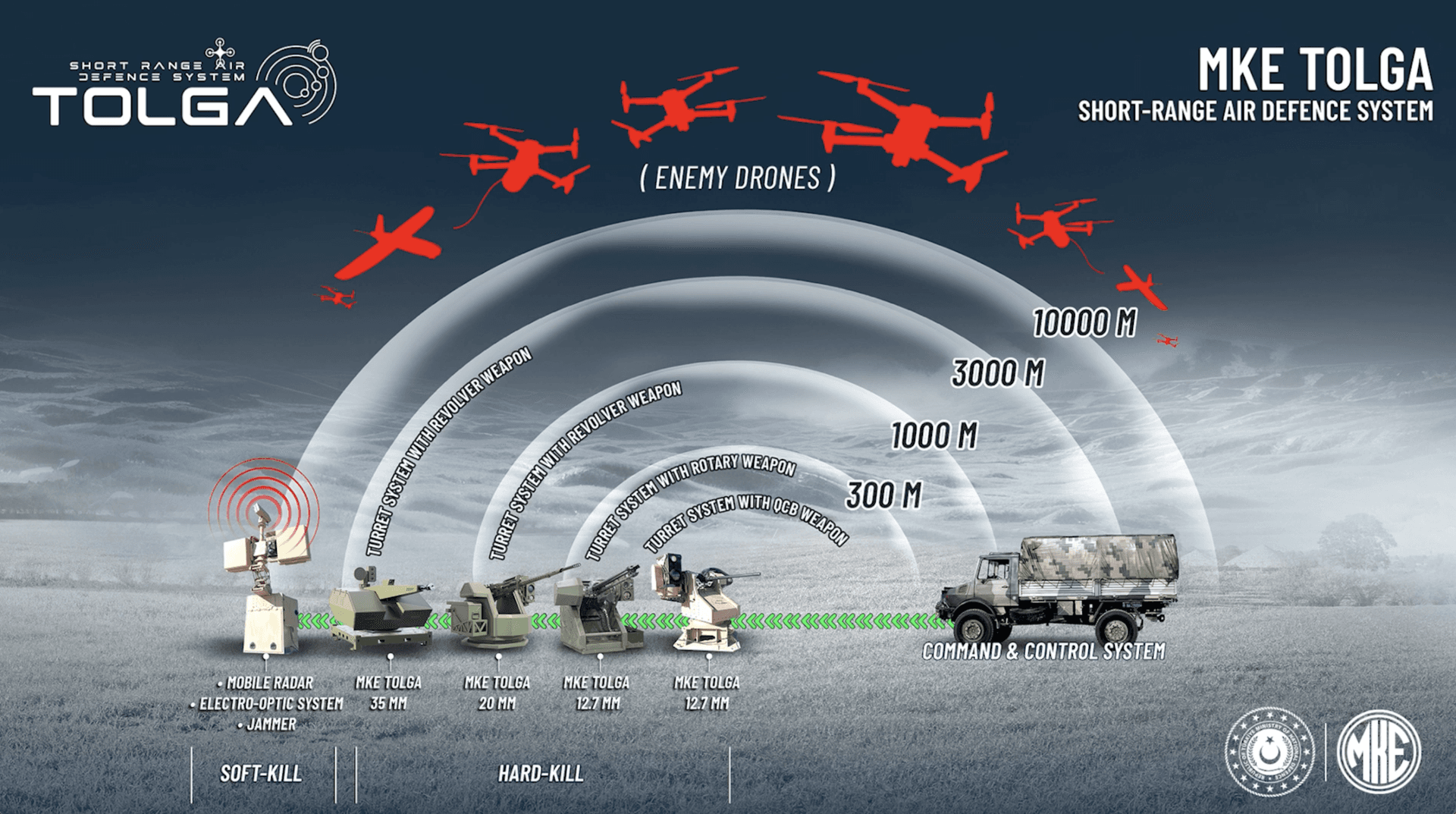
The 25 mm system sits within a portfolio that also includes larger-calibre KORKUT guns, jamming, directed-energy weapons and interceptor drones. Different threats impose different requirements: a very small quadcopter may call for one effect, while a larger fast fixed-wing aircraft may require another. Layered defence therefore depends on correct threat classification and timely weapon assignment, not simply the headline lethality of each individual weapon.
Defence Agenda previously covered KORKUT 35 demonstrations and the wider ASELSAN Steel Dome architecture. The new 25 mm footage should remain distinct from those events and from any fielding claims attached to other systems. No named customer, value, fleet size or acceptance certificate was established by the October footage, so the maturity description remains a manufacturer-publicised live demonstration.
Why Ammunition and Fire Control Matter
Counter-drone gun systems sit in a difficult part of the cost-effectiveness equation. A defender needs a credible intercept probability while limiting expenditure against targets that may be much cheaper than conventional missiles. Programmable ammunition offers a different engagement mechanism from direct-hit rounds, but it introduces its own requirements for accurate fuze programming and target tracking. A demonstration against two airframe classes indicates breadth of the visible test target set; it does not quantify how much ammunition a deployed unit would need in an extended attack.
The next practical questions concern engagements in cluttered airspace and under simultaneous threat arrivals. Fire-control sensors must discriminate hostile drones from birds, friendly aircraft and other objects, while crews must make engagement decisions under restrictive safety rules. Survivability and reload operations matter for vehicle-mounted units accompanying manoeuvre forces. A future contract, troop trial or declared acceptance programme would provide firmer evidence of adoption than publication of an impressive engagement video alone.
Implications / Next
The most useful follow-up reporting will document measured engagement range, salvo size, sensor architecture, the performance of repeated firings and procurement or operational qualification by a customer. For acquisition offices, the key issue is whether the demonstrable effect can be reproduced cheaply and at tempo across changing drone profiles. KORKUT 25 may strengthen the close-in layer, but the video does not settle those wider questions.