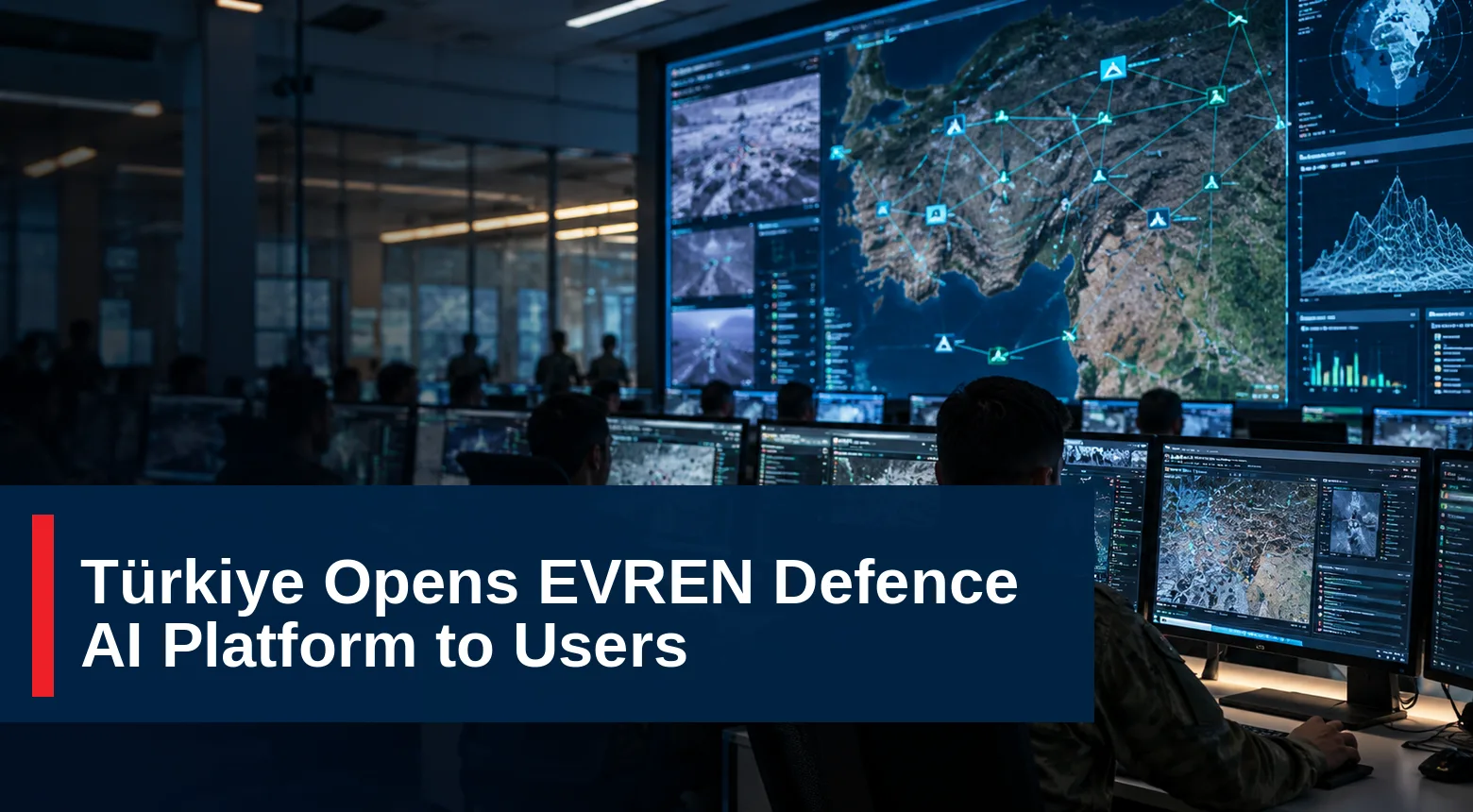
Türkiye’s Presidency of Defence Industries has opened the EVREN national artificial-intelligence platform for defence-industry users, creating a sovereign environment for AI tools, models and data-oriented workflows. The announcement concerns platform availability, not the fielding of a weapon system.
EVREN is an infrastructure milestone rather than a weapons announcement
Türkiye’s Presidency of Defence Industries has opened the EVREN national artificial-intelligence platform to the defence-industry ecosystem. Defence Turk and Anadolu Agency describe the platform as a sovereign digital environment intended to support companies, researchers, entrepreneurs and other users working on artificial-intelligence applications. The immediate milestone is access to a common AI platform; it should not be framed as the deployment of a combat system or as evidence that a particular model has been integrated into an operational weapon.
That distinction matters because defence AI spans several layers. Some programmes put algorithms directly into sensors, autonomous vehicles or command systems. Others, such as EVREN, build the development and data infrastructure that allows organisations to experiment, train models, share tools and retain control of sensitive information. The latter can be less visible than a new vehicle, but it can influence a much wider set of programmes over time.
Sovereign data and model access are becoming industrial requirements
Defence organisations are increasingly cautious about moving sensitive engineering, operational or supply-chain data into public cloud AI services. The risk is not limited to classified information. Proprietary design data, test results, procurement records and technical correspondence can also create security and intellectual-property exposure if they are processed in environments outside national or corporate control.
A sovereign platform gives programme teams a controlled place to use AI tools while aligning access and governance with defence-sector requirements. The strategic value therefore lies in reducing dependence on external general-purpose services for sensitive workflows. That does not automatically solve model quality, cybersecurity or data-governance problems, but it creates an institutional framework in which those problems can be managed under national rules.
The strongest impact may be across the supply chain
Türkiye’s defence industry is built around large primes, specialised suppliers, SMEs, universities and public research bodies. A common AI environment can lower the entry barrier for smaller organisations that do not have the resources to build their own model-hosting, compute and data-governance stack. If access expands as intended, EVREN could support tasks ranging from document analysis and software development to engineering knowledge management, predictive maintenance and programme analytics.
The value will depend on adoption rather than launch-day publicity. Defence-sector users will judge the platform by model performance, latency, cybersecurity, auditability, access to domain-specific tools and the ability to keep sensitive data segregated. The programme therefore needs to be tracked as an evolving digital capability, not as a one-time product unveiling.
Implications / Next
The next useful indicators are user growth, the number and type of models made available, integration with defence-company workflows, governance standards and examples of AI applications that move from experimentation into validated programme use. Any published rules for handling restricted data would also be important for understanding the platform’s practical scope.
For now, the verified milestone is that EVREN has been opened to users in Türkiye’s defence-industrial ecosystem. Its long-term significance will depend on whether it becomes shared infrastructure for real engineering and programme work rather than simply another AI portal. Defence Agenda will continue to separate public demonstration evidence from procurement and fielding claims. Future reporting should be updated only when the responsible authority, end user or manufacturer discloses a concrete milestone with a date, quantity or contractual status that can be independently checked. This avoids turning marketing language or programme intent into an unsupported statement about operational capability.
A second issue is governance. Defence AI platforms need clear rules covering model provenance, training data, user permissions, audit logs, cyber monitoring and the handling of outputs that may influence engineering or operational decisions. A sovereign hosting environment can reduce exposure to external services, but it does not remove the need to validate models or manage hallucination and bias. For procurement and programme offices, the most valuable future EVREN case studies will be those that show measurable improvements in engineering, logistics or decision-support workflows while preserving traceability. That evidence will determine whether EVREN becomes durable national infrastructure or remains primarily an access portal for general-purpose AI tools.