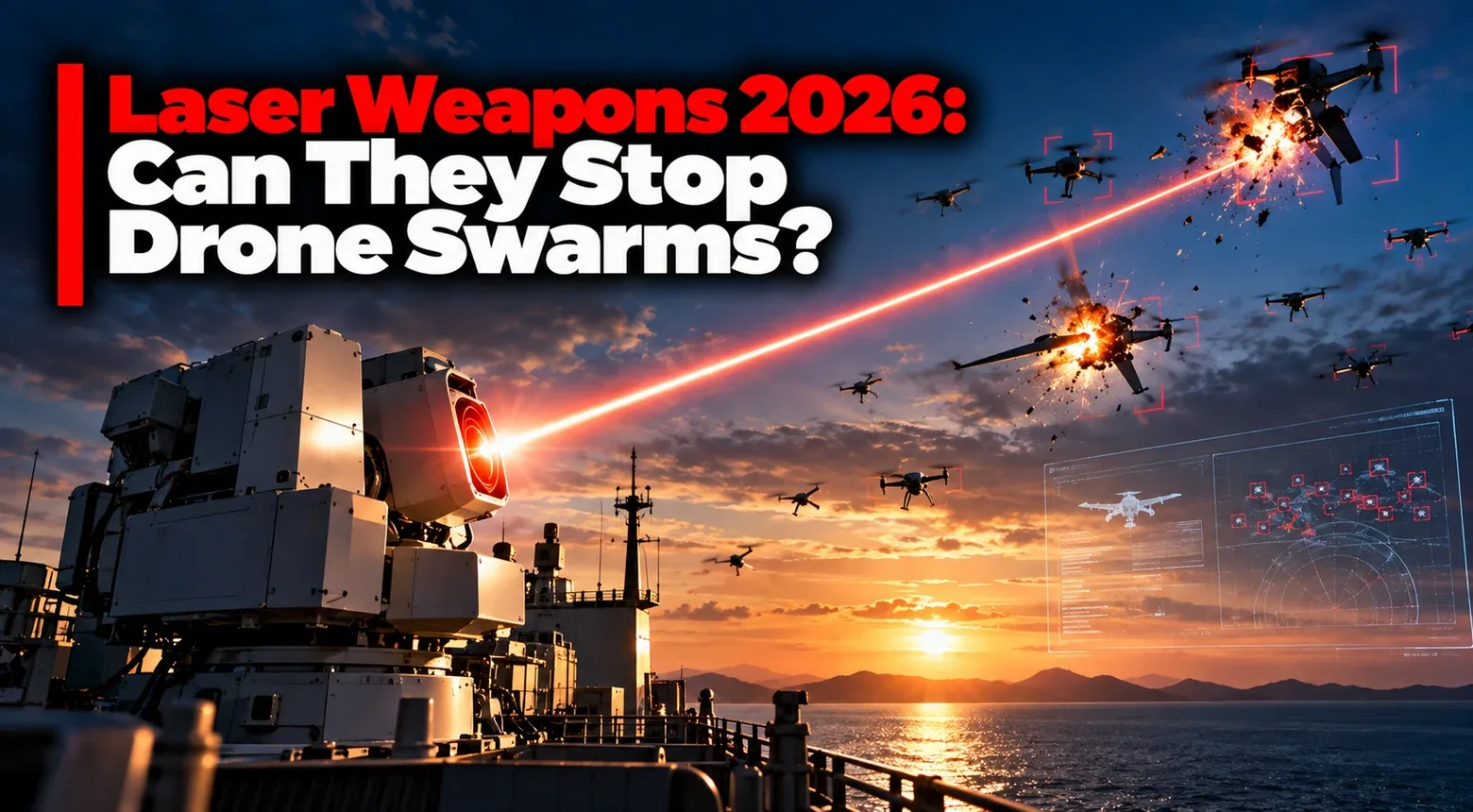
Laser weapons 2026 have moved closer to frontline deployment, but their ability to stop drone swarms remains unproven at scale. On 2 September 2026, the US Army announced its first production contract for a high-energy laser weapon, while the UK is preparing DragonFire for installation on a Royal Navy destroyer from 2027 and Israel is integrating Iron Beam into its layered air-defence network. These milestones could change the economics of counter-drone operations—but not eliminate the physics, engineering and command challenges of mass attacks.
The timing matters. On 16 October 2026, NATO Allied Command Transformation reported an expansion of its Layered Counter-UAS Initiative, linking multiple sensor, command and effector cells during Crucible 4-26. The Alliance's priority is not a single wonder weapon: it is an interoperable defensive network that can identify threats and select an appropriate response while incoming drones continue to change in speed, size and cost.
The answer is conditional: high-energy lasers can destroy individual drones under suitable conditions, as trials have demonstrated. There is not yet adequate public evidence that one laser installation can reliably defeat a large, simultaneous swarm in all weather. For planners, the relevant measure is defended-asset protection across an entire attack, not merely the cost of a successful shot.
Key Facts
- US production milestone: On 2 September 2026, the US Army announced an other-transaction agreement with AeroVironment for production under the Enduring-High Energy Laser (E-HEL) programme; contract value and production quantity were not stated in the Army release.
- UK contract and timetable: On 20 November 2025, the UK announced a £316 million MBDA contract for DragonFire, with installation on a Type 45 destroyer targeted for 2027.
- UK test evidence: DragonFire was reported to have defeated high-speed drone targets capable of flying up to 650 km/h during trials at the Hebrides range; the UK cites an estimated £10 per shot.
- Israeli delivery: Israel's defence ministry reported delivery of the first Iron Beam system on 28 December 2025; the status of subsequent large-scale fleet deployment is not established by that handover alone.
- Integrated test: On 30 June 2026, Israel reported joint Iron Dome–Iron Beam scenarios evaluated through the Iron Dome battle management centre.
- Türkiye's published specification: ASELSAN's April 2026 GÖKBERK 10 brochure describes a 10 kW laser with a 150 m–2 km focusing range; these are manufacturer specifications, not independently verified combat results.
- NATO integration: The 16 October 2026 LCI-X update focused on connecting multiple counter-UAS cells rather than proving any single effector could defeat an unlimited swarm.
Why Laser Weapons Are Suddenly a Procurement Priority
Small uncrewed aircraft have exposed a persistent problem in air defence: an attacker can launch numerous relatively inexpensive systems and force the defender to expend scarce missiles, aircraft time, manpower and sensor capacity. The costs are not symmetric. A successful intercept can still be economically unfavourable if it consumes a weapon far more expensive than the incoming aircraft.
Laser systems promise to change one component of that equation. Their energy is supplied electrically, so an engagement need not consume a conventional missile. The British government estimates DragonFire's shot cost at approximately £10, compared with traditional interceptors costing far more. That comparison is useful, but it is not a full lifecycle-cost assessment: power generation, cooling, acquisition, integration, training, maintenance and support are omitted from a headline electricity-related figure.
The US Government Accountability Office (GAO) has noted both the potential for inexpensive engagements and the operational drawbacks of directed energy, including shorter practical ranges and sensitivity to atmospheric conditions. A laser offers a different choice within the air-defence arsenal; it does not make guns, electronic warfare or interceptor missiles obsolete.
How High-Energy Laser Weapons Defeat Drones
A high-energy laser concentrates optical energy on a target long enough to damage material or critical components. An effective engagement depends on detection, classification, precise tracking, beam control and sufficient energy delivered to the same vulnerable area. The useful question is therefore not simply how quickly a beam travels—light reaches the target almost instantly—but how long the system must maintain an effective beam on a moving aircraft.
That distinction matters during a swarm. A laser may have enough electrical supply for many shots, yet still be constrained by its field of view, tracking arrangement, dwell time, cooling cycle and the speed with which it can switch between targets. Beam propagation is also influenced by turbulence, moisture, dust, smoke and line-of-sight obstructions.
A September 2026 analysis from the NATO-accredited Joint Air Power Competence Centre emphasised these factors and the operational importance of stabilisation, target tracking and power-and-cooling support. The centre also distinguished lasers from high-power microwave systems, which can produce different effects against electronic targets and may cover a different set of use cases.
DragonFire, Iron Beam and E-HEL: What Has Actually Changed?
The three most prominent programmes are advancing along different acquisition paths. Direct comparisons should distinguish a successful test, delivery of a first system, a production contract, and widespread operational deployment. These are not interchangeable milestones.
| Programme | Verified public milestone by 20 October 2026 | Intended role | What remains uncertain |
|---|---|---|---|
| DragonFire — United Kingdom | £316m contract announced 20 November 2025; 2027 Type 45 installation target | Naval close-in protection against aerial threats | Performance under operational sea conditions, sustained multi-target engagements and fleet rollout |
| Iron Beam — Israel | First system delivered 28 December 2025; integration scenarios reported 30 June 2026 | Complement Iron Dome and wider layered air defence | System-wide fielding numbers, availability and public evidence of sustained swarm defeat |
| E-HEL — United States | First US Army laser production agreement announced 2 September 2026 | Counter-uncrewed aircraft protection at bases and on deployable platforms | Delivery schedule, numbers, all-weather availability and verified operational performance |
| GÖKBERK 10 — Türkiye | 10 kW and 150 m–2 km focusing range listed in an April 2026 ASELSAN brochure | Short-range counter-Class I UAV layer | Independent combat assessment, contracted quantities and operational deployment status |
United Kingdom: DragonFire Nears Naval Integration
The UK Ministry of Defence reported on 20 November 2025 that DragonFire destroyed high-speed drones in testing and that MBDA had received a £316 million contract covering the next deployment phase. The announcement cited targets capable of flying at up to 650 km/h and proposed installation on a Royal Navy Type 45 destroyer by 2027.
A later UK parliamentary answer dated 30 March 2026 confirmed that the initial contract concerned two DragonFire units and that installation of the first was scheduled for 2027. Another parliamentary answer on 26 March 2026 framed the first installation as a minimum deployable capability, to be improved through later development. That wording is materially narrower than claiming that a mature fleet-wide anti-swarm shield already exists.
The shipboard context is especially demanding: the host platform moves, maritime air can be humid, and engagements may occur while other weapons, sensors and aircraft must operate safely in the same area. A Type 45 installation would be a significant integration step, not an end to testing.
Israel: Iron Beam Moves Into Layered Defence
Israel's Ministry of Defense announced the first Iron Beam handover on 28 December 2025, following reported trials against rockets, mortars and UAVs. The ministry characterised the handover as a move into operational use, with further systems in production. It did not publish independently auditable interception probabilities or an exhaustive assessment of large simultaneous drone attacks.
On 30 June 2026, the ministry said upgraded Iron Dome testing included joint operational scenarios involving Iron Beam within the Iron Dome battle management centre. That is an important distinction: the laser is envisaged as an additional effector selected by an integrated command system, not as a standalone replacement for missile-based layers.
United States: From Demonstrators Towards Production
The US Army's 2 September 2026 statement described its production agreement with AeroVironment for E-HEL as its first production contract for a high-energy laser weapon system. The Army highlighted a modular open-systems approach comprising 11 major interfaces, intended to support deployment on fixed, semi-fixed and mobile platforms. The release did not establish that operational formations had already received the contracted systems.
The need for realistic military evaluation is acknowledged within the US government. During an August 2026 Army counter-UAS media roundtable, a senior official described a year-long installation pilot to study how high-energy lasers and high-power microwaves can be operated, maintained and integrated without interfering with base activities. The point is operational viability, not merely laboratory feasibility.
Türkiye: GÖKBERK in a Wider Counter-UAS Architecture
Türkiye is pursuing directed energy within a broader mix of counter-uncrewed aircraft systems. ASELSAN's GÖKBERK 10 product brochure, marked April 2026, specifies a 10 kW output and a focusing capability from 150 metres to 2 kilometres against Class I UAVs. These are declared product characteristics; neither the figures nor a trade-show presentation establishes operational performance against a coordinated mass attack.
At MSPO 2026, ASELSAN presented its counter-UAS layer as a mixture of lasers, electronic-warfare capabilities, kinetic weapons and high-power electromagnetic effects. This architecture is more consequential than the specifications of any individual device: different threats and operating conditions favour different defensive tools.
Can a Laser Stop a Drone Swarm? The Critical Limits
The term swarm is often used imprecisely. A wave of independently controlled drones, a massed launch of one-way attack aircraft and a genuinely autonomous, collaborating swarm create different challenges. A laser can be extremely effective against a detectable target in clear conditions while still becoming overloaded by the number or timing of threats arriving together.
First is the time budget. Every engagement requires target validation, accurate pointing and sufficient dwell time. Even with abundant power, one beam director generally cannot maintain full-power engagement on numerous separated targets simultaneously. The practical limit depends on a system's design and the threat geometry; public trial figures do not yet supply a universal number of drones defeated per minute.
Second is the environment. Rain, fog, aerosols, dust and smoke can attenuate or scatter a beam. Thermal distortion can also reduce useful energy on target. Modern adaptive optics can mitigate certain effects, but cannot abolish atmospheric physics. GAO identifies weather as a significant constraint on some directed-energy weapons, while the Joint Air Power Competence Centre highlights moisture, obscurants and turbulence.
Third is the defended area. Mountains, buildings, the Earth's curvature and the mounting position impose line-of-sight restrictions. A laser defending a base or ship cannot cover every low-altitude approach without adequate sensor positioning, command integration and—in some cases—multiple distributed effectors.
Fourth is supportability. Lasers draw electrical power and produce waste heat. If the generating and cooling plant cannot support the desired engagement tempo, the theoretical availability of energy becomes operationally irrelevant. Spares, optics protection, maintenance and specialist operators are equally important during prolonged deployments.
These limitations explain why high-power microwave weapons attract interest as a separate form of directed energy. Their effects and engagement geometry differ from focused optical lasers, so they may offer advantages in some multiple-target scenarios, while bringing their own electromagnetic compatibility, identification and collateral-effects challenges. A layered defence may need both technologies alongside guns, electronic warfare and interceptor drones.
Cheap Shots Do Not Mean Cheap Defence
A claimed £10 DragonFire engagement should not be compared directly with the procurement price of a missile as though it represents the entire cost of employing a laser. Defence budgeting requires several different units of measurement.
| Cost measure | What it captures | What it cannot prove |
|---|---|---|
| Marginal shot cost | Additional energy and other immediate consumables associated with one firing; UK estimate around £10 for DragonFire | Total acquisition, maintenance or guaranteed target defeat |
| System acquisition | Laser, beam director, control electronics, platform integration and supporting infrastructure | Cost per successful kill over a service life |
| Operating and sustainment cost | Personnel, electricity generation, cooling, repair, spares and downtime | Availability in every tactical or weather condition |
| Cost per successful intercept | Full engagement cost adjusted for effective outcomes and repeated attempts | Ability to withstand saturation without other layers |
| Cost of defended assets | Damage avoided and continuity of military operations | Whether the least expensive effector is always tactically appropriate |
This is precisely why defence ministries should distinguish cost per shot from cost per defended engagement and cost per protected mission. One unsuccessful, cheap shot may be less valuable than a more expensive interceptor used at the right moment. Conversely, repeated successful laser engagements against small drones could preserve scarce missiles for higher-priority threats and improve force endurance.
The GAO's acquisition transition study warned that promising demonstrations do not automatically translate into sustainable military programmes. Engineering integration and procurement discipline remain central to whether projected savings become real operational savings.
NATO's New Counter-Drone Test Highlights the Real Requirement
On 16 October 2026, NATO Allied Command Transformation said its Layered Counter-UAS Initiative was linking multiple defensive cells across organisational and technical boundaries. Each cell combines sensing, command-and-control and effectors. The goal is to create an interoperable response rather than isolated devices competing independently for targets.
That development provides a useful lens for assessing lasers. A high-energy laser needs warning time and reliable target tracks; it must know which target is assigned to it, when other weapons are already engaging and when environmental or tactical conditions favour an alternative effector. Without that command architecture, a successful test of a standalone laser may have limited relevance to defence against a complex attack.
Defence Agenda has explored the wider context in its reports on NATO's more than $40 billion counter-drone investment plan, how drone swarm warfare is reshaping uncrewed combat, and MORFIUS and high-power microwave counter-drone concepts. Those developments point in the same direction: the winner is likely to be the most effective defensive architecture, not the most striking single-weapon demonstration.
Risks, Alternatives and Unanswered Questions
Laser advocates can legitimately point to successful tests, smaller logistic demands for each shot and potential savings against inexpensive drones. Their strongest case lies in fixed-site and naval defence where substantial power and stabilised sensors may already be available. However, critics are right to ask for measured effectiveness in adverse weather, realistic concurrent-attack scenarios, and maintenance-intensive deployments rather than in tightly managed trials alone.
Decision-makers should watch for several disclosures before treating a system as a mature counter-swarm solution: test conditions and threat mix; the number of targets engaged within a fixed interval; failed engagements as well as successes; power and cooling demands; availability across different weather conditions; and independent operational assessment. These metrics have not been made comprehensively public across the programmes compared here.
Alternative effectors remain necessary. Electronic warfare may disrupt some radio-linked threats but can be less useful against autonomous aircraft that do not require continuous control. Guns and interceptor drones can offer other engagement options but have ammunition, range or inventory limits. Missiles retain an essential role for higher-end or distant threats. A layered system preserves flexibility when one method becomes ineffective or overwhelmed.
Implications / Next
The most consequential near-term milestone is DragonFire's planned Type 45 integration in 2027, because moving from a land-based firing range to a deployed naval platform will test several of the engineering assumptions behind its operational use. For the United States, observers should follow E-HEL production deliveries, military operator feedback and disclosure of sustained availability metrics. For Israel, deployment scale and the outcome of joint Iron Beam–Iron Dome integration will matter more than the first-system handover alone.
Across NATO, the next test is whether LCI-X can help participating forces share reliable sensor tracks and coordinate a mixed set of interceptors rapidly. For manufacturers in Europe, the United States and Türkiye, commercial opportunity will depend on verified performance, open interfaces, service support, production capacity and transparent lifecycle costs rather than promotional cost-per-shot comparisons.
Conclusion
Laser weapons can already defeat individual drones in demonstrated conditions; publicly available evidence does not justify treating them as an all-weather, unlimited counter-swarm shield. By October 2026, contracts, deliveries and network-integration tests show genuine progress. Their military value will be determined by how reliably lasers work alongside missiles, guns, electronic warfare, high-power microwaves and interceptor drones in real defence networks. The decisive outcome is not the lowest advertised price for a beam—it is keeping the defended force operational during sustained attack.
Further Reading
- Defence Agenda — Drone Warfare 2026: AI, Robots and Swarms
- Defence Agenda — NATO Counter-Drone Capabilities Get $40bn Investment
- Defence Agenda — MORFIUS X-Rotor Targets 50+ Drones Per Flight
- UK Ministry of Defence — DragonFire high-speed drone trials and contract, 20 November 2025
- US Army — First E-HEL production contract, 2 September 2026
- Israel Ministry of Defense — Iron Dome and Iron Beam integration trials, 30 June 2026
- NATO Allied Command Transformation — LCI-X experimentation, 16 October 2026
- Joint Air Power Competence Centre — Bringing Directed Energy Weapons into Focus, 2026