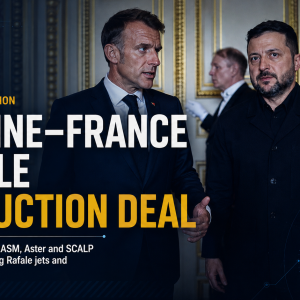
Ukraine French missiles production will become part of a new bilateral defence roadmap after France agreed to let Kyiv manufacture French-designed weapons while also ordering Rafale fighter jets and next-generation SAMP/T air-defence systems.
The announcement came after French President Emmanuel Macron and Ukrainian President Volodymyr Zelenskyy met in Paris. According to Reuters, France will license Ukraine to produce AASM precision-guided bombs, Aster air-defence interceptor missiles and SCALP long-range cruise missiles.
The move marks the first time France has agreed to license weapons production in Ukraine. As a result, Kyiv could expand stocks of precision weapons and air-defence interceptors at a time when Russia continues large-scale missile and drone attacks.
The roadmap also includes radar systems and the delivery of next-generation SAMP/T systems. These systems would follow earlier SAMP/T deliveries and additional missile supplies. In parallel, Macron said Ukraine ordered 16 Rafale fighter aircraft, with the aim of operating them in Ukrainian skies by 2028–2029.
Ukraine French Missiles Production Adds Industrial Depth
The Ukraine French missiles production agreement changes the structure of French support. Instead of relying only on deliveries from existing French stockpiles, Kyiv would gain a route to manufacture key weapons under licence.
This matters because air-defence and precision-strike demand now exceeds available Western inventories. Ukraine needs more interceptors, guided bombs and cruise missiles. France also needs to preserve its own readiness while supporting Kyiv. Therefore, licensed production offers a more sustainable model than repeated one-off transfers.
The three weapon families cover different mission areas. AASM gives Ukraine a precision air-to-ground strike option. Aster supports high-end air-defence missions. SCALP provides long-range strike capability against strategic targets.
Rafale Order Expands Ukraine’s Future Combat-Air Plan
The Rafale order adds a long-term airpower dimension to the roadmap. Ukraine has already moved toward a mixed Western fighter fleet. The addition of Rafale would give Kyiv a French combat-air pathway alongside other aircraft transitions.
Rafale can carry French precision weapons, including AASM and SCALP. Consequently, local weapons production and future aircraft deliveries could reinforce each other. Ukraine would not only receive aircraft; it would also build part of the weapons ecosystem needed to operate them.
The timeline remains important. Macron said the aircraft would be delivered with a view to operations in 2028–2029. That gives Ukraine and France time to address pilot training, maintenance, weapons integration, basing, protection and sustainment.
SAMP/T NG and Aster Strengthen Missile Defence
The roadmap also supports Ukraine’s air-defence architecture. Next-generation SAMP/T systems would increase Kyiv’s ability to counter aircraft, cruise missiles and some ballistic missile threats. Aster interceptor production would add another layer to this capability.
This fits a broader European effort to close missile-defence gaps exposed by the war. Ukraine has relied heavily on Patriot, SAMP/T, IRIS-T, NASAMS and other Western systems. However, interceptor supply remains one of the central constraints in the defence of Ukrainian cities, infrastructure and military sites.
By combining SAMP/T NG deliveries with licensed Aster production, France and Ukraine are trying to move from emergency support toward a more durable air-defence model.
Why the Roadmap Matters for European Defence
The agreement reflects a wider shift in European defence policy. Support for Ukraine is moving beyond equipment donations. It now includes licensed production, joint development, industrial scaling and long-term force planning.
For France, the roadmap strengthens its role in Ukraine’s future combat-air and missile-defence architecture. For Ukraine, it reduces dependence on foreign delivery cycles and gives the country a stronger domestic production base.
The model could also influence other European partnerships. If Ukraine can produce advanced Western weapons under licence, more allies may consider similar structures for drones, missiles, air defence, electronic warfare and ammunition.
A New Phase of France-Ukraine Defence Cooperation
The roadmap gives France-Ukraine defence cooperation a more industrial character. It combines immediate military support with future capability building. It also links Ukraine’s battlefield requirements to Europe’s rearmament agenda.
Still, implementation will define the outcome. Licensed missile production requires secure factories, supply chains, quality control, protected logistics and sustained funding. Rafale operations will require training, ground infrastructure and maintenance depth. SAMP/T NG integration will require radar, command-and-control and interceptor availability.
If these elements mature, the Ukraine French missiles production roadmap could become one of the most important European defence-industrial arrangements of the war. It would give Kyiv more sovereign capacity and give Europe a stronger model for wartime industrial cooperation.
For further Defence Agenda coverage, read our missiles, air defence and air warfare sections. Related analysis includes Freyja interceptor system and European missile defence and wingman aircraft in Europe’s rearmament debate.