Drone swarms are changing the calculation behind modern airpower, but they have not made fighter jets obsolete. The more immediate danger is often on the ground: a sophisticated combat aircraft is vulnerable when parked, refuelling or awaiting maintenance, even if it would be difficult for a small, slow drone to engage in flight. US Air Force base-defence trials and NATO counter-drone exercises during 2026 show militaries responding to this challenge with layered detection, electronic warfare, interceptors and new procurement arrangements. The question is whether protection can become as scalable and adaptable as the threats it must defeat.
The distinction between an aircraft's air-combat survivability and an airbase's ability to generate sorties under attack is central. A fighter can retain superior speed, sensors and weapons while its squadron loses operational effectiveness because runways, maintenance facilities, fuel infrastructure or aircraft on the ground are disrupted. Conversely, intercepting a small drone does not prove a base can withstand a sustained attack involving different types of weapons.
Recent experiments offer evidence of progress, not a guarantee. On 30 March 2026, the US Air Force described a joint airbase-defence drill at Osan. On 27 July, the NATO Support and Procurement Agency announced five counter-UAS framework contracts. Both developments illustrate that defending aircraft now requires a connected system of sensors, command-and-control tools, trained operators and appropriately priced effectors.
Why Drone Swarms Threaten Airpower Without Replacing Fighter Jets
The term drone swarm is frequently applied to any attack involving many uncrewed aircraft. Technically, a swarm implies a degree of coordinated behaviour, information-sharing or distributed task allocation. A wave of individually programmed one-way attack drones may impose a serious saturation problem without exhibiting all those characteristics. This distinction matters because the most plausible defensive response depends on whether the threat consists of short-range quadcopters, long-range strike drones, loitering munitions or genuinely networked autonomous systems.
The fighter itself remains a highly capable airborne platform. Modern combat aircraft operate at speeds and altitudes far beyond those of most small quadcopters, with sensors and weapons designed principally for air combat and strike missions. A small drone does not become an effective fighter interceptor simply because hundreds can be launched. Reliable airborne engagements would require detection, tracking, appropriate speed and geometry, communications and suitable effects—all of which vary by platform and mission.
The more profound shift concerns the airbase. Aircraft spend significant time being serviced, armed, fuelled, inspected or prepared for their next mission. These activities depend on ground crews, infrastructure, communications and predictable logistics. A threat need not destroy a fighter to affect an air operation: temporary disruption, alerts and additional protective duties can reduce sortie generation. The outcome, however, depends on many factors, including the size and type of the threat and the resilience of the installation.
NATO's updated air-defence overview of 8 October 2026 explicitly includes quick-reaction fighters, ground- and sea-based systems, and counter-drone technologies in an integrated framework. That doctrine is more realistic than treating fighter aircraft and small drone interceptors as interchangeable solutions.
What Ukraine's Airbase Attacks Really Demonstrate
The war in Ukraine has made the vulnerability of aviation infrastructure difficult to dismiss. On 1 June 2025, Ukraine announced a coordinated operation against Russian strategic airbases using small drones. Reuters reported Ukraine's claims that 117 drones had been used and 41 aircraft affected. Those totals came from Ukrainian officials; the reported damage figure and the aircraft-by-aircraft outcome should not be treated as independently verified solely on that basis.
The event is relevant to fighter-base protection even though its principal targets were strategic bombers and other aircraft rather than a representative fleet of tactical fighters. It demonstrated the potential for small uncrewed systems to threaten valuable aviation assets on the ground. It did not demonstrate that small drones could routinely defeat airborne fighters in aerial combat.
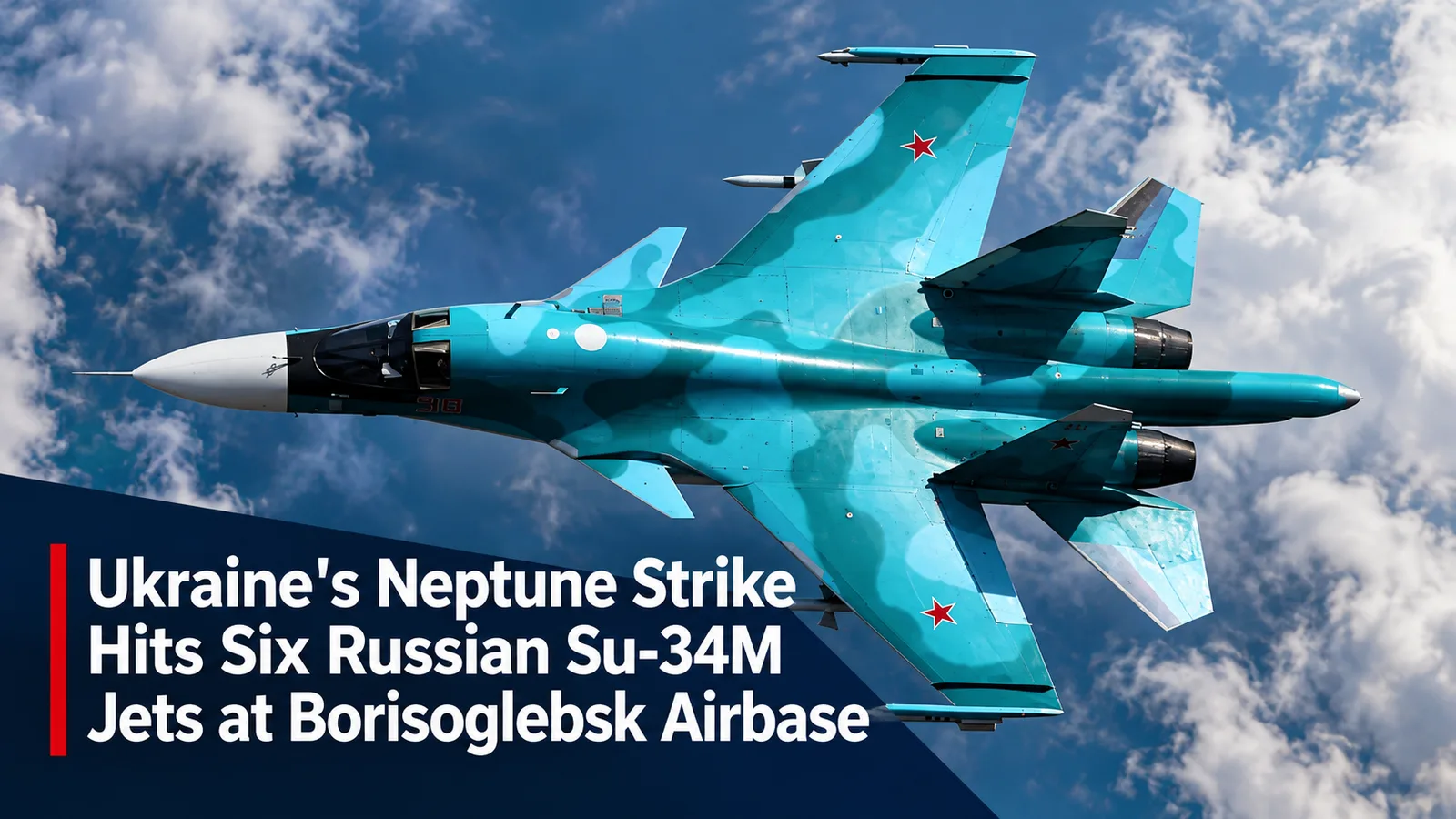
A separate case reinforces the importance of careful attribution. Defence Agenda reported on Ukraine's claimed Neptune strike against Borisoglebsk airfield on 14–15 October 2026. Ukrainian authorities described varying damage to six Su-34 aircraft, but the precise independently confirmed losses remained uncertain. That attack was reported as involving a Neptune missile, not a drone swarm. It belongs in an assessment of airbase resilience, not as proof of drone-swarm lethality.
Taken together, these cases underline an operational principle: expensive aircraft depend on less visible support systems. Airbase resilience cannot be judged by the survivability of the aircraft alone. Nor should every aviation-ground attack be relabelled as a swarm engagement for dramatic effect.
The 2026 US Air Force Response: Protect the Installation
The United States has been developing point-defence methods that integrate existing military air-defence capabilities with newer counter-drone tools. During Freedom Shield 26, US Air Force security forces and the US Army's 35th Air Defence Artillery Brigade exercised detection and response to a simulated hostile drone at Osan Air Base. According to the 30 March 2026 official account, the exercise involved an AN/TWQ-1 Avenger system. It validated coordination and training processes in a simulated environment, rather than proving successful protection against a real mass attack.
On 3 June 2026, the 325th Security Forces Squadron at Tyndall Air Force Base demonstrated counter-small-UAS techniques as part of a programme to strengthen installation protection. The US Air Force report described the development of a point-defence capability and specialist training. The significance lies in who is being prepared to respond: base security personnel increasingly need an airborne-threat skill set in addition to conventional perimeter security.
An Air Combat Command report dated 12 August 2026 explained the wider Point Defense Task Force's role in experimentation and data analysis. The remit extends beyond small drones to a broader range of threats, including cruise missiles. That wider framing matters: separate stovepipes for every aerial threat would complicate the command, sensor and response architecture that a base needs under pressure.
The 31st Air Task Force's August 2026 exercise connected detection, electronic warfare and physical interception in a final live-fire demonstration. Airmen practised recognising different airborne objects and employing layered defences. These are meaningful steps towards a deployable capability, but a controlled exercise does not provide a publicly established probability of defeating hundreds of simultaneous threats.
How Layered Counter-Drone Defence Works
Successful defence is an end-to-end systems problem. The protective architecture must discover a potential intruder, distinguish it from friendly and civilian activity, maintain a useful track, choose a proportionate response, and assess whether the danger remains. Each stage can add latency or produce false alarms. Real installations must also consider safety, airspace management and the legal authority to use particular countermeasures.
| Defensive layer | Intended contribution | Evidence and present limitation |
|---|---|---|
| Radar, electro-optical and acoustic sensing | Detect and classify low-altitude threats | NATO trials test mixed sensors; no single sensor covers every environment reliably |
| Command-and-control integration | Fuse tracks, assign responses and limit duplication | NATO TIE26 examined more than 40 C2 applications; interoperability still needs operational validation |
| Electronic warfare | Disrupt susceptible control or navigation links | Relevant against some drones, but effectiveness is threat-dependent and constrained by friendly-spectrum requirements |
| Guns and kinetic interceptors | Physically defeat targets threatening protected areas | US exercises demonstrate techniques; ammunition, safety and engagement capacity still matter |
| Directed-energy systems | Offer a potential lower marginal engagement cost | Weather, power, tracking and simultaneous-engagement limits require case-by-case testing |
| Passive protection and continuity measures | Preserve aircraft availability and essential operations | Resilience depends on infrastructure, procedures and sustained resupply; public test metrics are limited |
The table describes capability roles, not a ranking or proof that every technology can defeat every drone. For instance, electronic warfare can be effective against systems dependent on susceptible links, but it is not automatically decisive against autonomous navigation. A laser may avoid the cost of expending a missile per engagement, but it still needs power, cooling, line of sight, tracking and sufficient time on target. An interceptor drone might provide a useful option but introduces its own supply, control and deconfliction requirements.
This is also a command problem. Multiple radars may detect the same object, while friendly aircraft, birds and authorised drones add complexity. Unless the sensor picture and engagement permissions are integrated, an installation may own many devices yet remain unable to employ them as a coherent system.
NATO: From Demonstrations to Interoperable Airbase Defence
NATO's central challenge is not acquiring a single highly publicised counter-drone weapon. It is combining equipment from different suppliers and national forces into a deployable network. In the Netherlands during 11–22 May 2026, the NATO Communications and Information Agency convened Technical Interoperability Exercise 26, involving approximately 300 participants, 40 companies from 11 Allied countries, Ukraine and Australia, more than 60 technologies and 40 C2 applications. Those are reported exercise-participation and evaluation figures, not counts of systems accepted into service.
The follow-on Exercise Baltic Trust 26 in Latvia, 3–14 August 2026, moved selected solutions towards assessment in a realistic military environment. NATO's Layered Counter-UAS Initiative likewise emphasises connecting sensors, command systems and response options across national forces. Such trials provide evidence on interoperability and usability that a stand-alone vendor demonstration cannot.
Procurement is beginning to follow this logic. On 27 July 2026, the NATO Support and Procurement Agency established five C-UAS framework contracts. It named Axon, BSS, DEFSECINTEL, JISR and CS Group France among the pre-qualified suppliers. The arrangements provide a potential purchasing route for modular systems built around shared command-and-control. A framework contract does not mean that five complete systems have already been purchased, installed at airbases or proven against a mass attack.
Defence Agenda has covered the wider investment context in NATO Counter-Drone Capabilities Get $40bn Investment. That longer-term policy commitment is relevant, but announced investment plans should not be conflated with money already spent, systems accepted or protection actually available at a specific installation.
The Cost-Exchange Problem Is More Than Drone Price Versus Missile Price
A low-cost attacking drone can force an expensive defensive response, but the popular comparison of a drone's purchase price with an interceptor's unit price is incomplete. Defenders must consider the total cost per successful engagement, including detection, operators, maintenance, ammunition or interceptor replenishment, infrastructure and the consequences of a missed threat.
Equally, the attacker does not pay only for the airframe. Launch arrangements, transport, communications, targeting data, production losses and the proportion of drones that fail to reach a target all influence effective cost. Publicly reported unit prices frequently use incompatible assumptions, currencies, quantities and configurations. This article therefore does not invent a universal cost ratio for fighter-base protection.
The relevant acquisition question is how to employ the lowest-cost effective response while retaining sufficient capacity against different threats. A layered defence could reserve costly interceptors for threats that genuinely require them, use alternative effectors where appropriate and maintain passive resilience if some attacks penetrate. The goal is operational continuity rather than a visually impressive single intercept.
There are industrial implications. Demand is shifting towards modular sensor packages, software interfaces, target classification, electronic protection, training and sustainment. Suppliers able to integrate these elements with existing base security and air-defence networks may be better positioned than firms selling an isolated device without a credible logistics and interoperability plan.
Can Fighter Jets Defeat a Drone Swarm in the Air?
A different question is whether drone swarms can destroy fighter aircraft while airborne. No simple yes-or-no answer covers all threats. A formation of small short-range multicopters is not equivalent to a network of jet-powered uncrewed aircraft, nor is a fighter performing air-policing duties the same as one fighting through a dense integrated air-defence environment.
Airborne fighter aircraft can detect and engage many types of air threat, but their ability to defeat a particular drone depends on the sensor picture, weapons available, rules of engagement, fuel and mission requirements. Using a fighter and an expensive missile against each inexpensive aerial intruder may be unsustainable at scale. Conversely, assuming that any number of inexpensive quadcopters can chase and defeat a high-performance fighter misunderstands flight performance and the engagement problem.
The terminology of swarm can obscure these distinctions. Highly coordinated autonomous air vehicles could create future threats that differ significantly from today's mass attacks, especially if their individual sensors and behaviours allow distributed tasks. However, the public evidence cited here does not establish an operational capability to guarantee the destruction of airborne fighter formations through fully autonomous drone swarms.
Modern airpower is more likely to evolve into a combination of crewed fighters, collaborative uncrewed aircraft and several layers of ground protection. The fighter remains valuable for speed, payload, long-range sensors and command authority; uncrewed systems can augment some missions and complicate the threat environment. Replacing aircraft with cheap drones is not a universal answer, particularly where range, survivability, electronic warfare and strike effects matter.
Risks, Counterarguments and Open Questions
The strongest counterargument to predictions of a fighter-jet decline is that defenders learn. Electronic warfare, sensors, counter-interceptors, operational procedures and infrastructure protection can improve. The same Russian and Ukrainian experience that demonstrated drone effects also showed adaptation. It would be misleading to extrapolate a single successful strike into a claim that airfields are permanently defenceless.
Several problems nonetheless remain unresolved. Public exercise reports do not disclose consistent metrics for simultaneous track capacity, detection probability, false alarms, engagement throughput or sustained performance in bad weather and electronic interference. Defence procurement may also lag software adaptation. Training personnel for an integrated base-defence system is a persistent task, not a one-off purchase.
There are legal and safety challenges too. Electronic countermeasures near civilian aviation and military communications require careful management, while kinetic intercepts create falling-debris and airspace hazards. Human supervision and proportionate rules of engagement remain essential when sensors and AI-assisted classification are used in busy airspace. More automation may reduce operator workload but does not remove accountability.
For NATO and allied air forces, the industrial risk is fragmentation. If each nation buys a closed sensor-and-effector package that cannot exchange reliable information with neighbouring systems, collective investment may result in overlapping but poorly connected defences. Exercises and open-interface procurement can mitigate that risk, but only repeatable evaluations and operational acceptance can demonstrate success.
Implications / Next: What to Watch After October 2026
Four developments will indicate whether the 2026 activity is becoming useful airbase protection rather than remaining a sequence of demonstrations.
First, defence ministries and air forces need to report operationally relevant evaluation results, with clear distinctions between controlled live fire, deployment, initial operating capability and sustained readiness. Second, the NSPA framework contracts must translate into actual national orders, deliveries, integration and support arrangements where customers choose to proceed. Third, NATO's LCI-X and NCIA testing should produce workable cross-national interfaces linking sensors, decisions and effectors. Fourth, airbase commanders need evidence that these arrangements preserve flying operations during realistic, repeated disruption—not simply that one drone can be defeated.
For the defence industry, the opportunity spans radars, electro-optics, electronic warfare, interceptor drones, training and networked command software. For air forces, the programme question is how to balance aircraft procurement with the protection, engineering and sustainment that allow those aircraft to fly.
Conclusion
Fighter jets can remain central to airpower in the age of drone swarms—but only if the systems that support them are protected and resilient. In 2026, US and NATO programmes are shifting from isolated counter-drone equipment towards layered, integrated installation defence. That is a concrete and necessary response, not a claim that the problem has been solved. The central measure of success will be whether air forces can continue generating missions in contested conditions while avoiding unsustainable costs and excessive operational disruption.
Further Reading
- Defence Agenda — Drone Warfare 2026: AI, Robots and Swarms
- Defence Agenda — NATO Counter-Drone Capabilities Get $40bn Investment
- Defence Agenda — MKE TOLGA 20 kW Laser Destroys Drone at 760 Metres
- Defence Agenda — Ukraine Reports Neptune Strike on Su-34s at Borisoglebsk
- US Air Force — Integrated airbase defence at Osan, 30 March 2026
- NATO NCIA — Counter-drone interoperability exercise, 21 May 2026
- NSPA — Five C-UAS framework contracts, 27 July 2026
- US Air Force — Layered counter-drone training, August 2026