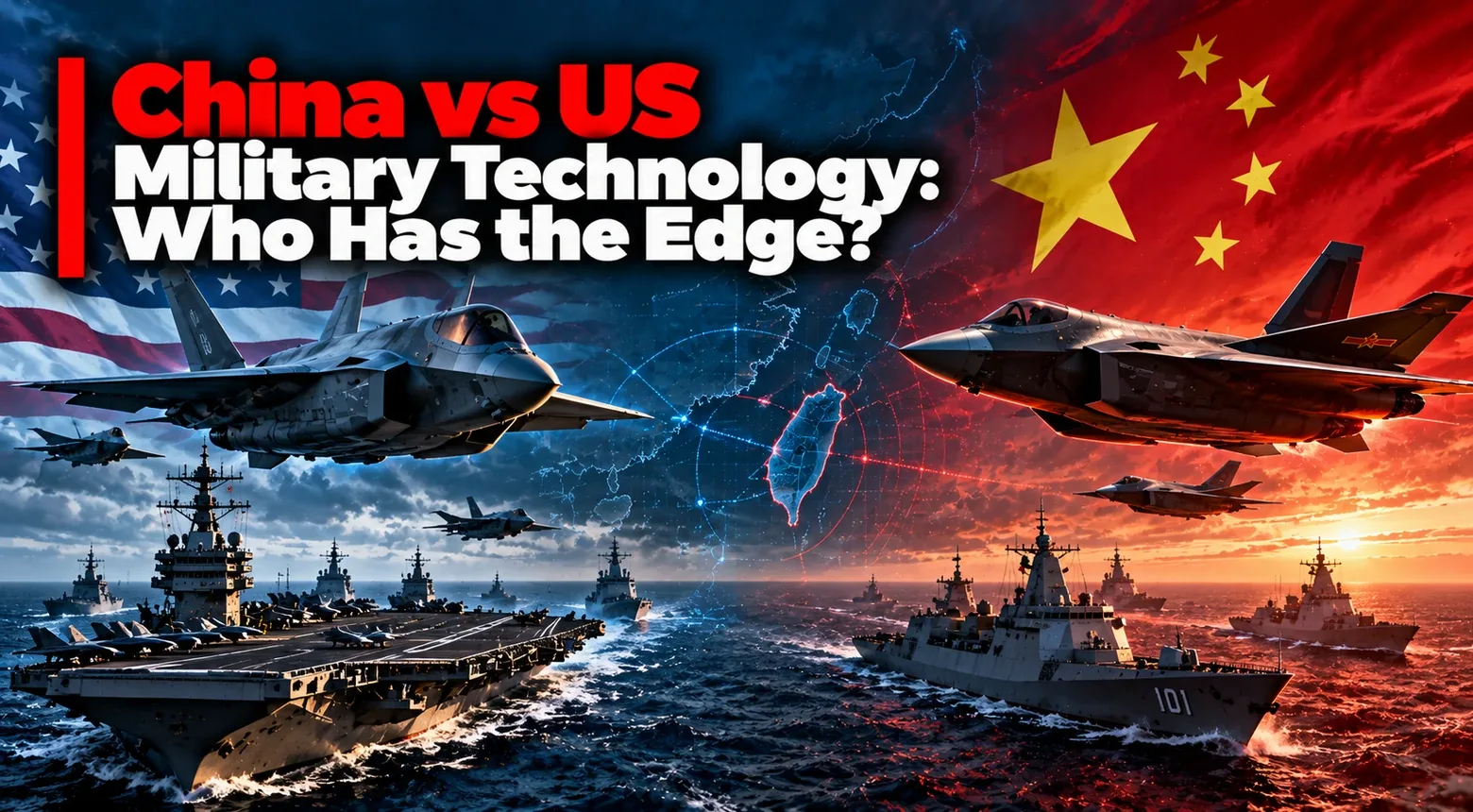
China vs US military technology in 2026 is not a contest with one universal winner. The United States retains the larger military expenditure and a broad set of mature power-projection capabilities, while China is expanding its regional military activity and industrial capacity. New evidence from the Stockholm International Peace Research Institute (SIPRI), US government auditors and Chinese budget authorities shows that combat readiness, geography, production and sustainment matter at least as much as the most advanced aircraft or missile.
The comparison has immediate relevance to Indo-Pacific defence planning. A force designed to fight near its own coastline faces very different logistics from one deploying across the Pacific. A bigger budget does not automatically provide more ready aircraft, a shipbuilding advantage does not prove superiority in every naval mission, and a successful weapon test is not the same as a deployed combat capability.
Key Facts
- 2025 US military expenditure: $954 billion, according to SIPRI's report published on 27 April 2026.
- 2025 Chinese military expenditure: approximately $336 billion, estimated by SIPRI using its comparable methodology.
- Spending ratio: US expenditure was approximately 2.8 times China's in 2025 on SIPRI's basis; this is not a combat-effectiveness ratio.
- China's announced 2026 defence budget: 1.94 trillion yuan in the national general public budget, up 6.9% on the preceding executed budget, according to China's Ministry of National Defense. This is not directly comparable to SIPRI's 2025 estimate.
- F-35 fleet mission-capable rate: 44% across the US fleet in fiscal year 2025, according to a US Government Accountability Office (GAO) report issued on 11 June 2026.
- Chinese Indo-Pacific activity: CSIS recorded a rise in observed PLA activity in several areas during 2025, reported on 5 February 2026.
- US space tracking procurement: the Space Development Agency announced contracts for 36 additional missile warning, tracking and defence satellites worth approximately $1.75 billion on 14 July 2026.
Who Has the Edge? The Answer Depends on the Mission
Comparing individual platforms is tempting: F-35 against J-20, carrier against carrier, missile against interceptor. That approach misses the systems that make those platforms useful. Airborne early warning, secure communications, ground support, satellite links, training, munitions inventories and repair capacity all affect combat power.
At global reach, the United States has a substantial advantage in its established network of allies, overseas bases and long-range expeditionary capabilities. Closer to China's mainland, geography favours Chinese forces in important respects: shorter logistics lines, land-based aircraft and missile forces, and the possibility of concentrating capabilities within a specific theatre. These are qualitative assessments of force structure, not predictions of an outcome in Taiwan or the South China Sea.
The distinction is also visible in operations. A CSIS ChinaPower analysis published on 5 February 2026 found increased Chinese military activity during 2025 around Taiwan, in the South China Sea, near Japan and beyond the First Island Chain. It documented observable operations, rather than demonstrating how either side would perform in a conflict.
Defence Budgets: The US Lead Is Real but Incomplete
The SIPRI figures published on 27 April 2026 put US military expenditure in calendar year 2025 at $954 billion and estimated China's at $336 billion. The gap is large, but buying power and accounting coverage differ. China's officially reported 2026 defence budget of 1.94 trillion yuan is expressed in a different currency, for a different year and with different reporting boundaries. Presenting the two figures as directly interchangeable would be misleading.
SIPRI's figures also capture spending that does not translate neatly into combat forces near Taiwan: US global commitments, personnel, overseas infrastructure and support activities are part of the wider picture. Equally, lower Chinese expenditure does not imply that advanced systems can be produced at any arbitrary cost or rate. Industrial inputs, labour costs, research capacity and procurement integrity are relevant and imperfectly visible.
The resulting editorial conclusion is narrow but important: the United States spent much more in 2025; neither country's spending total alone establishes superiority in a particular military operation.
Air Power: Stealth, Tankers and Mission Readiness
The United States operates an extensive ecosystem of fifth-generation aircraft, aerial refuelling, airborne battle management and global support. China's J-20 and other modern aircraft programmes reflect major progress in stealth aviation and sensor integration, but reliable open data on mission-ready inventories, detailed radar signatures and wartime sortie generation remain limited. A claim that one fighter would definitely defeat another would exceed the public evidence.
One revealing US benchmark is sustainment. In a GAO report published on 11 June 2026, the mission-capable rate across the F-35 fleet fell from 67% in fiscal year 2021 to 44% in fiscal year 2025. The full mission-capable rate fell from 38% to 25% over the same interval. Those fleet-wide figures concern availability across variants and services; they should not be mistaken for the survival probability or combat performance of an individual aircraft.
Both militaries are also studying crewed-uncrewed teaming. On 15 July 2026 the US Air Force reported an AIM-120 live-fire test from its YFQ-44A Collaborative Combat Aircraft at a digital target. This demonstrated a test milestone, not proof of operational deployment at scale or wholly independent lethal decision-making. Defence Agenda's separate analysis of AI fighter jets and crewed-uncrewed teaming explains the distinction between autonomous flight and human authority over weapons.
The balance in air power therefore depends on location and support as well as aircraft performance. Operations near Chinese bases may favour rapid local regeneration; longer-range US and allied operations rely on secure forward facilities, tankers and resilient logistical networks. The precise balance would change with mission objectives, timing and losses.
Naval Power: Fleet Size Is Not the Same as Sea Control
China's shipbuilding capacity is a strategic advantage in the contest to replace losses and grow fleets, particularly in its home region. The United States possesses sophisticated nuclear-powered aircraft carriers, attack submarines and an extensive allied maritime network. But a simple comparison of headline warship numbers is not a valid assessment: vessel definitions, displacement, weapons, sensors, endurance, maintenance and operational geography differ.
The industrial constraint on the US side is well documented. In testimony published on 22 April 2026, GAO said US Navy and Coast Guard shipbuilding programmes had suffered prolonged cost growth and delivery delays. It reported that Virginia-class submarine production had been running at approximately one boat per year as of June 2025, against a two-per-year goal. That is a production-rate observation at a specific point in time, not a permanent forecast.
A separate GAO report dated 27 August 2026 found that attack-submarine maintenance delays over a decade had produced more than 15,000 lost operational days and about $3.4 billion in costs. A 25 September 2026 GAO assessment estimated that revitalising four public naval shipyards could exceed $200 billion and take over 50 years under the examined plans. Both findings point to sustainment as a core determinant of readiness.
Meanwhile, China is exploring maritime autonomy. Defence Agenda reported on China's publicly displayed uncrewed surface vessels, but a parade or prototype demonstration cannot independently verify contested-environment autonomy, combat reliability or the size of a deployed fleet.
The practical question is not just who builds more hulls. It is who can maintain, crew, network, defend and regenerate useful maritime combat power during a prolonged crisis.
Hypersonic Missiles: A Competition in the Entire Kill Chain
China's investments in conventional missile forces and the US pursuit of long-range precision strike systems highlight a wider issue: a missile is only as effective as the chain that detects a target, maintains an accurate track, authorises engagement and assesses results. Hypersonic speed alone does not make a weapon impossible to intercept; equally, a demonstration of tracking or simulated engagement does not prove that a missile defence system can consistently defeat a realistic threat.
In a 17 July 2026 report, GAO found US Navy work to adapt the Zumwalt-class destroyers for Conventional Prompt Strike hypersonic weapons was about 24 months behind schedule. That underscores the gap between technology development and reliable fleet integration. China faces its own public-data limitations: system announcements do not disclose independent verification of every claimed performance parameter, mass-production output or operational doctrine.
For both countries, the strategically important capabilities are target detection, communications resilience, integrated defences, inventory depth and the speed at which munitions can be replaced. Missile range comparisons that omit those elements risk overstating precision-strike advantage.
Space and AI: Networks May Matter More Than Single Platforms
Satellite-enabled communications, positioning, early warning and surveillance can determine whether aircraft, ships and missile systems share timely data. In July 2026, the US Space Development Agency announced two agreements worth approximately $1.75 billion for 36 additional space vehicles in its Tranche 3 tracking architecture. These are contract awards and proposed capabilities, not evidence that all 36 satellites are already operating.
China is also developing military space and information capabilities, but public access to programme budgets, operational performance and resilience testing is uneven. Cyber operations and electronic warfare further complicate comparisons because many relevant capabilities are classified, and reported intrusions do not automatically establish the ability to disrupt a military system at a chosen time.
AI offers a parallel caution. Governments and companies may use the term for automated perception, maintenance prediction, data fusion, decision assistance or navigation. Those applications have very different maturity levels. A drone completing an autonomous flight path is not evidence that an AI command system can make lawful and dependable combat decisions under deceptive information, communications disruption and adversarial attack.
Operationally, the advantage is likely to come from systems that remain useful when satellites, datalinks and positioning are degraded. The robustness of networks, human decision processes and software validation deserves as much attention as the number of experimental AI systems announced.
China vs US Military Technology: Evidence-Based Comparison
| Domain | Observed US position | Observed Chinese position | Main caveat |
|---|---|---|---|
| Military spending | $954bn in 2025 (SIPRI) | Estimated $336bn in 2025 (SIPRI) | Spending is not operational combat power |
| Stealth air power | Mature F-35 fleet and broad support network; GAO reports readiness weaknesses | J-20 programme and expanding regional operations | Comparable readiness and signature data are not public |
| Naval industrial base | Advanced submarines and global deployments; production and maintenance backlogs | Large shipbuilding base and proximity to key theatres | Ship numbers alone do not measure effectiveness |
| Hypersonic and long-range strike | CPS integration continues; GAO documents delays | Substantial missile modernisation activity | Public performance data are incomplete |
| Space-enabled operations | Tranche 3 contracts for 36 planned satellites in July 2026 | Significant investment in military space and supporting networks | Contracts, launches and combat-ready capability are different milestones |
| Military AI and autonomy | YFQ-44A live-fire demonstration in July 2026 | Development and demonstrations across uncrewed domains | Neither side has publicly demonstrated general-purpose autonomous combat superiority |
| Geographic position | Global access through deployed forces and alliances | Concentration of assets closer to home theatres | Advantages vary by theatre, scenario and political decisions |
Methodology: This table separates measured expenditure, documented programme events and qualified assessments. It does not assign a universal numerical military-technology score, because common cross-national readiness and combat-effectiveness data do not exist in open sources.
Procurement, Industrial Capacity and Supply-Chain Risks
Over time, the most consequential advantage may be the rate at which each side turns research into functioning, supportable systems. For aircraft, ships and missiles, that means more than factory throughput. Certification, component availability, trained labour, secure software updates, spare parts and depot capacity determine whether production translates into sustained capability.
China's access to extensive commercial manufacturing can support military programmes, but integration, specialised components, supply-chain dependencies and governance are not automatically solved by volume. The United States benefits from a deep technology base, established suppliers and allied industrial partnerships, yet the GAO findings show that budgets and advanced design competence have not eliminated programme delays.
Export controls and emerging-technology restrictions can shape access to semiconductors and software. Their long-term effect is difficult to quantify from announcements alone. Procurement authorities should monitor verified deliveries and tested performance rather than assuming either restriction or subsidy produces an immediate military advantage.
Risks, Alternatives and Counterarguments
The strongest argument against a US technology lead is that China does not need to reproduce America's global military system to complicate intervention near its coastline. Concentrated sensors, aircraft, naval forces and long-range missiles could impose major operational costs on a force crossing the Pacific. In that region, US global superiority in particular categories may not translate into an uncontested local advantage.
The strongest argument against declaring China the new military technology leader is the limited public evidence on joint-force wartime readiness, sustained expeditionary operations, contested logistics and several advanced-platform performance claims. An impressive prototype, exercise or inventory estimate can coexist with significant integration and maintenance challenges.
A separate error is to assume that war would be decided by a bilateral inventory comparison. Allies, geography, political decisions, escalation management, economic resilience and civil infrastructure would all change the assessment. None of those variables can be reduced to a single credible 2026 score.
Implications / Next: What to Watch Through 2027
For analysts and procurement leaders, the next meaningful evidence will be measurable, independently attributable milestones. These include verified deliveries and operational assessments of collaborative combat aircraft; measurable improvements in F-35 readiness; Virginia-class submarine construction and maintenance rates; deployment rather than merely contracting of missile-tracking satellites; and observable changes in PLA training activity and logistical reach.
Industrial indicators are particularly valuable because they are harder to disguise with promotional imagery: production cadence, maintenance days lost, on-time deliveries, spare-parts availability, integration completion and multi-domain exercise results. Evaluating these trends at regular intervals offers a more useful view than repeatedly asking which single platform is superior.
Conclusion
The United States retains a clear measured spending lead and broad global military capabilities, while China poses an increasingly capable regional challenge supported by its manufacturing base and proximity to major Indo-Pacific theatres. The evidence available in October 2026 does not justify a universal winner in China vs US military technology. The strategic edge is contingent: readiness, logistics, industrial endurance, communications resilience, allies and specific mission geography will determine which advanced systems are actually usable.
Further Reading
- Defence Agenda — AI Fighter Jets 2026
- Defence Agenda — China Debuts Swarm-Capable USVs
- Defence Agenda — Drone Warfare 2026: AI, Robots and Swarms
- SIPRI — Global military spending report, 27 April 2026
- China's Ministry of National Defense — 2026 defence budget arrangement
- CSIS ChinaPower — 2025 military activity review, 5 February 2026
- GAO — Navy shipbuilding report, 22 April 2026
- GAO — F-35 sustainment report, 11 June 2026