The Royal Navy autonomous mine shift is accelerating. As a result, Thales has secured a contract to deliver AI-enabled Remote Command Centres for uncrewed mine countermeasures. [1]
Thales has won a contract from the UK’s Defence Equipment and Support (DE&S) to design and deliver a new generation of Royal Navy autonomous mine Remote Command Centres. The initial phase is valued at £10 million. However, the programme is structured to grow to around £100 million as capability matures. [1]
Key Facts
- Thales will deliver containerised Remote Command Centres to coordinate uncrewed mine countermeasures.
- The first phase is £10m, with expansion potential to about £100m as the system scales.
- The configuration pairs M-Cube mission management with Mi-Map, an AI-enabled analysis tool.
- The aim is to let operators control and monitor multiple assets from one suite.
- Thales says the work supports 200+ skilled roles across Somerset and Plymouth, plus UK supply chain jobs.
Royal Navy autonomous mine countermeasures: What the Navy is buying
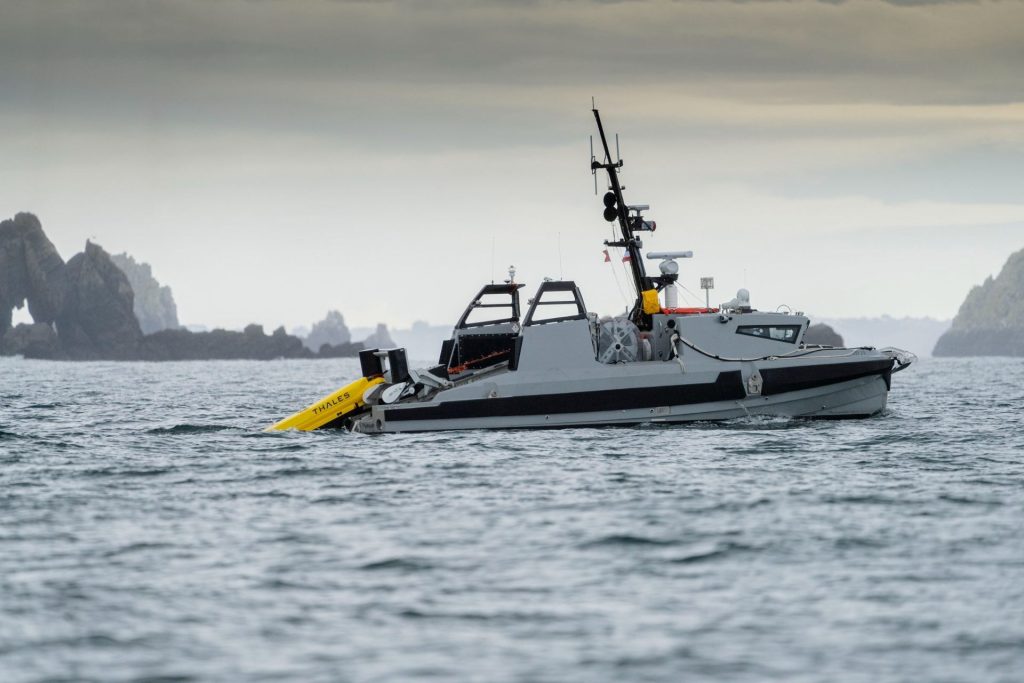
The programme modernises how the Royal Navy finds and neutralises sea mines. Instead of relying on crewed minehunters, the concept moves mission control into compact, modular hubs. These hubs can be hosted on ships, at shore bases, or at other facilities. [1]
Crucially, the Remote Command Centres are designed to coordinate a system of systems. In other words, they connect unmanned surface vessels, autonomous underwater vehicles, and sensor payloads through a common operating picture. Therefore, operators can plan, task, and assess missions without switching between disconnected tools. [1]
Royal Navy autonomous mine warfare: Why AI-enabled remote C2 matters
Mine countermeasures is a high-risk mission set. Therefore, distance from the threat is a direct safety advantage. Remote command hubs allow missions to continue while sailors stay physically removed from mined waters. As a result, the Royal Navy can preserve presence while reducing exposure. [1]
At the same time, the UK is operating in a more contested maritime environment. Undersea infrastructure and major sea lines of communication face higher levels of pressure. Consequently, faster detection, classification, and decision support matter more than ever. [1]
Royal Navy autonomous mine software stack: M-Cube, Mi-Map, and cortAIx
Thales is building the Royal Navy configuration around M-Cube, its mission management suite. M-Cube supports planning, tasking, and evaluation for mine clearance. Importantly, it is designed to integrate both autonomous and conventional methods. [1]
In addition, the system pairs M-Cube with Mi-Map, an AI-enabled analysis tool. Mi-Map is designed to filter and classify underwater sensor data at speed. As a result, it can reduce analyst workload and support quicker decision cycles. Thales also says the model improves as it learns from operational use. [1]
Thales is supporting that AI delivery through cortAIx, its internal accelerator for critical-system AI, cyber, and advanced sensing. The company says it uses this approach to shorten the pathway from research to deployable capability. Consequently, updates can arrive through iteration rather than long refresh cycles. [1]
Royal Navy autonomous mine hardware: Containerised command centres
The initial hardware is delivered as twin modular containers. However, the concept is expandable. Thales describes growth paths ranging from shipboard installations to larger shore operations centres. Therefore, the Royal Navy can scale the footprint to match mission needs. [1]
Industrial impact and the UK supply chain
Beyond capability, the contract has an industrial dimension. Thales says the work will support 200+ skilled roles at sites in Somerset and Plymouth. Moreover, it is expected to draw on a wider UK supply chain across autonomy, sensors, secure communications, and containerised systems. [1]
UK officials have framed the programme as both a readiness decision and an economic one. In practice, that means the Royal Navy can modernise while sustaining a domestic industrial base for autonomy-enabled maritime systems. [1]
What to watch next
First, the programme focuses on design and early delivery. Next, it should expand as integration deepens and more uncrewed assets come online. In parallel, the Royal Navy will need to refine concepts of operation for Royal Navy autonomous mine missions. For example, it must decide how many assets a single command team can supervise at once.
Finally, the success metric will operational tempo. If the AI toolchain reduces analysis time and increases mission throughput, then the Hybrid Navy transition gains credibility. If not, the Royal Navy will still need additional process and training reforms.
Further Reading
- Hybrid Navy transition and uncrewed fleets [4]
- Uncrewed mine countermeasures systems: USVs, AUVs, and mission payloads [5]
References
- Thales press release: “Thales secures major contract to transform Royal Navy mine countermeasures with AI powered remote command centres” (29 Dec 2025)
- UK Government: Defence Equipment and Support (DE&S)
- Thales: Defence & Security
- Defence Agenda analysis: Royal Navy Hybrid Navy transition and uncrewed fleets
- Defence Agenda explainer: Uncrewed mine countermeasures systems