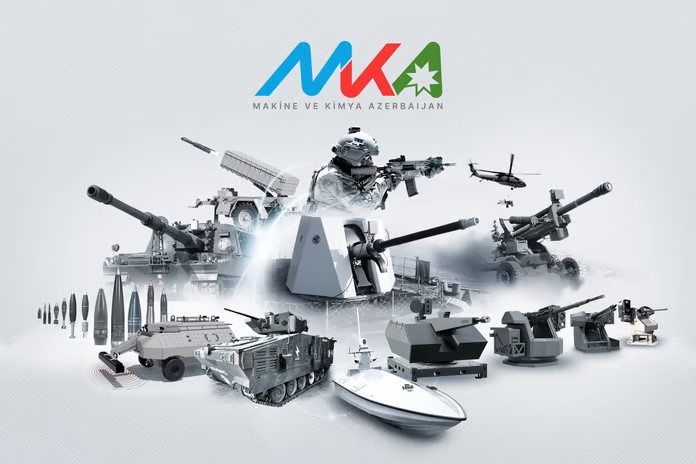
Türkiye and Azerbaijan are opening a new chapter in defence industry with the launch of Makine and Kimya Azerbaijan (MKA) in Baku. The new company, fully owned by Türkiye’s long-established manufacturer Makine ve Kimya Endüstrisi (MKE), anchors the MKE Azerbaijan defence industry partnership on an institutional and long-term footing.
The MKE Azerbaijan defence industry partnership centres on MKA as a vehicle for joint production, technology transfer and local employment. By formalising this structure, both countries aim to turn political solidarity into concrete capability gains for their armed forces and defence ecosystems.
MKE Azerbaijan Defence Industry Platform: Structure and Purpose
MKE is one of Türkiye’s most experienced defence manufacturers. Through MKA, it will replicate parts of its high-technology production base in Azerbaijan. The group is already installing a cartridge production line for Azersilah, the defence company under Azerbaijan’s Ministry of Defence Industry. This project offers an early example of how MKA will localise critical manufacturing and share know-how between the two countries.
Under the new framework, future facilities in Azerbaijan will produce a range of defence products for both Turkish and Azerbaijani requirements. These may include ammunition, components for land systems and other high-value items agreed by Ankara and Baku. In practice, key capability areas will no longer rely only on imports. Instead, they will draw on a shared industrial base that spans both sides of the Caspian.
Joint Production, Local Content and Regional Reach
The joint production model also supports long-term industrial development. As MKA expands, it will create skilled jobs in Azerbaijan and deepen the local supply chain. Over time, Azeri companies can move up the value chain from basic subcontracting toward co-development and design work. For MKE, the investment strengthens its brand, extends its global footprint and reinforces its role as a leading exporter of Turkish defence systems.
MKA also serves as MKE’s gateway into the wider Caucasus and Central Asia. With its capital fully owned by MKE, the company can act as a regional hub for business development, offset programmes and after-sales support. Production in Azerbaijan will not only serve the Turkish and Azerbaijani armed forces. It will also reach friendly and allied countries that seek NATO-compatible systems with flexible industrial participation options.
This regional positioning aligns with Ankara’s defence export strategy and Baku’s ambition to become a defence industrial centre in the Turkic world. By pooling resources, Türkiye and Azerbaijan can offer integrated solutions that combine platforms, ammunition and lifecycle support under one umbrella. In a competitive global market, such complete packages are often more attractive than stand-alone products.
Strategic Significance for Türkiye–Azerbaijan Defence Cooperation
The creation of MKA also carries strategic signalling value. It shows that Türkiye and Azerbaijan intend to embed their “one nation, two states” motto directly into the defence industrial domain. Joint facilities, shared technology and co-branded exports send a clear message about long-term strategic alignment and mutual trust. This message matters for deterrence as well as diplomacy, because partners and investors look for continuity in major defence projects.
From an operational perspective, the cooperation promises practical benefits for both armed forces. Common products mean common maintenance concepts, shared training pipelines and more efficient logistics. Ammunition and spare parts produced under the MKA umbrella can support both Turkish and Azerbaijani units. This reduces lead times and simplifies stock management during joint exercises and real-world contingencies.
Next Steps and Outlook
Looking ahead, success will depend on careful execution. The partners will need clear local content targets and technology protection rules. They will also need a realistic roadmap for product families to be produced in Azerbaijan. Strong programme management and transparent decision-making will help keep timelines and budgets on track while protecting sensitive intellectual property.
Nonetheless, the strategic direction is clear. As Europe and its neighbourhood rearm, demand for cost-effective and scalable land systems will remain high. By combining MKE’s industrial heritage with Azerbaijan’s political will and geographic position, the MKE Azerbaijan defence industry partnership is well placed to meet that demand. If implemented effectively, MKA can evolve from a single investment decision into a lasting pillar of regional security architecture.
For readers who want more context on regional developments, see our analysis of Turkey–Hungary defence industry cooperation and our overview of Türkiye’s evolving defence export strategy towards 2030. For an official corporate profile of MKE, visit the company’s website.