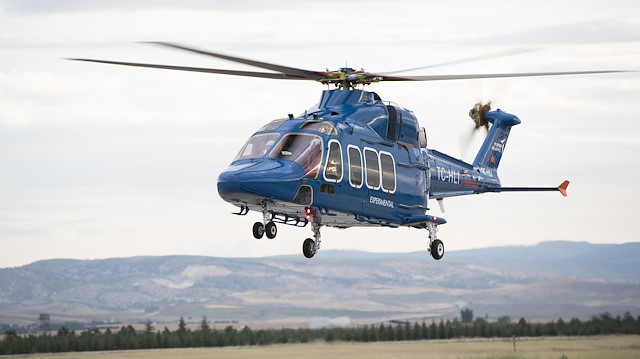
GÖKBEY civil certification is nearing a major milestone for Türkiye’s aerospace industry. Turkish Aerospace Industries (TUSAŞ) says the helicopter is expected to receive domestic civil certification by the end of March 2026. If completed as planned, this will be the first helicopter designed and built in Türkiye to receive civil certification from the country’s own Directorate General of Civil Aviation. The step would move GÖKBEY beyond a defence platform and into regulated civil aviation use.
Key Facts
- Date of statement: 06 March 2026, updated 07 March 2026
- Speaker: TUSAŞ General Manager Mehmet Demiroğlu
- Milestone: GÖKBEY is expected to receive domestic civil certification by the end of March 2026
- Next step: Air ambulance certification is expected 3–4 months after the first approval
- Planned delivery: 3 helicopters are scheduled for delivery to Türkiye’s Ministry of Health by the end of 2026
- Additional programme note: A 10-ton firefighting helicopter with 4-ton water-carrying capacity is planned for delivery from 2028
- Export signal: HÜRJET discussions with Spain currently point to 30 aircraft, with possible growth to 45
Why GÖKBEY Civil Certification Matters
This milestone matters because it takes GÖKBEY into the civil aviation domain. That is important for several reasons. It shows that a helicopter developed in Türkiye can meet domestic civil airworthiness requirements. It also opens the door to public-service missions such as air ambulance operations. Just as importantly, it gives TUSAŞ a way to extend defence aerospace know-how into civil applications.
Speaking at the “Kamp’üss” event at Hacettepe University in Ankara, Demiroğlu said GÖKBEY had been designed from the start with civil certification in mind. He said the certification work had been completed this month and that the formal award from Türkiye’s civil aviation authority was expected by the end of March 2026.
GÖKBEY and the Air Ambulance Pathway
Demiroğlu said the next stage after basic civil approval would be certification for an air ambulance version. He said that approval could come within three to four months after the first certification. He also stated that three helicopters would be delivered to the Ministry of Health by the end of 2026 for ambulance service.
This matters because it shows GÖKBEY is being positioned for more than one role. TUSAŞ appears to be building a wider mission set around the platform. That approach could support both state service missions and broader civil use. For the Turkish aerospace base, that creates a stronger long-term case for production, support and fleet growth.
The design approach is also significant. A platform built with civil requirements in mind from the beginning usually has a stronger certification path. It can reduce redesign work later. It can also improve documentation, testing discipline and operational credibility.
TUSAŞ Frames the Milestone as Part of a Larger Journey
At the same event, Demiroğlu described TUSAŞ’s growth as part of Türkiye’s long aerospace independence journey. He said the country had a competitive aviation base in the 1930s and 1940s. He added that this momentum later weakened. In his view, the lessons of the 1964 Cyprus crisis and the 1974 embargo pushed Türkiye back toward indigenous aerospace development.
He said TUSAŞ grew from two small huts in 1973 into a large aerospace complex that now covers 4 million square metres. He also highlighted major programmes such as KAAN, HÜRJET, ANKA, AKSUNGUR and ATAK-2.
This context matters because TUSAŞ is presenting GÖKBEY as more than a single helicopter programme. The company is linking it to a wider national effort built on certification, exports, industrial depth and sovereign capability.
Firefighting Helicopter Adds a Civil Use Case
Demiroğlu also referred to a firefighting helicopter under development for the General Directorate of Forestry. He said the aircraft would be a 10-ton platform with a 4-ton water-carrying capacity. Deliveries are expected to begin in 2028.
Together with the ambulance version, this points to a wider civil and public-service role for Turkish rotorcraft production. It shows how defence and aerospace engineering can support emergency response and disaster management as well.
That has industrial value. Dual-use programmes can improve resilience. Defence demand may support the early phase, while civil missions can add operational legitimacy and new procurement channels.
HÜRJET, Spain and the Engine Question
Demiroğlu also commented on HÜRJET discussions with Spain. He said the current figure is 30 aircraft, with the potential to rise to 45. At the same time, he underlined a broader challenge: propulsion.
He described engine technology as one of the hardest areas in defence and aerospace. He also said Türkiye must continue working on indigenous engines, especially for high-end programmes such as KAAN. Until then, external supply will remain part of the equation.
This point is relevant to GÖKBEY as well. Certification is important, but long-term success depends on subsystem reliability, supply continuity and sustainment performance. In other words, the certificate is a major step, but it is not the final test.
Universities and the Industrial Ecosystem
Hacettepe University Rector Prof. Dr. Mehmet Cahit Güran also spoke at the event. He described the rise of a “fourth-generation university” model. In his definition, universities do more than teach and research. They also take a more active role in solving social and regional challenges.
Güran said defence and aerospace technologies are not only tools of military power. He argued that they are also indicators of scientific progress, engineering capacity and national independence. He added that Hacettepe aims to train engineers who can serve in strategic institutions such as TUSAŞ.
That point strengthens the broader picture. Civil aviation capability depends on more than manufacturing. It also requires a steady talent pipeline, engineering culture and strong university-industry ties.
Assessment
If GÖKBEY receives the expected approval by the end of March 2026, it will mark a real milestone for Türkiye’s civil aviation sector. It will show that indigenous helicopter development can move into the civil certification space under domestic authority.
The next challenge will be execution. The key tests will be follow-on certifications, ministry deliveries, fleet entry and long-term support performance. Those factors will decide whether this becomes a one-off symbolic success or the start of a deeper Turkish civil rotorcraft presence.
For now, the direction is clear. GÖKBEY is becoming more than a defence platform. It is turning into a test case for whether Türkiye can convert indigenous aerospace development into certified and service-ready civil aviation capability.
Further Reading
- Anadolu Agency: GÖKBEY’e sivil sertifikasyon için geri sayım
- TUSAŞ: T625 GÖKBEY product page
- SHGM: SHT-21 Certification framework
- SHGM: Design organisation approval for the T625 GÖKBEY project
- Turkish Aerospace: Airbus agreement to boost HÜRJET exports
- FlightGlobal: Spain signs for 30 TAI Hürjet trainers