Bayraktar Kızılelma has reached another important milestone after Baykar confirmed the platform’s air-to-ground strike capability on 15 March 2026. The test matters because it moves Türkiye’s jet-powered uncrewed fighter closer to operational relevance, not only as a reconnaissance asset but as a precision-strike platform designed for manned-unmanned teaming. The result also strengthens the case for Kızılelma as a future loyal wingman for the Turkish Armed Forces.
Key Facts
- Test milestone: Baykar confirmed Kızılelma’s air-to-ground strike capability on 15 March 2026.
- Platform class: Jet-powered uncrewed fighter designed for high-speed, high-survivability operations.
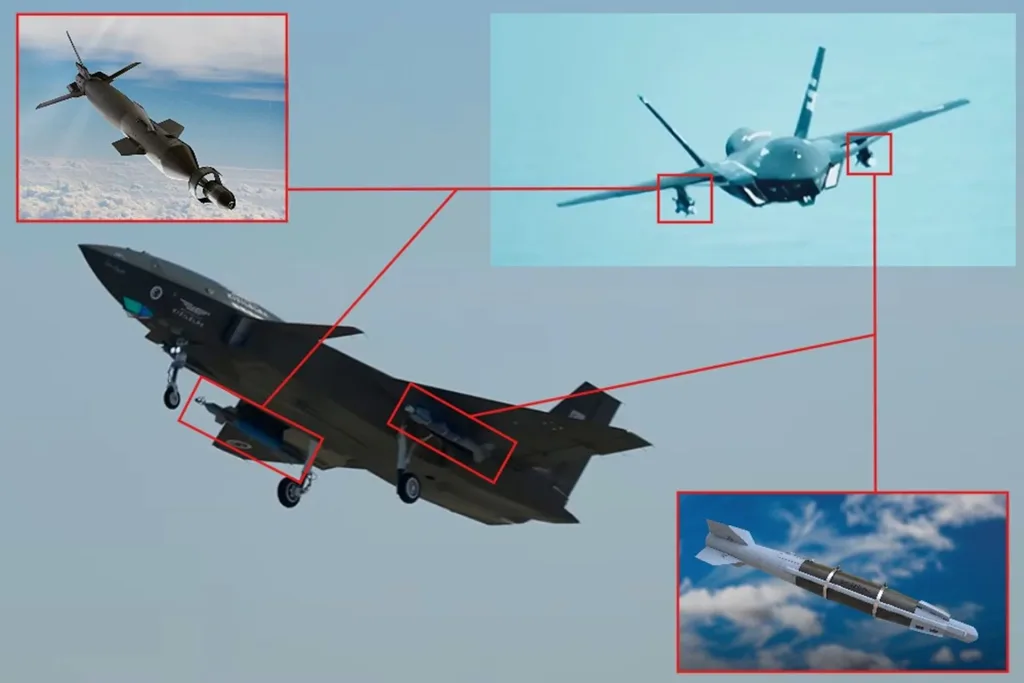
- Munition integration: The aircraft released LGK-82 and TEBER-82 guided munitions during live-fire trials.
- Top speed: Up to Mach 0.9.
- Combat radius: Around 500 nautical miles.
- Service ceiling: Up to 45,000 feet.
- Operational concept: Loyal wingman missions with crewed fighters, including future teaming with KAAN.
Bayraktar Kızılelma moves closer to combat relevance
The latest live-fire tests mark an inflection point for the Bayraktar Kızılelma programme. Until now, the aircraft has drawn attention mainly for its speed, low-observable design logic and potential role in future manned-unmanned teaming. The confirmation of accurate weapon release changes the discussion. It shows that Kızılelma is evolving into a multi-role combat asset rather than remaining a fast uncrewed demonstrator.
That shift is strategically important for Türkiye’s defence planning. A jet-powered uncrewed fighter that can conduct strike missions, support crewed aircraft and absorb risk in contested airspace expands operational flexibility. It also opens a path toward a force structure in which high-value manned platforms can operate with lower exposure during complex missions.
Strike tests validate smart munition integration
During the reported live-fire activity, Baykar used two domestically developed guidance systems. The first was ASELSAN’s LGK-82, a laser guidance kit fitted to the 500-pound MK-82 general-purpose bomb. The second was ROKETSAN’s TEBER-82, which combines laser guidance with GPS and inertial navigation.
This distinction matters. The LGK-82 supports semi-active laser homing against fixed or moving targets, including hardened positions and armoured vehicles, over several kilometres. The TEBER-82 adds a broader targeting envelope by enabling both pre-planned and dynamic engagements with metre-level precision and longer stand-off utility.
For Kızılelma, the successful integration of both kits broadens the mission set considerably. The aircraft is no longer positioned only for ISR support, electronic warfare or decoy-style operations. It is now moving toward a precision-strike role that can be scaled across different mission profiles.
What makes Bayraktar Kızılelma different
Bayraktar Kızılelma occupies a different category from earlier Baykar platforms such as the Bayraktar TB2 and Akıncı. While those systems demonstrated the export and battlefield value of propeller-driven uncrewed aircraft, Kızılelma is designed for a more demanding operational environment.
The aircraft measures 14.5 metres in length, with a 10-metre wingspan and a height of 3.5 metres. It can reach a top speed of Mach 0.9 and cruise at approximately Mach 0.6. Baykar states that the platform offers a combat radius of 500 nautical miles, endurance of more than three hours, a service ceiling of 45,000 feet, and a typical operating altitude of roughly 25,000 feet.
Those figures point to a clear design philosophy. Kızılelma is intended to combine speed, survivability and payload flexibility in ways that are difficult for slower propeller-driven systems to match. It also aligns with a concept of operations that requires rapid ingress, coordinated strike timing and closer integration with crewed fighter packages.
Loyal wingman concept gains practical shape
The Kızılelma programme is central to Türkiye’s manned-unmanned teaming vision. In practical terms, that means the aircraft is expected to operate alongside crewed fighters, contribute to reconnaissance and electronic warfare, deliver precision weapons, and potentially draw hostile fire away from human pilots.
This is why the loyal wingman framing matters more than the headline speed figures. The platform is being developed for distributed combat roles in which an uncrewed aircraft can extend sensor reach, increase magazine depth and complicate enemy decision cycles. When paired with aircraft such as the F-16 and the future KAAN, Kızılelma could provide a more layered and resilient strike package.
The aircraft’s compatibility with short-runway operations and its intended suitability for operations from TCG Anadolu add another dimension. That gives Türkiye the prospect of generating fixed-wing uncrewed combat airpower from sea-based platforms, a capability that remains rare in global service.
Domestic industrial depth is part of the message
The Kızılelma test campaign also reflects a broader industrial point. Baykar is developing the air vehicle, while ASELSAN and ROKETSAN are supplying critical guidance and munition components. That integration reinforces Türkiye’s long-standing push to build a more self-reliant defence industrial base across airframes, payloads and mission systems.
This matters operationally as much as politically. Programmes built on domestic subsystems usually offer better control over upgrade cycles, software changes, export policy and sustainment planning. For a next-generation uncrewed fighter, that level of industrial control can become a decisive advantage over time.
Why this milestone matters now
The successful strike trials suggest that Kızılelma is transitioning from a high-visibility prototype into a more credible operational system. The reported first deliveries in the first quarter of 2026 place additional weight on that timeline. A carrier-capable, jet-powered uncrewed fighter with precision-strike functionality would give Türkiye a distinctive capability in the evolving combat drone market.
There is still a difference between a successful weapons release and fully mature operational service. The next meaningful indicators will be sustained test tempo, repeatable mission performance, systems integration under realistic combat conditions and evidence of reliable teaming with crewed aircraft. Even so, the latest result is significant because it confirms that the programme is moving in the right direction.
Strategic assessment
Bayraktar Kızılelma is no longer only a symbol of ambition. With validated weapon release and a growing role in Türkiye’s loyal wingman architecture, it is becoming a serious element of future airpower planning. The combination of jet propulsion, smart munition integration, low radar cross-section and potential carrier operations gives the platform a profile that stands apart in the uncrewed combat aircraft segment.
For Türkiye, the implication is clear. Kızılelma could become one of the earliest operational examples of a domestically integrated, precision-strike loyal wingman built around national industrial capabilities and tailored for both land-based and sea-based missions.