Baykar K2 Kamikaze UAV entered the public spotlight on 14 March 2026 after Baykar disclosed successful five-aircraft swarm autonomy trials over the Gulf of Saros. The milestone matters because it points to a new layer in Türkiye’s unmanned strike portfolio: a larger, longer-range, and more autonomous expendable or attritable platform designed to deliver effects at lower cost than many traditional precision-strike options. If the concept matures beyond testing, K2 could widen the menu of massed strike tools available for contested environments where electronic warfare, distance, and cost pressure increasingly shape force design.
Key Facts
- Date announced: 14 March 2026
- Test location: Keşan Flight Training and Test Center, Edirne, with sorties over the Gulf of Saros
- Formation size: 5 K2 Kamikaze UAVs
- Formations flown: right echelon, line, and V formation
- Published payload claim: up to 200 kg warhead
- Published performance claim: 800 kg MTOW, 2,000+ km range, 200+ km/h speed, 13+ hours endurance
- Operational claim: navigation and strike capability in GNSS-denied or heavily jammed environments
Why the Baykar K2 Kamikaze UAV matters
The K2 announcement is important for two reasons. First, it shows Baykar moving further into the mass and autonomy side of modern airpower. Second, it suggests a deliberate effort to field a platform that can sit between a classic loitering munition and a more expensive armed UAV. That middle ground is drawing global attention because armed forces now need systems that can be produced at scale, absorb attrition, and still offer meaningful range and warhead effect.
Baykar framed K2 as part of a cost-effective defence solutions strategy. In practical terms, that means using a lower-cost platform to pressure high-value targets without consuming scarce and expensive stand-off missiles for every mission. This logic has become more relevant as recent conflicts have shown the value of affordable mass, distributed strike packages, and autonomous teaming.
Swarm autonomy moves from concept to visible testing
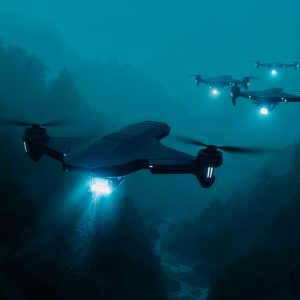
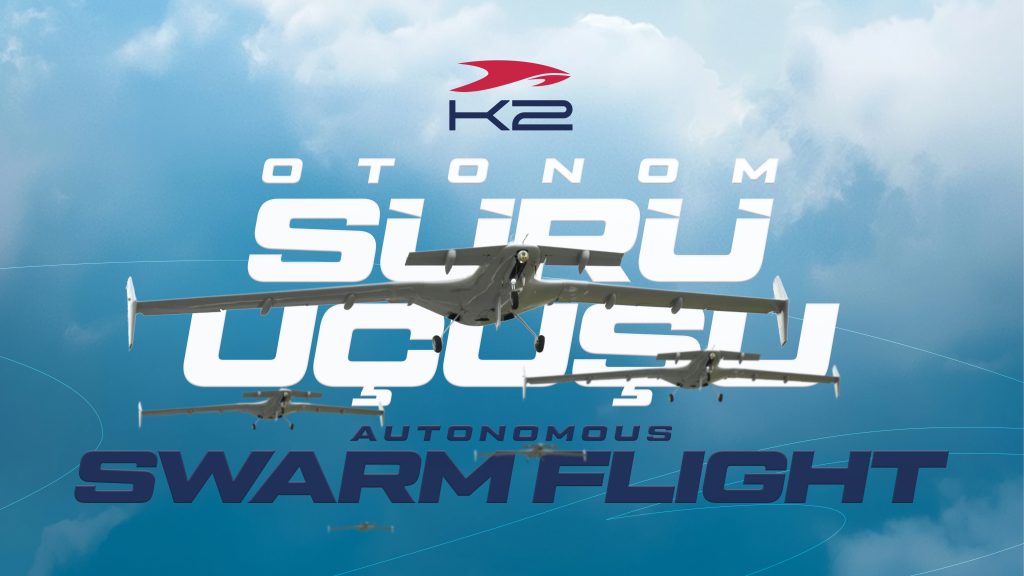
According to Baykar, five K2 aircraft flew over two days on 13 March 2026 and 14 March 2026. During those sorties, the aircraft executed right echelon, line, and V formations while using onboard artificial intelligence, sensors, and software to hold position within the group. Baykar also said the platform can perform other formations, including “Turan” and “wall” arrangements.
That point deserves attention. Formation flight alone does not equal full collaborative autonomy. However, reliable multi-aircraft formation control is a meaningful building block. It supports later steps such as distributed reconnaissance, route deconfliction, target allocation, decoy behaviour, and coordinated terminal attack. In other words, K2’s current test profile appears to validate the basics of group behaviour that future operational concepts would require.
GNSS-denied navigation is a key design choice
One of the most notable claims in Baykar’s release concerns navigation under electronic attack. The company says the K2 seyrüsefer architecture is designed to function even when global navigation satellite systems are unavailable or under heavy jamming. In those conditions, the UAV is said to use a gimbal camera and a night-capable belly camera to scan terrain visually and estimate position.
This matters because the credibility of many low-cost unmanned strike systems drops sharply in dense electronic warfare environments. A platform that can keep navigating, searching, and approaching the target without dependable satellite signals would be more relevant for high-end conflict. This feature, if proven at scale and under realistic stress, could become one of K2’s strongest operational differentiators.
Large warhead, long range, and short-strip flexibility
Baykar describes the K2 as the largest kamikaze platform in its class. The published figures are notable: 800 kg maximum take-off weight, 200 kg warhead, more than 2,000 km range, speed above 200 km/h, and endurance above 13 hours. The company also says the aircraft can operate from short runways, which would improve dispersal and field logistics.
Those numbers place K2 in a category that looks larger and more strategically oriented than many tactical loitering munitions. Based on the published specifications, the platform appears less like a small expendable battlefield drone and more like a long-range attritable strike system that could be used for deep attack, saturation pressure, or high-risk missions in defended airspace. That does not make it a substitute for every missile or armed UAV. It does, however, suggest a new cost-performance trade space for planners.
Recoverable versions could expand the concept
Baykar also signalled a potentially important next step. The company said future versions may be able to release their munition on the target and then return to base for reuse. If that roadmap materialises, K2 would move beyond a pure one-way attack profile and toward a more flexible attritable architecture.
That shift would matter for both cost and force structure. Reusable variants can support training, reconnaissance, and lower-risk strike roles without treating the airframe as a single-use asset. They may also allow operators to adapt the same basic platform to multiple mission types. For procurement planners, that kind of commonality can improve inventory efficiency and sustainment logic.
Programme context: Baykar’s wider industrial momentum
The K2 reveal arrives as Baykar continues to link product development with export-led industrial scale. The company said it achieved $2.2 billion in exports in 2025, with exports accounting for 88% of total revenue. Baykar also states that it has signed export agreements with 36 countries for the Bayraktar TB2 and 16 countries for the Bayraktar AKINCI, for a total of 37 countries across the two platforms.
That context matters because mass production, supply-chain depth, and international demand often determine whether a new unmanned concept remains a demonstrator or becomes a durable programme. Baykar’s recent trajectory suggests it has both the industrial confidence and the market incentive to explore adjacent product classes quickly.
Assessment: strengths, caveats, and what comes next
K2’s early profile has three obvious strengths. It promises scale. It is designed for autonomy. It also appears tailored for contested electronic warfare conditions. Together, those traits match a clear battlefield trend: forces want more low-cost, AI-enabled strike mass without surrendering range or effect.
Still, caution is warranted. Most public claims so far come from Baykar’s own release. Independent testing data is limited, and key questions remain open. These include survivability against layered air defence, communications resilience in a large swarm, terminal accuracy under combat conditions, and real unit cost at production scale. The practical value of K2 will depend on how well the system performs under those harder conditions.
Even so, the debut is strategically significant. Türkiye is no longer only iterating on medium-altitude armed UAVs. It is also expanding into autonomy-heavy, attritable strike concepts that reflect the lessons of recent wars. For Baykar, K2 is more than a new air vehicle. It is a signal that the company wants a place in the next debate over affordable combat mass.
Further Reading
- Bayraktar AKINCI passes 150,000 flight hours
- Kızılelma Gökdoğan missile test
- Baykar official release: K2 Kamikaze UAV takes the field
- Defense News: Baykar tests swarm behaviour of its K2 drone
- Janes: Türkiye debuts K2 Kamikaze OWA UAV
- Baykar official release: global UCAV export leader in 2025