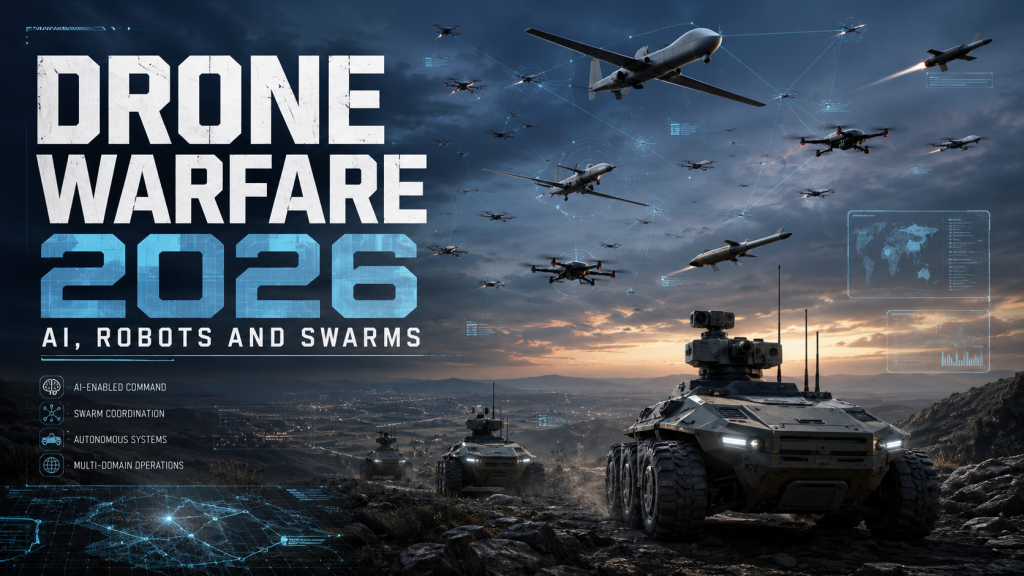
Drone warfare 2026 has entered a more complex phase. Ukraine’s battlefield shows that FPV drones, unmanned ground vehicles, AI-enabled targeting and open digital command systems can alter tactical outcomes with striking speed. Yet the same war also exposes the limits of drone-centric warfare: electronic warfare, short-range air defence, hardened infrastructure and mass counter-UAS adaptation are already compressing the advantage.
Key Facts
- Ukraine said in April 2026 that Russian soldiers surrendered to a position taken by aerial drones and ground robots without a Ukrainian infantry assault.
- Ukraine’s Defence AI Center A1 argues that AI will increasingly connect drones, ground robots and information systems into a coordinated battlefield network.
- Delta, Ukraine’s situational awareness system, has become a practical case study in software-defined command and control.
- RUSI warns that NATO should not treat drones as a substitute for artillery, air power, armour or traditional firepower.
- China’s PLA continues to study UAV swarms and manned-unmanned teaming, but mature autonomous swarm command and control remains a contested frontier.
- The operational lesson is not “drones replace armies”; it is that networked, attritable, software-updated systems now reshape how armies see, decide and strike.
From Drone Attrition to Machine-Led Tactical Shock
The most striking battlefield signal came from Ukraine’s reported use of drones and ground robots to capture a Russian position without committing infantry to the assault. Ukrainian officials described the episode as a wartime first: Russian soldiers surrendered after aerial drones and unmanned ground vehicles isolated the position and forced its collapse. The tactical meaning is larger than the incident itself. It suggests that unmanned systems can now produce not only reconnaissance or strike effects, but also coercive ground-control effects when they combine surveillance, psychological pressure, fire threat and remote manoeuvre.
This does not mean that infantry has become obsolete. It means that infantry increasingly operates inside a machine-mediated battlespace. Drones locate, fix and harass. Ground robots move into lethal zones. Operators and commanders orchestrate pressure from outside the immediate line of fire. In the best case, this reduces casualties and allows a smaller force to generate local overmatch. In the worst case, it creates a fragile illusion that cheap machines can deliver operational success without the logistics, combined-arms integration and mass required to hold terrain.
Ukraine’s AI Strategy: Survival, Not Experimentation
Ukraine’s AI push is not a laboratory project detached from combat. It is an adaptation cycle driven by manpower constraints, ammunition pressure and the need to extract more effect from every sensor and munition. On 4 May 2026, Ukraine’s Ministry of Defence said artificial intelligence was already making weapons smarter by helping drones resist electronic warfare and complete missions even without a stable operator link. The stated next step is a unified “digital organism” in which drones, ground robots and information systems work as a coordinated network [1].
Reuters reported on 21 January 2026 that Ukraine’s new defence leadership was pursuing a data-driven overhaul of the military, including mission-control systems for drone flights and mechanisms to use wartime combat data for AI training with allies [2]. That is strategically important. AI advantage in this theatre will not come from a single exquisite platform. It will come from feedback loops: millions of hours of drone footage, target-recognition models trained on real combat data, faster assessment of crew effectiveness, and software updates pushed to systems already in the field.
The implication for NATO and partner militaries is direct. Procurement models built around slow platform cycles are poorly suited to a battlefield where software, sensors and countermeasures change weekly. Ukraine’s wartime model is not fully transferable to peacetime bureaucracies, but it demonstrates a core principle: the force that shortens the sensor-to-software-to-shooter loop gains tempo.
Open Architecture Is Becoming a Combat Capability
The open-architecture debate is no longer abstract. Ukraine’s Delta situational awareness system has become one of the clearest examples of software-defined warfare. CSIS described Delta as a platform that evolved from a focused situational awareness tool into an integrated command-and-control ecosystem serving multiple levels of the Ukrainian military [3]. Its value lies not simply in mapping the battlefield, but in fusing drones, satellites, sensors, reconnaissance inputs and applications into a usable operational picture.
That stands in contrast to many traditional Western defence systems, which often optimise for proprietary control, long certification timelines and closed integration pathways. Delta’s lesson is different: start with a useful operational tool, expand through modular applications, absorb new data sources and keep improving under combat pressure. This is why the system matters to debates around CJADC2 and allied command-and-control modernisation. The question is not whether Western militaries can build better software in theory. The question is whether they can field, update and integrate it at wartime speed.
The Asymmetric Economy Has Limits
The early drone-war narrative focused heavily on cost asymmetry: cheap FPV drones damaging expensive tanks, artillery and air-defence systems. That logic remains powerful. Defence Agenda has previously examined how the drone cost-exchange ratio punishes defenders that use high-cost interceptors against expendable threats. But by 2026, the battlefield has adapted.
RUSI’s Justin Bronk has cautioned that NATO should not replace traditional firepower with drones. His argument is not anti-drone; it is anti-illusion. Russia has used the war to mature layered electronic warfare, short-range air defence, camouflage, deception, dispersion and infrastructure hardening. As a result, many drones fail before reaching target areas, while those that do arrive often struggle to achieve decisive effects against hardened or mobile systems [4].
This is the strategic paradox of drone warfare 2026. Drones have transformed the tactical edge, made concealment harder, compressed kill chains and increased the lethality of small units. Yet they have not ended the war. They have not replaced artillery mass, air defence depth, logistics, engineering, armour, electronic attack or political endurance. They are revolutionary at the tactical and operational interface, but insufficient as a standalone strategy.
Swarm Warfare: The Next Threshold
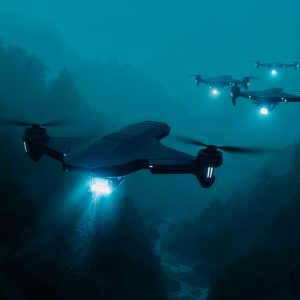
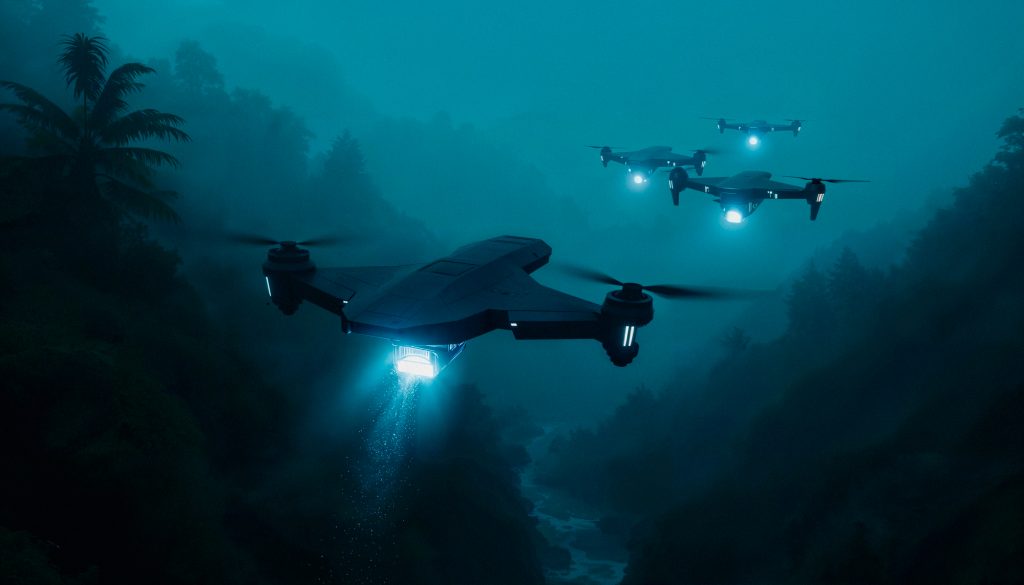
True swarm autonomy remains the next threshold. Many current “swarms” are better understood as massed drones, coordinated launches or operator-assisted clusters. Real swarm behaviour would require unmanned systems to share information, allocate tasks, route around losses, adapt to jamming and pursue mission objectives with limited human input. That capability would not merely add more drones to the battlespace; it would create a distributed combat organism.
China is one of the most consequential actors in this domain. A 2025 China Aerospace Studies Institute paper on PLA concepts of UAV swarms and manned-unmanned teaming found that PLA-affiliated research discusses multiple command-and-control models, including centralised coordination, hierarchical coordination and more distributed forms of swarm behaviour [5]. The paper also suggests that Chinese thinking remains unsettled on the precise command model for unmanned systems, which is a critical point. Beijing is advancing rapidly, but autonomy at scale is still a doctrinal, technical and command-authority problem.
In the Indo-Pacific, this matters because the geometry of a Taiwan or wider Pacific scenario differs sharply from Ukraine. Distance, maritime targeting, contested electromagnetic spectrum and anti-access networks would all shape swarm employment. A force able to launch, network and sustain large numbers of autonomous or semi-autonomous systems under fire could impose severe saturation dilemmas. Defence Agenda’s previous analysis of swarm warfare and the future fight outlines why autonomy, EW resilience and C4ISR integration will define the next phase of this competition.
Implications: What Defence Planners Should Take Seriously
The first implication is that counter-drone defence must become a core layer of force protection, not an add-on. Units need soft-kill electronic warfare, guns, interceptor drones, passive detection, rapid camouflage, deception and low-cost effectors. Expensive missiles should remain available for high-end threats, but they cannot be the default answer to every small unmanned system.
The second implication is that command architecture now matters as much as platform inventory. A military with many drones but weak data fusion will generate noise. A military with fewer systems but stronger networking, target validation and mission control may produce greater combat effect. This is why Delta-style architectures deserve attention from NATO, not as a system to copy mechanically, but as a model for modularity, speed and user-driven iteration.
The third implication is industrial. Attritable systems require attritable economics. Western defence industries must learn to produce, update and replace unmanned systems at a tempo closer to software and automotive supply chains than traditional aerospace procurement. That does not remove the need for high-end platforms. It changes the balance between exquisite systems and mass.
Next: From Tactical Revolution to Strategic Integration
The next phase of drone warfare will be decided by integration rather than novelty. FPV drones, loitering munitions, unmanned ground vehicles, AI targeting, electronic warfare and swarm autonomy will matter only when they fit into a wider kill web. The decisive question for 2026 and beyond is therefore not whether drones are revolutionary. They are. The harder question is whether militaries can turn that revolution into sustainable operational advantage under electronic attack, attrition, procurement pressure and adversary adaptation.
Ukraine has shown what rapid adaptation can achieve. Russia has shown how quickly countermeasures can mature. China is signalling how swarm concepts may scale in a future Pacific fight. For NATO, the lesson is clear: drones are not a substitute for combined arms. They are becoming the connective tissue of combined arms.
Further Reading
- Defence Agenda: Drone Cost-Exchange Ratio Is Rewriting War
- Defence Agenda: Swarm Warfare and the Future Fight
- Defence Agenda: Mastering Ukraine’s Long-Range Attack Drones
- Ukraine Ministry of Defence: Defense AI Center A1
- CSIS: Does Ukraine Already Have Functional CJADC2 Technology?
- RUSI: NATO Should Not Replace Traditional Firepower with Drones
References
- Ukraine Ministry of Defence, “Defense AI Center A1: Artificial intelligence will accelerate and enhance decision-making on the battlefield,” 4 May 2026.
- Reuters, “Ukraine’s new defence minister vows data-driven overhaul of military,” 21 January 2026.
- CSIS, “Does Ukraine Already Have Functional CJADC2 Technology?”, 11 December 2024.
- RUSI, Justin Bronk, “NATO Should Not Replace Traditional Firepower with ‘Drones’,” 4 August 2025.
- China Aerospace Studies Institute, “PLA Concepts of UAV Swarms and Manned/Unmanned Teaming,” 21 April 2025.
- Business Insider, “Ukraine said it captured a Russian position using only robots and drones,” 14 April 2026.