Missiles | Türkiye | SAHA 2026
The Yildirimhan missile programme has entered a more consequential phase after Türkiye disclosed progress in domestic liquid-propellant production. The announcement does not yet make the system operational. It does, however, move the programme from a display milestone toward the harder test-and-industrialisation phase that will decide its real strategic value.
Key Facts
- Programme: Yıldırımhan long-range ballistic missile, developed by the Turkish Ministry of National Defence R&D Center.
- Declared range: 6,000 km, above the 5,500 km threshold commonly used for ICBM-class systems.[4]
- Declared payload: up to 3,000 kg, according to Turkish official information reported by defence media.[1]
- Propulsion: liquid-propellant architecture using UDMH fuel and dinitrogen tetroxide oxidiser.[1]
- Status: laboratory test processes have been completed; ground or field tests are expected in the next phase.[2]
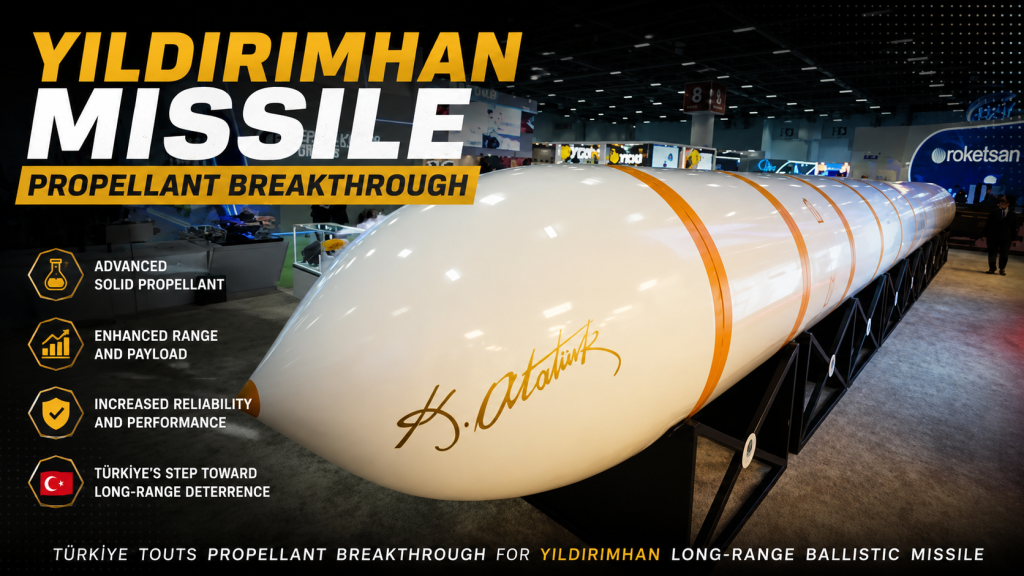
- Venue: the missile was publicly shown during SAHA 2026 in Istanbul, held on 5–9 May 2026.
Yildirimhan Missile Moves From Display to Test Logic
Türkiye used SAHA 2026 to place Yıldırımhan at the centre of its strategic missile narrative. The platform drew attention because of its declared 6,000 km range, reported hypersonic-speed profile and liquid-fuel propulsion. Defence News reported on 8 May 2026 that Turkish officials framed the latest step as a propellant breakthrough, not only as a missile reveal.[1]
The distinction matters. A full-scale missile body can signal ambition. A stable domestic supply of fuel, oxidiser and related production infrastructure can change programme maturity. It can also reduce exposure to foreign supply controls. For long-range missiles, energetic materials and propulsion chemistry often set the pace for development as much as guidance, structures or launch systems.
Turkish Defence Minister Yaşar Güler said the system had completed laboratory test processes. He also said ground or field tests would begin in the coming period. TRT Haber, citing Anadolu Agency, reported the remarks on 7 May 2026 during SAHA 2026 in Istanbul.[2]
Why Liquid Propellant Is the Critical Variable
Most publicly known Turkish ballistic missile systems, including earlier short- and medium-range families, have centred on solid-fuel architectures. Yıldırımhan marks a different branch. Its reported use of unsymmetrical dimethylhydrazine and dinitrogen tetroxide points to a storable liquid-propellant design. Such systems demand strict control over handling, production quality and safety.
Nilüfer Kuzulu, director-general of the Ministry’s R&D Center, described the work as the result of an effort lasting roughly a decade. Turkish media also reported that the team moved from laboratory-scale quantities to serial-scale production work for the relevant propellant inputs.[3]
This does not remove the need for full test evidence. Long-range ballistic systems must validate propulsion stability, staging behaviour, structural loads, thermal performance, guidance accuracy and re-entry dynamics. The propellant breakthrough therefore narrows one bottleneck. It does not close the entire development cycle.
Programme Maturity: Capability Claim vs Fielded Weapon
The most important editorial caveat is simple: Yıldırımhan is not yet a fielded, combat-proven system. Al Jazeera reported on 7 May 2026 that Türkiye unveiled a prototype and that production had not begun.[5] Turkish officials also presented the next phase as testing, not deployment.
That gap matters for policymakers and industry readers. A displayed missile may indicate design intent. A tested missile confirms far more. A deployed force requires command-and-control architecture, launch doctrine, basing arrangements, sustainment, crew training and political signalling. None of those elements should be assumed from a public exhibition reveal.
Still, Türkiye’s decision to show the system at SAHA 2026 was not accidental. It placed the missile inside a broader industrial message. Ankara wants to show that its defence and aerospace ecosystem can move beyond tactical platforms and into strategic technologies. That message supports deterrence. It also supports export diplomacy, even when the system itself may remain under strict national control.
Strategic Implications for Türkiye and NATO
The Yildirimhan missile announcement affects three linked debates. First, it expands the perception of Türkiye’s strategic depth. A declared 6,000 km range places the programme above the common ICBM threshold. That alone will attract attention from NATO capitals, neighbouring states and arms-control analysts.
Second, the programme shows how Türkiye’s defence-industrial base is moving upstream. The key claim is not only about range. It is about mastering materials, propulsion chemistry and test infrastructure. These are enabling technologies. They can influence missiles, space launch systems, high-speed research and advanced propulsion programmes.
Third, the announcement forces a credibility test. Türkiye can gain strategic leverage if future tests validate the declared performance. It may face scepticism if test evidence remains limited. For that reason, the next publicly visible milestone will matter more than the unveiling itself.
Implications / Next
The immediate watch item is the ground or field-test campaign. Clear data on propulsion performance, flight envelope and test range will shape external assessment. The second watch item is industrial capacity. If Türkiye can sustain serial production of the relevant propellants, the programme will sit on a stronger domestic base.
The third watch item is strategic messaging. Ankara will need to balance deterrence value with alliance sensitivities. Yıldırımhan can strengthen Türkiye’s image as a high-end defence technology actor. It can also invite sharper scrutiny over missile ranges, payload claims and escalation dynamics.
For now, the Yildirimhan missile is best understood as an emerging strategic programme. Its propellant breakthrough is significant. Its operational status remains unproven. The next tests will determine whether the system becomes a durable capability or remains primarily a signal of technological ambition.
Further Reading
- SAHA 2026 Post-Show Media Review
- Roketsan Missile Programmes: Tayfun and Gökbora
- Roketsan’s Next-Gen Missiles and UAV Strategy
- Defense News report on Yıldırımhan propellant breakthrough
- TRT Haber report on Minister Güler’s Yıldırımhan remarks
References
- Defense News, “Turkey touts propellant breakthrough for Yıldırımhan long-range ballistic missile,” 8 May 2026.
- TRT Haber / Anadolu Agency, “Bakan Güler: Yıldırımhan’ın testlerine önümüzdeki dönemde başlayacağız,” 7 May 2026.
- Uzmanpara / İHA, “10 yıllık çalışmanın emeği: YILDIRIMHAN,” 7 May 2026.
- CSIS, “North Korea’s New ICBM,” 6 July 2017.
- Al Jazeera, “Turkiye unveils its first intercontinental ballistic missile: What we know,” 7 May 2026.