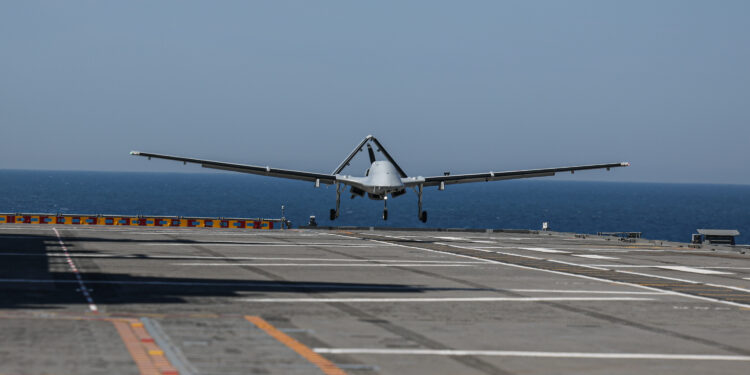
Bayraktar TB3’s operations from TCG Anadolu during NATO Steadfast Dart 2026 moved Türkiye’s shipborne unmanned airpower concept beyond the demonstration phase and into a more serious discussion about operational maturity. Short-runway autonomous take-off and landing, engagement against surface targets, and mission persistence in demanding maritime conditions make the TB3 programme more than a platform story. It is increasingly a strategic indicator of how the Turkish defence and aerospace ecosystem is integrating naval and airpower.
Key Facts
- Bayraktar TB3 operated from TCG Anadolu during NATO Steadfast Dart 2026.
- The platform demonstrated autonomous take-off and landing from a short-deck naval platform.
- Open-source reporting indicated that TB3 carried out salvo strikes with MAM-L against surface targets.
- According to TRT Haber, the platform remained airborne for 8 hours and covered roughly 1,700 kilometres in one mission profile.
- Operations conducted in adverse weather conditions reinforced the argument that the aircraft is moving beyond symbolic demonstration toward sustained mission execution.
Context and the New Development
Bayraktar TB3 differs from the conventional land-based UCAV category by design. Its folding-wing architecture and configuration for operations from short-deck ships tie the programme directly to the TCG Anadolu concept. Within that framework, the mission profile demonstrated during Steadfast Dart 2026 became one of the clearest public tests so far of Türkiye’s long-developing shipborne unmanned airpower model.
Information released by Baykar and presented on the company’s press pages indicated that TB3 autonomously launched from TCG Anadolu’s short runway and assumed an operational role in a highly visible setting. Reporting by Anadolu Agency and TRT Haber added technical and operational context. What stood out in that coverage was not merely a successful take-off and landing sequence, but an increasingly complete mission chain involving target tracking, data connectivity, persistence, and strike effect.
Technical and Operational Implications
The significance of TB3 lies in its potential to create a new force multiplier for the Turkish Navy rather than in the symbolism of a shipborne drone alone. A UCAV operating from a short-deck amphibious assault ship can support intelligence, surveillance and reconnaissance, target designation, surface-target tracking, and precision strike missions with lower risk exposure and extended endurance.
Two technical themes from the Steadfast Dart 2026 reporting deserve particular attention. The first is autonomous take-off and landing. This matters because it can reduce human error in deck operations and potentially increase sortie tempo. The second is mission persistence. TRT Haber’s reporting on an 8-hour mission covering 1,700 kilometres suggests that the platform may be usable not only for local-area surveillance but also across a wider maritime battlespace.
In addition, Anadolu Agency’s reporting on strike activity suggested that TB3 executed paired salvo engagements against surface targets. That point is significant because it shows that the aircraft is being framed not only as a sensor node but also as a credible strike asset in the naval environment. For littoral operations, narrow-sea control, coastal approaches, and amphibious support scenarios, that creates a notable capability set.
Programme and Procurement Dimension
The TB3 programme is not simply another addition to Baykar’s product portfolio. It also reflects Türkiye’s search for a cost-effective model of shipborne airpower. Compared with manned fixed-wing naval aviation, a UCAV-centred approach may offer lower operating costs, more flexible deployment, and faster mission cycles.
This has at least three implications for force structure and procurement. First, it increases the operational value of platforms such as TCG Anadolu. Second, it creates deeper demand across the industrial base for munitions, data links, ship combat-system integration, and mission software. Third, it gives Türkiye a stronger export narrative around a full concept package rather than a single air vehicle. What can potentially be marketed is not only a drone, but a platform-ship-network-concept architecture.
Risks and Constraints
That said, the real significance of the programme cannot be judged on demonstrations alone. In shipborne operations, sustained maintenance, deck density, data-link resilience, mission continuity under electronic warfare conditions, and the management of simultaneous sorties will be decisive.
The long-term operational value of TB3 will also depend heavily on the depth of its integration with sensors, command-and-control systems, and the ship’s combat management architecture. The open-source picture is positive and suggests that the concept works. But full maturity will depend on how the platform is employed at flotilla or fleet level over time. The current picture therefore supports the argument that an important threshold has been crossed, but not yet that the capability has reached its final form.
Why It Matters
Bayraktar TB3’s operations from TCG Anadolu show clearly where the Turkish defence industry is heading: naval-air integration, autonomous mission execution, platform-to-platform data flow, and lower-cost power projection. The programme is becoming one of the most visible examples of Türkiye’s effort to transfer its momentum in unmanned systems into the maritime domain.
From a defence planning perspective, the central implication is this: TB3 has the potential to transform TCG Anadolu from a simple aviation-capable platform into a networked unmanned mission node. That would carry consequences not only for doctrine, but also for exports, industrial integration, and future force design.
Further Reading
- Bayraktar TB3 UCAV Makes a Show of Force at NATO Exercise — Baykar
- Flawless Performance by Bayraktar TB3 UCAV in the Harsh Conditions of the Baltic Sea — Baykar
- Bayraktar TB3 SİHA’dan zorlu hava koşullarında başarılı uçuş — Anadolu Ajansı
- Steadfast Dart-2026 kapsamında Bayraktar TB3, TCG Anadolu’dan MAM-L salvo atışı gerçekleştirdi — Anadolu Ajansı Video
- Almanya’daki NATO tatbikatına Bayraktar TB-3 SİHA damgası — TRT Haber
- Bayraktar TB3’ten zorlu koşullarda yapay zeka destekli uçuş — TRT Haber