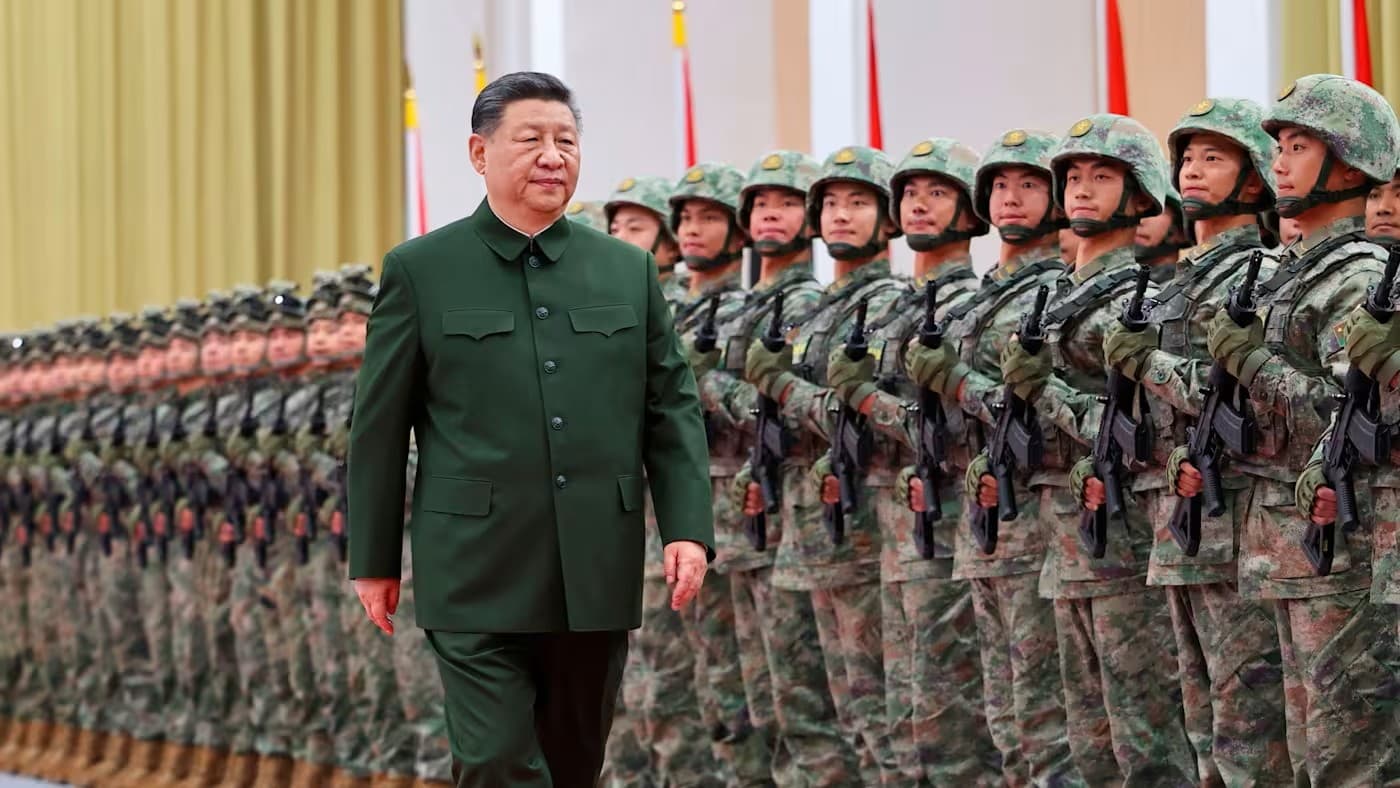
China’s investigation into senior military figures has triggered renewed debate about the balance of power between the Communist Party and the People’s Liberation Army (PLA). The latest focus is General Zhang Youxia, a vice-chair of the Central Military Commission (CMC) and a long-time ally of President Xi Jinping. Several outlets report that authorities have placed Zhang under investigation as part of a wider discipline and anti-corruption drive.
A separate analysis published by the Financial Times argues that the episode may signal more than routine clean-up. The columnist, former US National Security Council official Dennis Wilder, contends that many outside observers overestimate Xi’s freedom of action. Instead, he suggests the move reflects deeper institutional tensions and growing elite concern about decision-making at the top.
Key Facts
- 26 January 2026: Reuters reports that China has announced investigations into Zhang Youxia and senior officer Liu Zhenli for alleged “serious violations of discipline and law.”
- 28–29 January 2026: Reuters reports that Zhang’s fall is fuelling uncertainty in Washington about PLA readiness and internal stability.
- 30 January 2026: The Financial Times publishes an analysis by Dennis Wilder on the meaning of the military purge and the party–army relationship.
- Wilder’s core claim: Zhang’s downfall may reflect power politics and civil–military tensions, not only corruption enforcement.
What the investigation is — and what remains unclear
Chinese state language around “serious violations of discipline and law” often signals corruption probes. However, it rarely provides technical detail, timelines, or a clear legal pathway. As a result, outside analysts must infer motive and scope from personnel moves, official phrasing, and historical precedent.
At this stage, public reporting leaves key points unresolved.
- Authorities have announced an investigation, yet they have not released an evidence base.
- External reporting varies on whether Zhang is “ousted” or simply “under probe.”
- China’s leadership has not set out how the investigation affects day-to-day CMC decision-making.
Therefore, any assessment should separate verified procedural facts from interpretive claims.
The FT argument: Xi is powerful, but not omnipotent
Wilder’s Financial Times analysis challenges the assumption that Xi can reshape elite politics without constraint. He offers two mechanisms.
1) Elite fear and countervailing power inside the system
First, Wilder argues that Xi’s long-standing suspicion of foreign interference shapes his behaviour. He suggests that internal criticism of the decision to remove or investigate senior figures can amplify that suspicion. In turn, Xi may act pre-emptively to prevent rivals from consolidating influence.
2) Structural tension between the party and the PLA
Second, Wilder emphasises the structural friction between civilian party authority and the military. In his view, this tension is chronic, not episodic. He points to historical cases where senior officers questioned political choices and paid a high price.
Even if today’s PLA is more tightly controlled than in earlier decades, Wilder argues that the party still treats military autonomy as a strategic risk. Consequently, Beijing has incentives to rotate leadership, enforce discipline, and prevent alternative power centres.
Why Zhang matters in particular
Zhang is not a routine figure. He sits at the apex of the command structure beneath Xi, and he carries institutional weight from decades of service. That status creates both operational utility and political sensitivity.
Wilder’s analysis proposes a specific dynamic: if a senior officer accumulates influence inside the CMC—especially by shaping personnel outcomes—then Xi may judge that influence as incompatible with the “chairman responsibility system” that anchors party control of the armed forces.
Other analysts have raised a parallel question: whether disputes over readiness, training, and Taiwan contingencies could have widened fault-lines between senior officers and the top leadership.
Strategic implications for Taiwan and regional signalling
Whether the driver is corruption, factional rivalry, or policy disagreement, leadership turbulence matters because it can affect risk perception.
- If Xi believes internal discipline is slipping, he may tighten control and accelerate political loyalty checks.
- If senior officers fear sudden political reversal, they may become more cautious in operational advice.
- If promotion pathways depend on politics more than competence, readiness can suffer over time.
At the same time, Beijing can use high-profile investigations as a deterrent signal. It can show domestic audiences that no one sits above discipline. It can also signal to foreign observers that the party retains the initiative.
A competing interpretation: purge as consolidation, not weakness
Not every reading supports Wilder’s implied warning about constraint. A competing interpretation sees the probe as consolidation.
Under this view, Xi uses discipline campaigns to remove networks that resist reform or threaten control. The party then replaces them with leaders who align with the leadership’s priorities. That approach can stabilise the chain of command in the short term, even if it carries longer-term readiness costs.
Therefore, the key analytical question becomes practical: does personnel churn improve performance, or does it erode trust, initiative, and professional candour?
What to watch next
The next signals will come from observable personnel and messaging moves.
- Appointments: who fills Zhang-linked roles, and how quickly?
- Language: does official phrasing shift from discipline to “political loyalty” themes?
- Exercises and posture: do Taiwan-facing activities change pace, scale, or risk profile?
- Defence industry impact: does the crackdown slow procurement, modernisation, or technology programmes?
If Beijing couples the probe with an aggressive external posture, the episode may be more about control than caution. Conversely, if the leadership emphasises internal rectification and slows escalation, it may reflect a leadership that wants to reduce operational risk during a sensitive political moment.