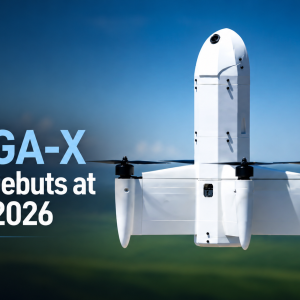
Baykar’s MIZRAK loitering munition will make its first public appearance at SAHA 2026, adding a long-range, AI-assisted strike and surveillance system to Türkiye’s expanding unmanned warfare portfolio. The system matters because it combines more than 1,000 km of range, over seven hours of endurance and GPS-denied mission logic in a 200 kg class airframe, giving operators a bridge between tactical loitering munitions and deeper, networked precision effects.
Key Facts
- Debut: Baykar announced that MIZRAK will be unveiled at SAHA 2026 in Istanbul.
- Range and endurance: The system is listed with an operational range exceeding 1,000 km and endurance of more than seven hours.
- Payload: MIZRAK can carry a 40 kg twin-warhead configuration or a 20 kg single-warhead variant with an RF seeker.
- Airframe: Baykar states a 4 m wingspan, 200 kg maximum take-off weight, 100 KIAS maximum speed and 10,000 ft service ceiling.
- Navigation: AI-assisted autopilot, optical guidance, sensor fusion and visual positioning support operations in GPS-denied environments.
- Network integration: MIZRAK can communicate with Bayraktar TB2, Bayraktar TB3 and Bayraktar AKINCI via Baykar’s digital data and video link.
Baykar Positions MIZRAK for Deep Surface-to-Surface Missions
Baykar said on 30 April 2026 that MIZRAK, an intelligent loitering munition developed indigenously by the company, would be displayed for the first time at SAHA 2026, the international defence and aerospace exhibition scheduled for 5–9 May 2026 at the Istanbul Expo Centre. The company describes the platform as a surface-to-surface deep-operation system with long-duration surveillance, real-time strike capability and flexible mission profiles.
The announcement expands Baykar’s role from UAV prime contractor into a more integrated effects architecture. In operational terms, MIZRAK sits in a category that is increasingly central to modern force design: systems that can search, classify, track and strike targets across extended distances while remaining more flexible than a conventional one-way missile. That distinction is important. A loitering munition can delay terminal engagement, update target selection and maintain surveillance before attack. For commanders, this creates a wider decision window and improves the ability to engage time-sensitive or relocatable targets.
MIZRAK Loitering Munition Specifications
The MIZRAK loitering munition is offered in two main configurations. The first uses a twin-warhead arrangement with a total payload of 40 kg. The second carries a 20 kg payload and adds an RF seeker head for more precise target detection. Baykar also lists EO and IR camera options, allowing mission planners to configure the system for day/night reconnaissance, surveillance and terminal engagement requirements.
Baykar’s published specification set places MIZRAK in a heavier and longer-range bracket than small tactical tube-launched or hand-launched loitering munitions. The company states a 4 m wingspan, 200 kg maximum take-off weight, 100 KIAS maximum speed and 10,000 ft service ceiling. More significantly, it claims more than 1,000 km of range and more than seven hours of endurance, which would allow the platform to support long-range search-and-strike missions well beyond the tactical edge.
AI-Assisted Autonomy and GPS-Denied Operations
The most consequential part of the MIZRAK announcement is not only range. It is the stated emphasis on autonomy and navigation resilience. Baykar says the system uses AI-assisted autopilot, optical guidance, sensor fusion and built-in visual positioning. The company frames these features as enabling target location and mission execution in areas affected by electronic warfare or GPS denial.
This reflects a broader operational lesson from recent conflicts: long-range precision systems must now assume contested spectrum conditions. Satellite navigation may degrade. Data links may face jamming. Target coordinates may change before impact. In that environment, a munition’s value increasingly depends on its ability to preserve navigation accuracy, maintain target recognition and operate inside a degraded command-and-control environment. MIZRAK’s stated anti-jamming features and GPS-independent mission logic therefore address a problem that is now central to procurement planning, not a niche requirement.
Network-Centric Integration with Bayraktar Platforms
Baykar also highlights MIZRAK’s ability to communicate with Bayraktar TB2, Bayraktar TB3 and Bayraktar AKINCI through the company’s digital data and video link. The line-of-sight communication range is listed as exceeding 80 km, while optional satellite communication can extend the network beyond those limits.
This networked approach may be more important than the munition as a standalone airframe. If MIZRAK can operate as part of a wider ISR-strike chain, Baykar can offer users a more coherent unmanned architecture: UAVs for detection and relay, loitering munitions for persistent strike, and data links for mission coordination. That approach aligns with the direction of modern unmanned warfare, where the decisive variable is not simply platform performance but the speed and resilience of the kill chain.
Why SAHA 2026 Is the Right Launch Venue
SAHA 2026 gives Baykar a concentrated audience of defence procurement officials, platform integrators, investors, suppliers and international delegations. The exhibition’s emphasis on unmanned systems, space technologies, advanced munitions and disruptive defence innovation makes it a natural venue for a system such as MIZRAK. It also gives Türkiye’s defence industry an opportunity to place loitering munitions within a wider narrative of indigenous autonomy, network-centric operations and exportable battlefield effects.
For SAHA 2026 coverage, the MIZRAK debut fits a broader post-show pattern: Turkish firms used the exhibition not only to display platforms, but also to communicate doctrine. Systems such as MIZRAK, long-range missiles, counter-drone layers and unmanned ground systems all point toward a defence-industrial ecosystem focused on persistent sensing, distributed strike and survivability in contested environments.
Programme Implications and Export Logic
MIZRAK’s export potential will depend on more than advertised range and payload. Prospective users will assess sensor performance, terminal guidance reliability, resistance to electronic warfare, command authority, training burden, support infrastructure and compliance with national rules of engagement. The system’s runway and Rocket-Assisted Take-Off options may improve deployability, especially for users that need long-range effects without depending on large airbases.
The platform may also create an internal portfolio logic for Baykar. TB2, TB3 and AKINCI provide persistent ISR and strike at different performance tiers. MIZRAK adds a consumable, long-range effector that can extend the reach of those systems without requiring a crewed aircraft or a high-end cruise missile for every target set. The result is a layered unmanned strike architecture that could appeal to countries seeking affordable precision, operational autonomy and supply-chain diversification.
Risks, Open Questions and What Comes Next
The main open questions concern testing status, production maturity, seeker performance, datalink resilience and integration timelines with Baykar’s existing UAV ecosystem. Baykar’s release describes the capability envelope, but procurement authorities will still look for validated performance data, operational test results and evidence of repeatable production quality. MIZRAK’s claimed ability to operate under GPS denial will also draw close attention because navigation resilience is one of the hardest claims to prove under realistic electronic attack conditions.
The next milestone is likely to be a fuller technical presentation at SAHA 2026, followed by additional test disclosures, integration demonstrations and potential customer engagement. If Baykar can validate the system’s range, autonomy and networked employment logic, MIZRAK could become a significant addition to Türkiye’s precision-strike portfolio and a more ambitious competitor in the global loitering munition market.
Further Reading
- SAHA 2026 Post-Show Media Review
- STM completes ALPAGU loitering munition deliveries
- Loitering Munitions vs CIWS
- Yıldırımhan Missile Propellant Breakthrough
- Baykar official MIZRAK announcement
- SAHA 2026 official exhibition information