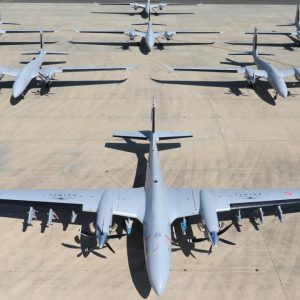
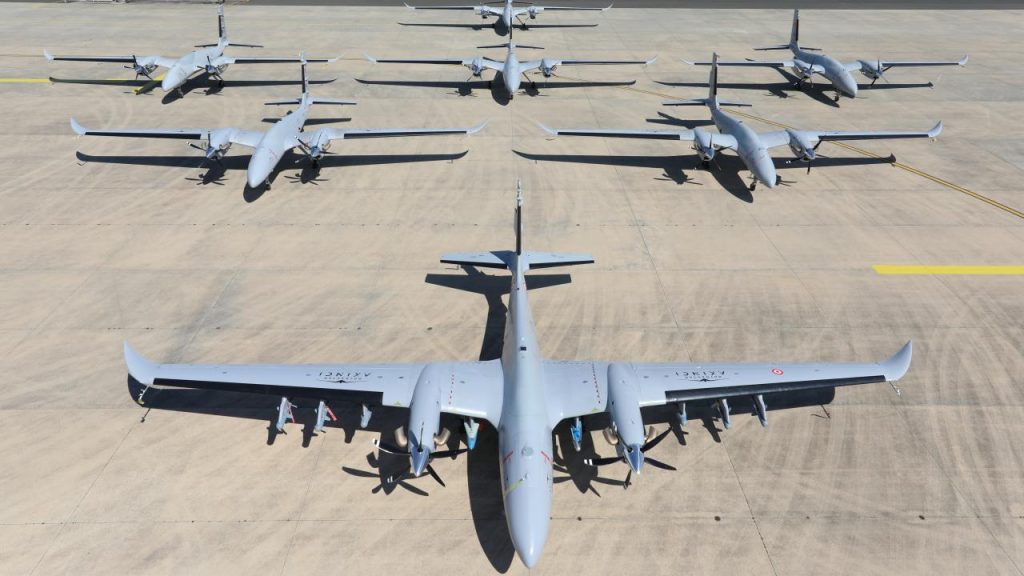
Bayraktar AKINCI has exceeded 150,000 flight hours, marking another important milestone for Türkiye’s indigenous combat UAV programme. Developed nationally by Baykar under the leadership of the Presidency of Defence Industries (SSB), the platform continues to expand its operational footprint while supporting the integration of a growing portfolio of locally developed munitions, sensors, and mission systems.
This milestone matters because it highlights both fleet maturity and mission sustainability. It also reinforces AKINCI’s role as a proven high-endurance platform in Türkiye’s broader defence and aerospace ecosystem, where operational use, export performance, and payload integration increasingly shape programme relevance.
Key Facts
- Platform: Bayraktar AKINCI TİHA
- Milestone: More than 150,000 flight hours completed
- Programme Authority: Presidency of Defence Industries (SSB)
- Developer: Baykar
- Export Status: Export contracts signed with 16 countries
- Service Entry: Entered Turkish Armed Forces inventory on 29 August 2021
- Altitude Record: Reached 45,118 feet (13,716 metres) on 21 June 2022
A New Milestone for the AKINCI Programme
The Bayraktar AKINCI programme has now crossed the 150,000-flight-hour threshold, an indicator of both operational tempo and platform durability. For an advanced combat UAV, accumulated flight hours are more than a symbolic number. They reflect reliability, sustainment performance, and user confidence across training, operational deployment, and test activity.
AKINCI has become one of the most visible pillars of Türkiye’s unmanned airpower architecture. Since entering service, the platform has supported operational missions while continuing to serve as a testbed for a broad set of domestically developed payloads and smart munitions.
Tests Continue Across National Payloads and Sensors
The latest phase of AKINCI’s flight activity has focused heavily on the integration of indigenous systems. According to the provided programme update, the platform has conducted test missions over the past two weeks with the following capabilities:
- MURAD AESA Radar
- EREN High-Speed Multi-Purpose Loitering Munition
- MAM-L Mini Smart Munition
- KEMANKEŞ-1 AI-Assisted Mini Cruise Missile
This integration tempo is strategically important. It shows that AKINCI is not being positioned merely as a long-endurance air vehicle, but as a scalable combat aviation node capable of carrying sensors, precision-guided weapons, and mission systems across different operational profiles.
Operational Record Since Service Entry
Bayraktar AKINCI has been in active service with the Turkish Armed Forces since 29 August 2021. Since then, it has operated successfully in the field while also maintaining its place in national aviation history through a major altitude achievement.
On 21 June 2022, during endurance, high-altitude, and high-speed testing conducted in the presence of SSB and Turkish Air Force delegations, AKINCI climbed to 45,118 feet (13,716 metres). That result established a record in Turkish aviation history and strengthened the platform’s image as a high-performance indigenous UAV.
The combination of operational deployment and continuing test activity is a strong programme signal. It indicates that AKINCI is not static after induction; rather, it remains under active capability expansion.
National Munitions Integration Expands the Combat Envelope
One of the strongest aspects of the AKINCI programme is its role in integrating domestically produced smart munitions. The platform’s development campaign has already included tests with a broad range of Turkish weapons, including:
- MAM-L
- MAM-L TV
- MAM-T
- MAM-T IIR/TV
- MAM-C
- TOLUN
- TOLUN IIR
- Teber-81
- Teber-82
- LAÇİN 82
- LGK-81
- LGK-82
- HGK-82
- Gökçe Guidance Kit
- Gözde Guidance Kit
- KGK-82-SİHA
- İHA-230 Supersonic Missile
- İHA-122 Supersonic Missile with TV and laser seeker variants
- Çakır Cruise Missile
These tests demonstrate the breadth of the platform’s strike architecture. Rather than relying on a narrow weapon set, AKINCI is evolving into a multi-mission strike asset with the flexibility to engage different target types using precision-guided indigenous effectors.
Baykar states that, during firing tests, AKINCI hit its targets with high accuracy using national munitions. This broad payload compatibility enhances the platform’s deterrent value and supports the wider objective of reducing foreign dependency in critical combat aviation capabilities.
Export Momentum Adds Strategic Weight
Another notable element in the AKINCI story is its export performance. The platform has been exported under contracts signed with 16 countries, underscoring strong international demand for Türkiye’s unmanned systems.
From a defence-industrial perspective, export success matters for three reasons. First, it validates the platform in competitive international markets. Second, it supports economies of scale for production and sustainment. Third, it strengthens Türkiye’s position as a supplier of advanced unmanned combat systems rather than only a domestic end-user.
In this context, the 150,000-flight-hour milestone is also a commercial credibility marker. It provides a measurable proof point for fleet maturity at a time when buyers increasingly evaluate not just payload data or brochure-level specifications, but operational history and integration depth.
Why the Milestone Matters
The crossing of 150,000 flight hours is significant because it sits at the intersection of operations, technology, and exports.
Operationally, it suggests a platform that has moved well beyond prototype status into sustained and repeatable use. Technologically, it reflects the continued integration of advanced sensors and indigenous weapons. Industrially, it supports Baykar’s argument that AKINCI is a mature and scalable combat UAV with strong international relevance.
For Türkiye’s defence and aerospace ecosystem, AKINCI’s latest milestone is therefore not just a programme update. It is evidence of cumulative progress in unmanned aviation, sovereign payload integration, and export-oriented capability development.
Outlook
The next phase for Bayraktar AKINCI will likely be defined by deeper mission-system integration, broader operational deployment, and further export expansion. If current testing continues at pace, the platform is positioned to strengthen its role as one of the flagship products of Türkiye’s high-end unmanned combat aviation portfolio.
As the AKINCI programme builds on its 150,000 flight hours, its long-term significance will increasingly depend on how effectively it combines endurance, strike flexibility, sensor fusion, and export sustainability into a coherent operational advantage.
Suggested Internal Links
- Baykar programme coverage
- Turkish unmanned combat aviation developments
- Indigenous smart munitions integration news
- Related Baykar international expansion
Further Reading
- Original Anadolu Agency report
- Official Baykar AKINCI programme page
- Baykar press release: AKINCI surpasses 100,000 flight hours
- Baykar press release: EREN integration milestone
- ASELSAN: MURAD 100-A integration background
- SSB weekly update: KEMANKEŞ-1 test on AKINCI
- SSB weekly update: MURAD AESA test flight on AKINCI