Today, the ASELSAN innovation ecosystem is shifting from product-centric competition to competition between whole networks of actors. Speaking at the “Growing Together: Advancing Through Cooperation” panel, ASELSAN General Manager Ahmet Akyol underlined how structured partnerships with startups, small and medium-sized enterprises (SMEs) and universities now sit at the core of Türkiye’s defence technology strategy.
According to Akyol, success in defence no longer depends only on standalone platforms. Instead, it rests on tightly connected networks of companies, labs and talent that can react quickly, scale production and co-create new technologies. In this model, ASELSAN’s role resembles that of a “school” and a system integrator for the entire ecosystem, not just a prime contractor.
From Products to Ecosystems: Competing Through Collaboration
Akyol stressed that the real competition today is between ecosystems, not isolated products. Small companies need strong collaboration among themselves, a healthy link to the wider innovation network and sound business models. When these elements come together under a shared vision, the entire ecosystem gains an edge over foreign rivals.
Many large technology firms see their relationships with small suppliers as a challenge. However, ASELSAN takes the opposite view and treats this relationship as an opportunity. As the prime, ASELSAN tackles some of the most complex engineering and integration tasks. At the same time, it deliberately pulls in startups, SMEs and academic partners to deliver niche technologies, subsystems and specialist services.
As a result, this approach supports Türkiye’s broader move toward a resilient, innovation-driven defence industrial base. It also positions ASELSAN as a platform company that grows by lifting the entire ecosystem rather than trying to do everything inside its own walls.
ASELSAN’s Entrepreneurship Strategy
In his remarks, Akyol described ASELSAN’s entrepreneurship strategy as outward-looking and partnership-driven. The company aims to build world-class products, develop game-changing technologies and pursue growth through international cooperation. Within that vision, startups and SMEs are not peripheral actors but core partners.
In practice, ASELSAN actively looks for ways to integrate smaller firms into its programmes. It treats ecosystem capacity as a force multiplier when competing globally. Rather than viewing supplier challenges as threats, the company uses them as drivers to improve processes, share know-how and align incentives. Consequently, this means more open engagement with entrepreneurs, more joint development projects and stronger bridges between industry and academia.
ASELFLIR-500: A Case Study in Fast-Track Innovation
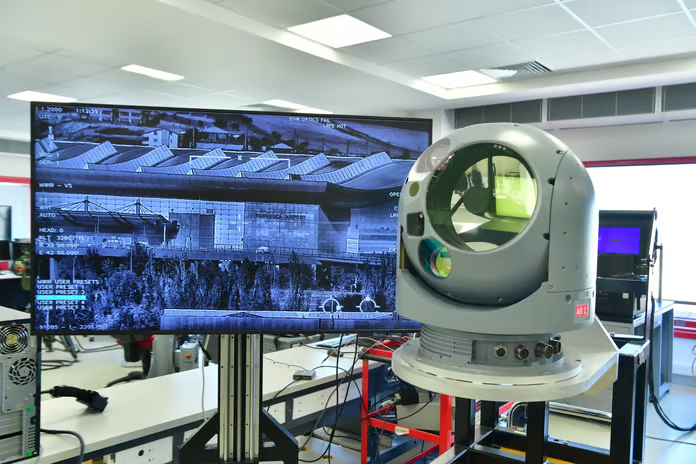
Akyol highlighted the ASELFLIR-500 electro-optical system, used on Türkiye’s armed UAVs, as a flagship example of rapid innovation through ecosystem collaboration. The previous camera generation took seven years to reach full maturity. By contrast, ASELFLIR-500 reached global-class performance in about three years.
After entering production in 2025, ASELFLIR-500 quickly reached its 100th delivered unit and is now in service with users in about 20 countries. Operators describe it as one of the best sensors in its category. For ASELSAN, the programme shows how strong coordination between internal teams, local suppliers and research partners can shorten development cycles and turn them directly into export success.
Overall, the lesson is clear. In a competitive global market, time to field is as important as technical performance. Careful ecosystem orchestration is what allows ASELSAN and its partners to react quickly, adapt designs and deliver at scale.
Scaling the Supply Chain: 3.5 Billion Dollars in 11 Months
The scale of ASELSAN’s ecosystem impact is visible in its supply chain numbers. In just eleven months, the company passed around 3.5 billion dollars in orders to Turkish SMEs and medium-sized companies. This figure is more than a simple procurement statistic. Instead, it is a clear indicator of how growth at the prime contractor level translates into growth for the entire national industrial base.
As ASELSAN wins new contracts and exports more systems, it pulls a broad network of local suppliers alongside it. Consequently, that dynamic strengthens Türkiye’s technological sovereignty, expands employment and ensures that key capabilities remain within allied and friendly jurisdictions.
Asel Labs and Quantum Technology Investments
Another major pillar of the ASELSAN innovation ecosystem is Asel Labs, the company’s extended R&D structure. Akyol noted that ASELSAN has set up seven laboratories across four universities, backed by more than 20 million dollars of investment. One of these labs focuses on quantum technologies and has already produced Türkiye’s first quantum computer and the country’s first quantum chips.
These projects show how ASELSAN uses academic partnerships to move into new technology areas with direct defence relevance. Quantum computing and quantum devices promise long-term impact on secure communications, advanced sensing and data optimisation. By anchoring this work inside Asel Labs, ASELSAN helps ensure that Türkiye develops its own talent pool, intellectual property base and testing facilities in a field often dominated by a few global players.
Bayraktar KIZILELMA: Embedded Sensors and New Capability Levels
Akyol also pointed to Bayraktar KIZILELMA as a symbol of the ecosystem’s ability to move up the technology ladder. In the past, FLIR systems usually sat in external pods hanging from the aircraft. Now, the new design for KIZILELMA embeds the camera inside the airframe. This change reflects a clear step forward in both integration and stealth.
ASELSAN flew this embedded sensor solution on KIZILELMA and supported the platform as it recently achieved a world first by firing an air-to-air missile. This milestone came from tight cooperation between ASELSAN, Baykar and TÜBİTAK SAGE. Together, they combined advanced sensors, platform design and indigenous missiles in a single national ecosystem.
As a result, this kind of complex integration shows foreign observers that Türkiye can deliver end-to-end solutions, from mission computers and sensors to seekers, data links and effectors. As Akyol noted, such achievements have turned Türkiye into a country that others now watch closely and, increasingly, seek to emulate.
Global Positioning and the Role of the Startup Ecosystem
The international impact of the ASELSAN innovation ecosystem now extends beyond individual platforms. The success of systems such as Bayraktar KIZILELMA and ASELFLIR-500 has helped position Türkiye as a key reference point in the global defence and aerospace community. International media, armed forces and industry players track these developments as technology stories and as signs of a wider national innovation direction.
Within this context, ASELSAN sees itself as a learning organisation. It actively applies models from the startup world inside a large defence company environment. The aim is to combine the agility and creativity of entrepreneurs with the scale, discipline and export networks of an established prime contractor.
In addition, Akyol emphasised that pure technological capability is no longer enough to dominate in this environment. Success also depends on cultivating a strong and inclusive ecosystem that draws in more entrepreneurs, more universities and more academics. ASELSAN’s clear commitment is to open doors, share opportunities and ensure that the next generation of innovators finds a place inside the defence technology value chain.
Conclusion: Ecosystem Power as a Strategic Advantage
Taken together, the picture that emerges from Akyol’s remarks is clear. The ASELSAN innovation ecosystem rests on three main pillars: deep collaboration with startups and SMEs, fast-track innovation on flagship products and long-term investment in new fields such as quantum technologies and next-generation combat aviation.
Looking ahead, as Türkiye’s defence and aerospace sector expands its global presence, ecosystem power will matter as much as individual products. Companies that manage their networks well — aligning industry, academia and the startup community under a common vision — will move ahead of competitors. In this sense, ASELSAN is positioning itself, and the wider Turkish ecosystem, to be among those future leaders.
Further Reading
For more on Türkiye’s evolving defence innovation landscape and ecosystem-driven growth, see: