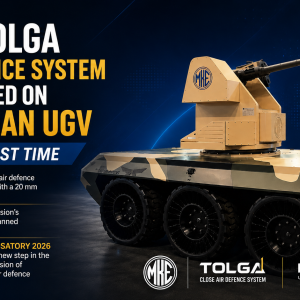
The MKE TOLGA air defence system has entered its first European platform integration through the installation of a 20 mm weapon system on HT Division’s KATICA 6×6 unmanned ground vehicle. Presented at EUROSATORY 2026 in Paris, the integration marks a new step in the international expansion of Türkiye’s layered air defence and counter-UAS capabilities.
The development follows a memorandum of understanding signed between Makine ve Kimya Endüstrisi (MKE) and Hungary-based HT Division during SAHA 2026. Under the new configuration, the 20 mm weapon system within the TOLGA family is integrated with the KATICA unmanned ground vehicle, creating a mobile counter-UAS and close air defence solution for low-altitude threats.
For further context on Europe’s changing air defence requirements, Defence Agenda has previously covered the wider push for European air defence production depth and NATO’s pressure to accelerate defence-industrial output.
MKE TOLGA Air Defence System Moves into the European Defence Ecosystem
The KATICA integration is significant because it carries the MKE TOLGA air defence system into Europe for the first time. MKE has already pursued cooperation around TOLGA in Qatar, Egypt and Saudi Arabia, but the Hungarian platform integration gives the system a new European reference point and strengthens its visibility among European defence users and manufacturers.
For MKE, the move is not limited to a single turret or vehicle demonstration. It signals an effort to position TOLGA as a modular air defence family that can be adapted to different platform classes, threat environments and customer requirements.
MKE TOLGA Air Defence System Adds a Mobile Counter-UAS Layer to KATICA
The first phase of the integration centres on the 20 mm weapon system. According to the source report, the system uses MKE-produced 20×102 mm ammunition and can operate together with TOLGA’s radar and electro-optical sensors. This allows the platform to engage mini and micro UAVs without relying on missile-based interception for every low-cost aerial threat.
That operational logic is increasingly important. Armed forces are looking for lower-cost ways to respond to drones, loitering munitions and low-altitude threats without exhausting expensive missile inventories. A gun-based counter-UAS layer, especially when paired with radar, electro-optical sensing and suitable anti-drone ammunition, can provide a more sustainable defensive option for bases, convoys and mobile formations.
For a broader view of how drones are reshaping defence planning, read Defence Agenda’s analysis of drone warfare, AI, robots and swarms.
Layered Air Defence Architecture Behind TOLGA
MKE describes TOLGA through an “effective, simple, low-cost” design logic. The system is intended to counter mini and micro UAVs, kamikaze drones, cruise missiles and other low-altitude threats. Its architecture combines radar, jammer and multiple weapon-system options into a layered defensive structure.
The same modular architecture is expected to expand beyond the 20 mm weapon integration. Future cooperation between MKE and HT Division may include the 12.7 mm remote-controlled weapon station, ENFAL-17 missile system, laser weapon system, acoustic detection system and electronic jamming components within the TOLGA family.
Why the European UGV Integration Matters
Integrating TOLGA with an unmanned ground vehicle changes the employment model. Instead of being limited to fixed-site protection or manned vehicle deployment, the system can be moved into more dispersed, mobile and potentially higher-risk areas. A UGV-mounted air defence layer could support convoy protection, forward base security, border surveillance and mobile unit defence missions.
The KATICA integration also points toward a broader trend in air defence: the merger of counter-UAS systems with autonomous or remotely operated ground platforms. As drones become more numerous and less expensive, defensive systems must become more mobile, distributed and cost-efficient.
Industrial Cooperation Beyond Hardware
The agreement between MKE and HT Division is expected to cover more than platform integration. The cooperation also includes joint engineering activities, system adaptation work and technical personnel training. This matters because exportable air defence systems increasingly require local integration, sustainment models and user-specific configuration rather than a one-size-fits-all product approach.
For Türkiye’s defence industry, the European integration of TOLGA adds another example of how modular systems can support international market entry. Rather than exporting only a complete standalone system, MKE is positioning TOLGA as a capability family that can be inserted into allied and partner platforms.
Strategic Takeaway for MKE TOLGA Air Defence System
The first European integration of the MKE TOLGA air defence system is a technical milestone and an export signal. Technically, it demonstrates how a Turkish close air defence system can be adapted to a European unmanned ground vehicle. Strategically, it shows how counter-UAS, layered air defence and unmanned mobility are converging into a new operational category.
As low-cost aerial threats continue to reshape force protection requirements, systems such as TOLGA will be judged by their ability to combine affordability, mobility, sensor integration and scalable platform compatibility. The KATICA integration gives MKE a European platform reference at a time when demand for mobile counter-UAS solutions is rising across the defence market.