ASELSAN Steel Dome gained a broader lower-layer air-defence package at SAHA 2026, where ASELSAN introduced six systems designed to strengthen Türkiye’s electronic warfare, directed-energy and counter-drone architecture. The display matters because cheap drones, FPV threats and saturation attacks now test the economics of air defence as much as its technical performance.
Key Facts
- Date: ASELSAN presented the systems at SAHA 2026 in Istanbul on 6 May 2026.
- Programme: The systems support Çelik Kubbe, Türkiye’s multi-layered integrated air and missile defence architecture.
- New systems: ILGAR 3-LT, KORAL AD, MİĞFER, GÖKALP, GÖKBERK 10 and EJDERHA 210.
- Threat set: FPV drones, mini/micro UAVs, kamikaze UAVs, swarm attacks, hostile communications and radar-dependent air threats.
- Industrial track: ASELSAN leadership said several systems have moved toward production or near-inventory status.
- Strategic effect: The package shifts Steel Dome from a missile-and-radar story into a wider “system of systems” for layered air defence.
ASELSAN Steel Dome Moves Beyond Interceptors
At the Istanbul Fuar Merkezi, ASELSAN positioned the new Steel Dome package around two operational requirements. The first is spectrum dominance. The second is economical defeat of drones at short and very short ranges. Anadolu Ajansı reported that the company showed ILGAR 3-LT Communication Electronic Warfare System, KORAL AD Air Defence Electronic Warfare System, MİĞFER Self-Defence FPV Interceptor System, GÖKALP Autonomous Kinetic Drone Neutralisation System, GÖKBERK 10 Laser Weapon System and EJDERHA 210 High-Power Microwave Weapon System [1].
This is a significant shift in the public framing of the programme. Steel Dome already links radars, command-and-control nodes, interceptors and electronic warfare assets. The SAHA 2026 display placed more emphasis on the hard-kill and soft-kill tools needed against massed, low-cost aerial threats. That balance is now central for countries trying to defend bases, critical infrastructure and manoeuvre units without spending premium interceptors on every small target.
For background on the programme’s earlier public unveiling and architecture, see Defence Agenda’s previous coverage of ASELSAN Steel Dome and its analysis of the SAHA 2026 post-show media narrative.
Electronic Warfare Becomes a Front-Line Air-Defence Layer
The new package gives electronic warfare a more visible role inside the ASELSAN Steel Dome architecture. ILGAR 3-LT targets hostile communication systems across V/UHF and partial SHF bands. Its reported functions include electronic attack, reactive jamming, direction finding and support for operations on the move. In operational terms, this places communications disruption closer to the tactical air-defence kill chain.
KORAL AD addresses a different segment of the electromagnetic spectrum. It combines electronic support and electronic attack functions against radar-dependent air and ground threats. ASELSAN’s public messaging describes it as a system that can detect, identify and then jam or deceive hostile radars. That role matters because modern air attack depends on sensing, targeting and data links before it depends on weapons release.
This also clarifies why Steel Dome should not be read as a single interceptor programme. It is better understood as a layered defensive architecture. Sensors generate the air picture. Command-and-control systems assign tasks. Electronic warfare shapes the engagement space. Kinetic and directed-energy effectors then close the final layer.
Counter-Drone Systems Target the Cost Curve
The most immediate operational pressure comes from drones. FPV systems, loitering munitions and larger kamikaze UAVs force defenders to solve a cost-exchange problem. A missile may defeat a drone, but it may do so at an unsustainable price. ASELSAN’s SAHA 2026 package therefore prioritises a wider menu of effectors.
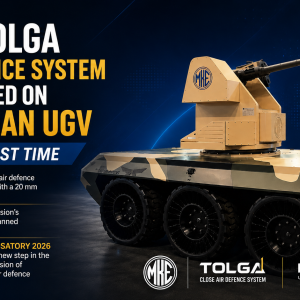
GÖKALP uses high-speed interceptor drones for kinetic defeat of FPV and kamikaze UAV threats. GÖKBERK 10 adds a 10 kW directed-energy option for close-in defence of land platforms, energy sites, critical facilities and headquarters. MİĞFER provides a hard-kill FPV protection layer for armoured platforms such as 4×4, 6×6 and tank-class vehicles. EJDERHA 210 uses high-power electromagnetic energy against mini and micro UAVs, with particular relevance to swarm scenarios.
EDR Magazine’s SAHA 2026 reporting adds technical context around this lower layer. It described MİĞFER as a short-range hard-kill FPV defence option and noted that GÖKBERK 10 doubles the output of the earlier GÖKBERK version to 10 kW. It also identified EJDERHA AD 210 as an upgraded high-power electromagnetic system able to operate more independently through integrated radar and electro-optical sensors [2].
Production Tempo Will Decide Operational Impact
The technical display only becomes militarily decisive if production, integration and training keep pace. Reuters reported on 5 May 2026 that ASELSAN plans to increase Steel Dome-related deliveries by 50% and aims to deliver more than 150 components in 2026. The same report said ASELSAN’s share of the wider Steel Dome contract package amounts to about USD 3.2 billion from a USD 6.5 billion national effort [3].
That production angle is crucial. Integrated air defence requires density. A small number of advanced systems can protect selected nodes. A national air-defence architecture needs distributed sensors, redundant communications, trained crews, spare parts, test infrastructure and a doctrine that links each layer. The SAHA 2026 presentation suggests that ASELSAN wants to close the lower-layer gap while parallel work continues on upper-layer systems such as SİPER variants.
Why SAHA 2026 Was the Right Stage
SAHA 2026 gave ASELSAN a defence-industrial audience rather than a purely military audience. That distinction matters. Counter-UAS and air-defence systems now sit at the intersection of procurement, industrial scaling, export control, component supply and operational doctrine. By showing multiple systems in one venue, ASELSAN framed Steel Dome as a modular industrial ecosystem rather than a closed national shield.
The timing also supports Türkiye’s wider export narrative. Many armed forces now seek layered, scalable and affordable air-defence solutions. Not every customer can procure a top-tier missile shield. Many need radars, jammers, lasers, hard-kill FPV defences and autonomous interceptors that protect bases, ports, energy infrastructure and mobile forces. Steel Dome’s lower layer could therefore become a more exportable segment than the full national architecture.
Risk and Integration Caveats
The main caveat is integration. A trade-show unveiling does not prove field maturity across all missions. Directed-energy systems need reliable power and thermal management. Microwave systems require careful safety, doctrine and deconfliction. Autonomous interceptors must work inside rules of engagement and airspace control measures. Electronic warfare systems must avoid fratricide against friendly communications and sensors.
There is also an adversary adaptation problem. Drone operators can shift frequencies, use fibre-optic control, fly lower, disperse launches or saturate one defence layer. Steel Dome’s advantage will depend on how quickly its software, sensors and effectors update against new tactics. In that sense, Ahmet Akyol’s description of Steel Dome as a living project is operationally accurate. The system will need continuous iteration, not a one-time procurement cycle.
Implications / Next
The SAHA 2026 launch signals that ASELSAN is expanding Steel Dome where the threat is moving fastest: drones, spectrum warfare and low-altitude saturation. The next test will be visible production flow, inventory entry, military integration and field exercises that show how the six systems connect to existing radars, command-and-control nodes and interceptor families.
If ASELSAN sustains the delivery tempo reported by Reuters, Türkiye’s air-defence posture could move from selected capability demonstrations toward a denser layered network. For international buyers, the most relevant takeaway may not be the entire Steel Dome architecture. It may be the exportable lower-layer package: electronic warfare, laser, microwave and kinetic counter-drone systems designed to make air defence more affordable at scale.
Further Reading
- Defence Agenda: ASELSAN Steel Dome Unveiled
- Defence Agenda: SAHA 2026 Post-Show Media Review
- Defence Agenda: Drone Warfare 2026
- Anadolu Ajansı: ASELSAN introduces new Steel Dome capabilities
- Reuters: ASELSAN to ramp up Steel Dome deliveries in 2026
- EDR Magazine: ASELSAN widens Steel Dome C-UAS capabilities
References
- Anadolu Ajansı — ASELSAN, Çelik Kubbe’nin yeni yeteneklerini SAHA 2026’da tanıttı
https://www.aa.com.tr/tr/bilim-teknoloji/aselsan-celik-kubbenin-yeni-yeteneklerini-saha-2026da-tanitti/3929137 - Anadolu Ajansı Video Gallery — ASELSAN, Çelik Kubbe’nin yeni yeteneklerini SAHA 2026’da tanıttı
https://aa.com.tr/tr/vg/video-galeri/2026561855_aselsan-celik-kubbenin-yeni-yeteneklerini-saha-2026da-tanitti/148733 - Reuters — Türkiye’s Aselsan to ramp up delivery of ‘Steel Dome’ parts in 2026
https://www.reuters.com/world/middle-east/turkeys-aselsan-ramp-up-delivery-steel-dome-parts-2026-2026-05-05/ - EDR Magazine — SAHA 2026: ASELSAN adds new elements to its Steel Dome, widening its C-UAS capabilities
https://www.edrmagazine.eu/saha-expo-2026-aselsan-add-new-elements-to-its-steel-dome-widening-its-c-uas-capabilities