Counter-UAS | Türkiye | SAHA 2026
By Muzaffer Ünsaldı | 21 May 2026 | Defence Agenda
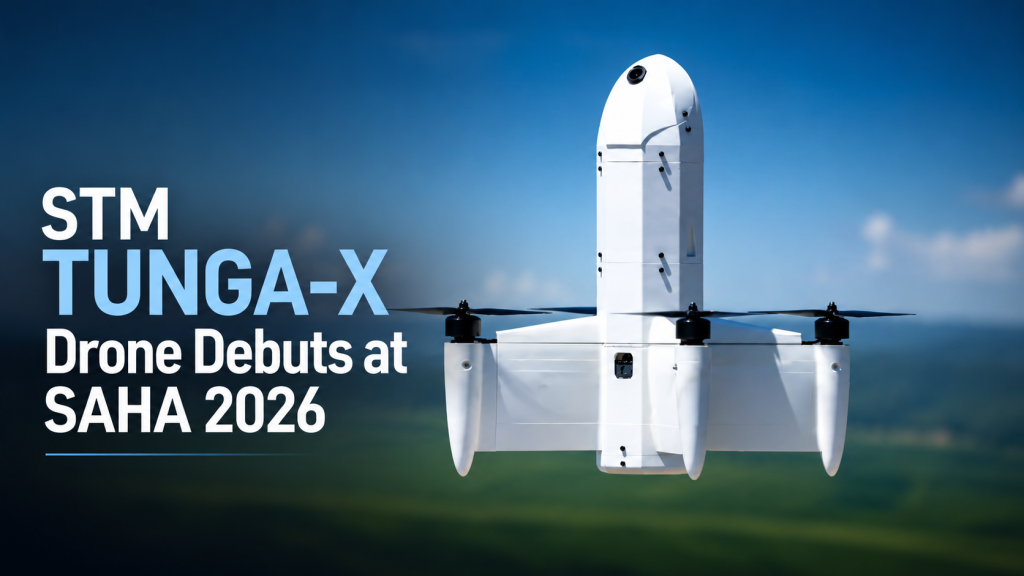
STM TUNGA-X drone made its public debut at SAHA 2026 in Istanbul, positioning Türkiye’s autonomous-systems sector inside one of the most urgent air-defence debates of the current battlefield: how to defeat low-cost unmanned aerial threats without exhausting high-value missile inventories. Developed by STM as a radar-integrated interceptor UAV, TUNGA-X signals a broader shift toward layered, cost-conscious counter-UAS architectures for critical infrastructure and deployed military units.
Key Facts
- Event: STM unveiled TUNGA-X at SAHA 2026 in Istanbul on 6 May 2026.
- Role: High-speed interceptor UAV designed to neutralise hostile drones in flight.
- Speed and range: STM lists a maximum speed of 300 km/h and a 25 km range at 150 km/h and 1,500 m AGL.
- Endurance and altitude: The system has a 15-minute endurance and a maximum altitude of 5,000 m AGL.
- Payload: The platform carries a 750 g lethal payload comprising warhead and fuze.
- Guidance: TUNGA-X supports manual and autonomous control modes, with GNSS or optical guidance during the attack phase.
Why the STM TUNGA-X Drone Matters
The operational logic behind the counter-UAS market has changed. Small loitering munitions and one-way attack drones can impose disproportionate costs on defenders. When a relatively inexpensive UAV forces a military to fire a far more expensive surface-to-air missile, the defender may win the tactical engagement while losing the economic exchange.
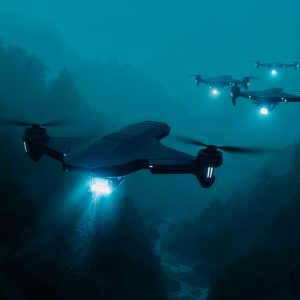
STM’s official announcement frames TUNGA-X as a response to that imbalance. The company said the interceptor was developed to work with UAV detection radars and engage hostile unmanned aircraft in mid-air. This places the system in the same conceptual category as emerging “drone-on-drone” air-defence solutions, where the interceptor itself becomes a disposable or recoverable layer inside a wider sensor-and-effector network.
Technical Profile: Speed, Payload and Guidance
According to STM’s published product data, TUNGA-X uses a rotary-wing architecture and performs launcher-free vertical take-off. That design allows the interceptor to operate from confined spaces, including fixed sites, mobile units and potentially naval or land platforms. STM lists a 750 g lethal payload, 15 minutes of flight endurance, 300 km/h maximum speed, 25 km range under stated cruise conditions, and a maximum altitude of 5,000 m AGL.
The guidance architecture combines radar cueing with onboard electro-optical/infrared verification. After an external radar detects a threat, the interceptor can move toward the estimated approach corridor and then use its day/night EO/IR imaging system for terminal confirmation. STM also identifies image-processing-based autonomous tracking, GNSS guidance and optical guidance as part of the system’s capability set.
EDR Magazine adds further exhibition-level detail. Its report states that TUNGA-X uses a lightweight composite airframe, has an approximate mass of 4 kg, and can neutralise targets through a proximity-fuzed high-explosive fragmentation warhead, manual triggered detonation or direct-impact kinetic effect when geometry allows. Those details reinforce the system’s focus on tactical interception rather than surveillance or strike roles.
Autonomy Status and Spiral Development
The autonomy picture requires careful wording. STM presents TUNGA-X as a platform with autonomous mission capability, autonomous target tracking and manual/autonomous control modes. EDR Magazine, reporting from SAHA 2026, notes that the drone was understood to be manually flown at the time of the exhibition, while autonomous take-off was expected to be added in late 2026 as STM moves toward a fully autonomous interceptor.
This is not unusual for a new counter-UAS system. Interceptor drones tend to mature through phased software, sensor-fusion and safety upgrades. In practice, military customers will scrutinise not only speed and payload but also false-positive control, engagement authorisation logic, mission-abort reliability, electronic-warfare resilience and integration with existing air-defence command-and-control systems.
SAHA 2026 as a Counter-UAS Showcase
TUNGA-X’s appearance at SAHA 2026 also matters for the exhibition’s strategic positioning. The fair has increasingly served as a platform for Turkish firms to move beyond platform display and into operational concepts. Counter-UAS is a strong example. It links sensors, effectors, autonomy, software, radar integration and cost-per-kill economics into one acquisition problem.
For Türkiye’s defence industry, the system also complements STM’s existing unmanned portfolio. STM has already built export visibility around rotary-wing loitering systems and tactical unmanned platforms. TUNGA-X moves that experience into an increasingly competitive domain where Ukraine, NATO members and Middle Eastern operators all face the same pressure: mass drone attacks can stress legacy air-defence inventories faster than industry can replace them.
Programme and Market Implications
The next milestone will be operational validation. Public specifications establish a credible baseline, but procurement interest will depend on live intercept performance, radar integration depth, command-and-control compatibility and lifecycle cost. EDR Magazine reported that the system was ready for production and that quotations had been provided to national and friendly customers. STM’s own language is more cautious, focusing on the debut, capabilities and modular deployment model.
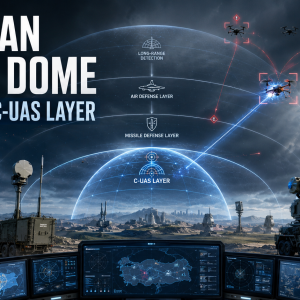
The market opportunity is clear. Military forces need affordable layers between electronic warfare, gun-based systems and missile interceptors. TUNGA-X aims to occupy that middle ground. Its value proposition rests on three factors: rapid launch from confined spaces, radar-cued engagement against incoming UAVs, and mission-cancel return-to-home functionality when an engagement no longer makes sense.
Implications / Next
For STM, the priority will be to convert a strong SAHA 2026 debut into test-backed procurement traction. Customers will likely ask for evidence across multiple threat classes, especially fixed-wing kamikaze UAVs, small tactical drones and low-altitude saturation profiles. They will also assess whether TUNGA-X can integrate into national air-defence networks without creating another isolated counter-drone layer.
For the wider market, the message is more direct: counter-UAS is moving from ad hoc protection to structured air-defence architecture. The STM TUNGA-X drone reflects that transition. It does not replace missiles, guns or electronic warfare. Instead, it gives commanders another option in the cost-exchange chain, where the right interceptor must match the price, speed and risk profile of the incoming threat.
Further Reading
- SAHA 2026 coverage on Defence Agenda
- Counter-UAS analysis and air-defence trends
- Drone warfare 2026: AI, robots and swarms
- STM official announcement on TUNGA-X
- STM TUNGA-X product page
- EDR Magazine field report on TUNGA-X